
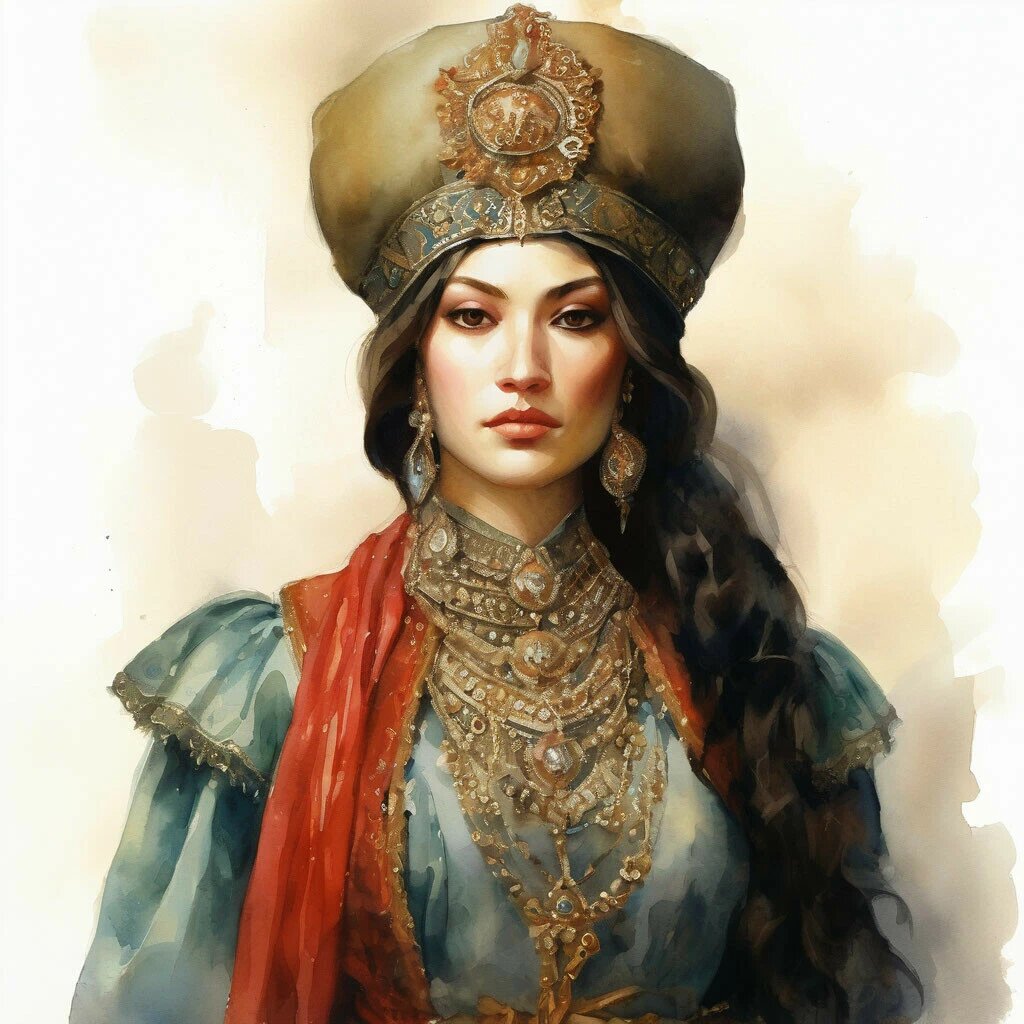
She stood in the crowd as they prepared the noose for her son in the square in Osh. Nearby, her allies whispered, “Just say the word. One word—and we’ll rally the people.” She remained silent. And not because she couldn’t. Because she understood: the people are more important.
That is what it means to be a ruler. Not to wear a crown. But to pay for it.
Kurmanzhan-Datka lived to be ninety-six years old. She led an army of ten thousand horsemen, dictated terms to khans, and received Russian generals as an equal. But it was precisely that day in Osh, March 2, 1895, that became her true trial—quiet, invisible, unbearable.
In 1811, in a mountain village near Osh, a girl was born into a family of nomads from the Mungush tribe. The mountains of the Alay Range, where neither Persian poets nor European travelers had ever ventured, were her first world. The girl was named Kurmanzhana. Dark eyes, a strong character, and a complete lack of inclination toward submission.

When she turned eighteen, her parents found her a husband. A man three times her age, from another tribe. She saw him for the first time right at the wedding. And that very night, she ran away.
She didn’t leave quietly. She actually ran away. She returned to her father, stayed there for three years—and no one condemned her. Rumor had it that her fellow tribespeople looked upon her with secret admiration: nothing like this had ever happened before.
It was then that Alymbek-datka noticed her—one of the most influential beks of Alay, a man with an army and a title that, in those parts, was equivalent to the rank of general. He wanted to take Kurmanzhan as his wife. She replied coldly: not until she was free—no discussion. Not even the khan would get a different answer.
Alymbek secured the annulment of her first marriage through the Kokand court. Only then did she agree.
This was not a surrender. It was her first political victory.
They lived together for thirty years. They had five sons. Kurmanzhan became not just a wife—she became an advisor, a negotiator, and, in effect, a co-ruler. While her husband was away on campaigns, she made decisions regarding tribal disputes. The Alays—a fragmented people, dozens of clans with ancient grievances—obeyed her.
But in 1862, it all came to an end. Alymbek fell into a trap during the palace intrigues of the Kokand Khanate and was killed. He was over sixty. She was in her fifties.

Traditionally, a widow was supposed to fade into the shadows.
Kurmanzhan did exactly the opposite.
She declared herself her husband’s heir. She took command of his army. The Kokand Khan, Khudoyar, initially decided this was a convenient moment to subjugate the Alay people and impose taxes on them. He did not know who he was dealing with. Kurmanjan put so much pressure on the khan through negotiations and a show of force that he backed down. And—in an unprecedented move—he officially bestowed upon her the male military title of “datka.” She was the first woman in the Muslim East to be received at court with official honors.
Then came the Emir of Bukhara. The same result. Then the Russian generals.
When, in the late 1870s, the troops of the Russian Empire approached Alay, Kurmanzhan-datka already understood the situation. She had traveled throughout the entire region on horseback. She had seen the fall of Khiva and Kokand. To resist meant condemning her people to destruction. This was not weakness. It was a sober calculation.
In 1876, she personally met with the Russian command and announced Alay’s voluntary annexation to the empire. The terms were agreed upon. Her people retained their way of life, traditions, and relative autonomy.
The Russians called her the “Queen of the South.” They say that Finnish Baron Gustaf Mannerheim—the very same man who would become a marshal and president of Finland—made a special detour to her village in 1906 during an expedition to Central Asia. He wanted to see her in person.
She was ninety-five years old at the time. She still rode a horse.
But it was precisely then, a year before that meeting, that something happened that broke her from within—quietly, without war, without victors.
In 1893, a customs official arrived at the home of her son Kamchybek to conduct a search: there was suspicion of contraband cargo from Afghanistan. Kamchybek himself was in Osh. His wife was at home. The customs officers behaved insultingly—and Kamchybek’s servant, unable to restrain himself, dealt with them himself, without his master’s knowledge.

It made no difference. A case was brought against Kamchybek.
Two years of investigation. Twenty-one people arrested. Kurmanzhan traveled to Margilan to see the governor-general in person. She pleaded. She, who had never asked anyone for anything.
Some of her relatives were spared—the death penalty was commuted to hard labor in Siberia. But she could not save Kamchybek, her beloved youngest son.
On March 2, 1895, he was executed in the town square in Osh.
They say that just before this, the rope snapped. The crowd gasped—in the old days, this meant a pardon. But not this time.
Kurmanzhan stood there. She spoke her final words to her son: “Look straight ahead.”
After that, she left for the village of Mady, in the mountains. She never returned to public life.
It wasn’t a defeat. It was a price.
The very price paid by people who decide to put the people above themselves. Above their own pain. Above their own child.
Most rulers throughout history did exactly the opposite—sacrificing thousands for the sake of one. She chose differently.

Kurmanzhan Datka died on February 1, 1907. She was buried in Osh, next to Kamchybek. In Kyrgyzstan, her portrait appears on a banknote. Her name is on an order awarded to women for outstanding achievements. In 2014, a feature-length historical film about her life was released—the first major Kyrgyz epic since independence.
But one detail speaks louder than any film. At ninety-five years old, she still jumped onto a horse. Not to prove anything to anyone. Simply because she didn’t know how to do it any other way.