
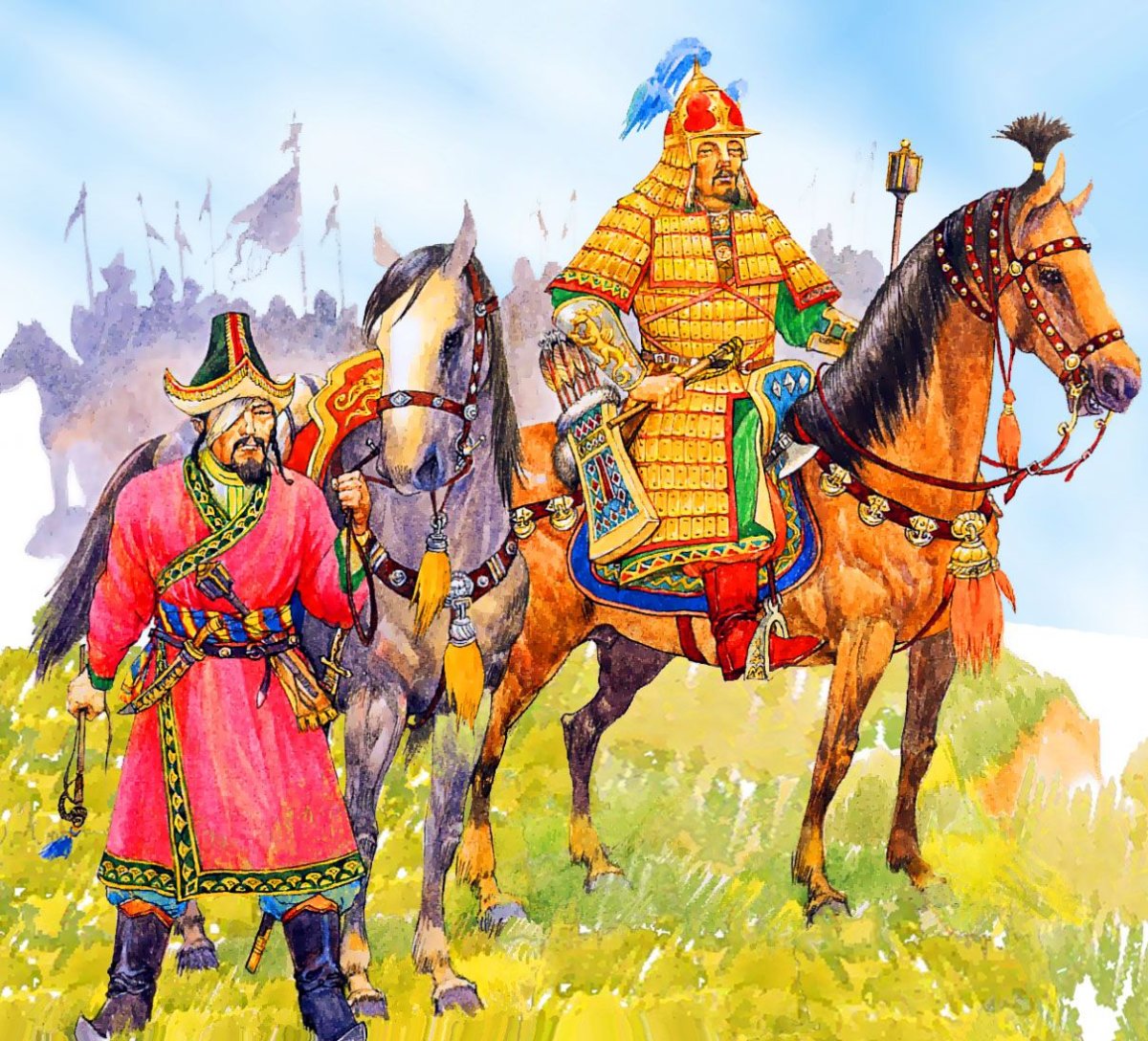
The evolution of steppe warriors: the transformation of the Dzungaria military arsenal
The history of the military art of the nomadic peoples of Central Asia spans thousands of years. From the Scythians and Xiongnu to the empire of Genghis Khan, steppe warriors repeatedly created powerful states, relying on the advantages of their mobility, endurance, and unique military traditions. However, by the 17th century, the classic model of a nomadic army, built around light cavalry armed with bows, began to give way to the armies of sedentary states with their firearms, regular infantry, and artillery.

At this critical moment in history, one of the nomadic peoples, the Dzungars (Western Mongols or Oirats), managed to undergo an impressive transformation, adapting their military art to the new realities and creating a unique military complex that combined the traditional advantages of nomads with the latest technologies.
Until the mid-17th century, the weapons of the Dzungar warriors differed little from the arsenal of their eastern tribesmen, the Khalkha Mongols. The basis was traditional nomadic composite bows, sabers, spears, and lamellar armor consisting of many small metal or leather plates connected by lacing. This weapon system, honed over centuries, was ideally suited to the mobile tactics of the Mongol peoples, which were based on maneuverability, speed, and the ability to strike from a distance.

However, the geographical location of Dzungaria at the crossroads of civilizations—between China, the Russian lands, and the Muslim states of Central Asia—created unique conditions for military-technological innovations. As early as the second quarter of the 17th century, elements of weaponry uncharacteristic of the Eastern Mongolian tradition began to appear in the Oirat armies: chain mail armor (bekhtertsy), chain mail, and pikes. These items were borrowed both from the arsenal of Central Asian states, primarily the Bukhara Khanate, and through trade with Russia, where they were manufactured by the so-called “yasachnye people” – blacksmiths from the Siberian peoples subordinate to the Russian state.
A fundamental change in the military affairs of the Dzungars occurred in the 1660s and 1670s and was associated with the widespread introduction of hand-held firearms. Historical sources link this to a series of Oirat-Kazakh-Bukhara wars, during which the Dzungar rulers became convinced of the effectiveness of firearms, especially in defensive actions from fortified positions. It is noteworthy that the very idea of using firearms by nomads was not fundamentally new—even the Mongols of the Genghis Khan era demonstrated an impressive ability to borrow and quickly adapt the military technologies of conquered peoples, such as siege techniques from the Jurchen. However, the scale of the rearmament of the Dzungar army is truly astonishing.
According to contemporary accounts, the number of Dzungar riflemen armed with guns reached 20,000, and according to some sources, even 30,000. The latter figure seems doubtful, given that the total number of the Dzungar army during this period was estimated at 40-50 thousand soldiers. Nevertheless, even with more conservative estimates, we are talking about an unprecedented level of introduction of firearms for nomadic peoples.
Russian sources of that time consistently emphasize this aspect of Dzungar military affairs, especially when compared to their Eastern Mongolian tribesmen: “And the Kalmyks (Dzungars) are much stronger than the Mongols (Khalhas) in military affairs and have a lot of firearms from the Bukharans,” “…the Kalmyk Boshohtu Khan with his people defeated the Mongol Khan with a lot of firearms…” This qualitative difference in armament largely predetermined the outcome of the confrontation between the western and eastern Mongols, which ended with the conquest of the Khalkha Mongols by the Manchu Qing dynasty.
At the beginning of the 18th century, the Dzungars established the production of rifles and muskets on their territory, but in the 17th century, the main source of firearms was imports from Central Asian states and Russia. It is noteworthy that a significant part of Russian weapons entered Dzungaria through smuggling. Bukhara merchants, whom the Russian authorities, unlike Mongolian envoys, did not dare to subject to thorough inspection, were actively engaged in purchasing firearms in Moscow. Until the early 1680s, large shipments of up to 30 carts of guns and ammunition were regularly sent to Dzungaria.
In addition to introducing firearms, the Dzungar army was distinguished by its complex structure, which included various types of troops. Based on Manchu miniatures depicting military clashes with the Oirats, it can be concluded that the Dzungar musketeers did not wear heavy armor and were not equipped for hand-to-hand combat. Therefore, in battle, they were covered by warriors with spears and pikes. An interesting detail confirming the widespread use of long-shafted weapons in the Dzungar army: on the eve of the Battle of Ologoy, pikes from the khan’s arsenals were even issued to Russian envoys who happened to be with the army at the start of hostilities.
The following main elements can be distinguished in the general structure of the Dzungar army: mounted archers armed with rifles (who moved on horseback but dismounted in battle); traditional mounted archers; heavily armed horsemen (armored soldiers) armed with long and short bladed weapons, as well as spears and pikes. In addition to ethnic Oirats, the troops of the Dzungar khans, in particular Galdan Boshoku Khan, included detachments of Kyrgyz, Bukharans, and Khalkhas who had defected to Dzungaria. These auxiliary contingents complemented the main Oirat forces, bringing their unique military traditions and skills.
Thus, by the end of the 17th century, the Dzungar army was a complex and well-balanced military system that combined traditional elements of nomadic military art with the advanced technologies and tactical developments of sedentary civilizations. This allowed the Dzungar Khanate to become the dominant force in Central Asia and challenge the region’s major powers, the Russian and Qing empires.
Revolution in the steppe: the introduction of firearms and its consequences
The introduction of firearms into the Dzungar army is a rare example in history of a successful military-technological revolution carried out by a nomadic society. This process deserves special attention because it not only changed combat tactics but also transformed the entire military organization and ultimately influenced the geopolitical situation in Central Asia.
Although the exact date of the beginning of the mass introduction of “fire fighting” in the Dzungar army remains a subject of debate, most researchers associate this process with the reign of Sengge Khuntaiji (1653-1670) and especially his brother and successor Galdan Boshokt Khan (1670-1697) . It was during this period that the Dzungars conducted a series of successful military campaigns against the Kazakhs, Kyrgyz, and Bukharans, during which the Oirat military leaders were able to observe the effectiveness of the use of hand-held firearms by the troops of the Central Asian states.
The types of firearms used by the Dzungars were quite diverse. Russian sources mention “pishchali,” “muskets,” and simply “guns.” Judging by archaeological finds and pictorial sources, these were mainly matchlock guns with a straight stock, a long barrel, and a caliber of about 12-16 mm. Such guns provided fairly high accuracy and lethality at a distance of up to 100-150 meters, which significantly exceeded the effective range of the traditional Mongolian bow.
The process of training Dzungar warriors in the use of new weapons was probably carried out with the help of foreign instructors. Historical sources mention the presence at the court of the Dzungar rulers of “Bukhara gunners” and even European specialists, in particular Swedes who found themselves in Siberia after the Northern War. These people not only helped to establish the production and repair of firearms, but also taught Oirat warriors the basics of shooting, gunpowder manufacturing, and the rules of gun maintenance.
The issue of organizing the production of firearms and ammunition directly in Dzungaria deserves special attention. While in the early stages of rearmament the Dzungars were completely dependent on imports, by the end of Galdan Boshokt Khan’s reign there was evidence of the existence of their own armories. During the reigns of Tsavan Rabdan (1697-1727) and Galdan Tseren (1727-1745), the production of guns and even artillery pieces in Dzungaria was put on a regular basis.
The urban settlements of Dzungaria, such as Kulja (Gulja), became centers of firearms production, where craftsmen were concentrated—both local and foreigners who had been captured or voluntarily entered the service of the Dzungar khans. Masters from East Turkestan, who had long traditions of metalworking and weapon production, were especially valued.
An important aspect of the rearmament of the Dzungar army was ensuring a stable supply of gunpowder and lead. Gunpowder was initially purchased in Bukhara and Russia, but over time, the Dzungars mastered its production. The main components—saltpeter, sulfur, and charcoal—were available within the khanate or in the regions under its control. Lead for bullets was mined in the Tien Shan and Altai mountains, where the Dzungars controlled several mines.
The introduction of firearms required Dzungar military leaders to develop new tactical techniques that took into account both the advantages and limitations of this type of weaponry. The main problem was the low rate of fire of matchlock guns, which required lengthy reloading. To compensate for this shortcoming, the Dzungars developed mixed battle formations, where archers operated under the protection of traditional mounted and foot soldiers armed with cold weapons.
Another important innovation was the use of field fortifications—a kind of steppe “wagenburg” created from pack animals, carts, and portable wooden shields. Such fortifications allowed the Dzungar archers to fire accurately from relatively safe positions, inflicting damage on the enemy even before close combat began.
Firearms had a significant impact on the social structure of Dzungar society. Traditionally, in Mongolian states, military service was the duty of all adult men capable of bearing arms. However, handling firearms required special training and skills. This led to the emergence of a category of professional warrior-archers in the Dzungar army, who were paid from the khan’s treasury and were not involved in traditional nomadic farming.
It can be argued that it was thanks to the successful introduction of “fire combat” that the Dzungar Khanate achieved impressive military successes in the late 17th and first half of the 18th centuries. Particularly noteworthy are the Dzungar victories over the technologically advanced army of the Qing Empire in the battles of Zhaoiyodo (1690) and Ulan-Butoon (1696). In these battles, the firepower of the Dzungar archers allowed them to effectively counter the numerically superior Manchu troops, who were armed with similar weapons.
Tactical skill: battle formations and techniques of the Dzungar commanders
The Dzungar commanders developed a unique tactical system adapted to the realities of steppe warfare with the use of firearms. This system took into account both the traditional strengths of the nomads—mobility, endurance, and excellent knowledge of the terrain—and the new opportunities provided by “firepower.”
Unlike the Eastern Mongolian armies, which continued to rely on traditional methods of warfare, the Dzungars showed remarkable flexibility in their tactics. In the west, against the Kazakhs and Central Asian states, they more often used mobile raids by their heavy cavalry, striking swiftly and retreating quickly before the enemy could organize effective resistance. On the eastern front, against the numerically superior and technologically advanced armies of the Qing Empire, the Dzungars preferred to fight defensive battles, using natural barriers and field fortifications, and then launching decisive counterattacks.
The main tactical formation of the Dzungar army on the battlefield was a two-line arrangement of troops. The first line usually consisted of musketeers and spearmen, arranged so that the flanks were advanced toward the enemy and, if possible, protected by natural obstacles such as swamps, forests, mountains, or steep river banks. This arrangement made it difficult for the enemy to maneuver around them and allowed for the most effective use of firearms.
The positions of the first line of shooters were fortified whenever possible. Either natural folds in the terrain or artificial barriers—woven fences, earthen ramparts, or rows of carts—were used as cover. In the event of a sudden enemy attack, when there was no time to build fortifications, the Dzungars could use herds of cattle, which always accompanied the nomadic army, as a living shield.
The second line of the Dzungar battle formation was formed by heavy cavalry, consisting of armored horsemen with spears and bladed weapons. Its main task was to deliver a decisive blow to the flanks and rear of the enemy at the moment when its attack was stopped by the fire of the first line of archers. This combination of defensive tactics and a powerful counterattack allowed the Dzungars to effectively resist even a numerically superior enemy.
The density of fire provided by the Dzungarian gunners made a strong impression even on experienced warriors of the Manchu army. According to eyewitnesses, in some battles Manchu horsemen, despite the support of their own artillery, were forced to dismount and attack the positions of Galdan Boshoktu-khan on foot in order to minimize losses from the Dzungarian muskets.
This tactic of fighting with reliance on firearms infantry and active cavalry actions was well known in Central Asia since the XVI century, but was quite innovative for the steppe spaces east of the Altai Mountains. In fact, the Dzungars created the penultimate stage in the evolution of nomadic military art, preceding the complete transition to regular armies of the European type.
The battle at Lake Olgoi at the beginning of the conflict between Galdan and the Khalkhas was a clear demonstration of the superiority of Dzungar tactics over the traditional methods of warfare used by the Eastern Mongols. After a classic steppe cavalry battle, the Khalkha warriors were pushed back by the Dzungars to the marshy shores of the lake, where, in the words of a Russian eyewitness, “it was impossible to ride a horse.” Finding themselves in a disadvantageous position, the Khalkha Mongols attempted to organize a defense, hastily erecting improvised fortifications. However, these measures proved ineffective against the concentrated fire of the Dzungar archers, who shot their trapped opponents at point-blank range. Only Tushet Khan himself managed to escape the encirclement with a small group of bodyguards. This victory effectively paved the way for Galdan to unite all of Mongolia under his rule, and only the intervention of the Qing Empire prevented him from carrying out this plan.
Another example of the effectiveness of the Dzungar tactics is the Battle of Zhaoiyodo (Zhao-Modo) in 1690, where Galdan’s troops managed to inflict a serious defeat on the Manchu army under the command of Emperor Kangxi himself. In this battle, the Dzungars skillfully used the rugged terrain, setting up an ambush in a narrow pass between two mountain ranges. A sudden volley from their musketeers caused panic in the ranks of the Manchu cavalry, and the ensuing attack by the Oirat heavy cavalry nearly led to the complete defeat of the imperial army.
It should be noted that the Dzungar commanders paid great attention to reconnaissance and gathering information about the enemy. Before each major campaign, they sent spies to the enemy camp, often disguised as merchants or ambassadors. These agents gathered information about the number, armament, and movement routes of enemy troops. Galdan Boshokt Khan, for example, had an extensive network of informants among both the Khalkha Mongols and in the border regions of the Qing Empire.
Another important feature of the Dzungar military system was its logistical organization. Unlike traditional nomadic armies, which often lived off the spoils of conquered territories, the Dzungars created an effective system for supplying their troops. Along the main routes of the army’s movement, warehouses for provisions and fodder were set up, as well as stations for changing horses. This system allowed the troops to maintain high mobility even during long campaigns on enemy territory.
Survival strategy: the Dzungars’ confrontation with the great powers
The geopolitical position of the Dzungar Khanate between two growing empires—Russia and Qing—required its rulers to develop a complex and flexible foreign policy strategy. This strategy had to ensure the survival and development of the khanate in conditions of constant external threat and, ideally, allow Dzungaria itself to become the dominant power in Central Asia.
The foundations of this strategy were laid by Batur-Khuntaiji (1634-1653), but it was most fully developed under Galdan Boshokt Khan (1670-1697) and his successors. The Dzungar foreign policy was based on the principle of “divide and rule” — the desire to prevent the unification of enemy forces by playing on the contradictions between them.
In their relations with Russia, the Dzungar khans sought to maintain formal loyalty, periodically sending embassies to Moscow to express their “subjection” to the Russian tsar. However, this “subjection” was purely nominal – the Dzungars retained complete independence in their domestic and foreign policies. Moreover, they actively competed with Russia for influence over the peoples of Southern Siberia and the Kazakh steppes.
At the same time, the Dzungar rulers understood that open conflict with the Russian Empire would be extremely disadvantageous for them. Therefore, they sought to maintain trade relations with the Russians, gaining access through them to European goods and technologies, especially firearms. Formal recognition of the suzerainty of the Russian tsar facilitated these contacts, allowing Dzungar embassies and trade caravans to visit Moscow and other Russian cities unhindered.
The Dzungars’ strategy toward the Qing Empire was completely different. The Manchu dynasty, which conquered China in the mid-17th century, was viewed by the Dzungars as their main geopolitical adversary. This was determined both by historical reasons—centuries of confrontation between the Mongols and the Chinese-Manchu states—and practical considerations—the expansionist policy of the Qing in Mongolia and East Turkestan.
Galdan Boshokt Khan sought to unite all Mongol peoples under his rule in order to create a force capable of resisting Manchu expansion. His campaign against the Khalkha Mongols in 1688, which ended with the Battle of Lake Olgoi, was part of this strategic plan. However, the Qing Empire’s rapid intervention in the conflict prevented the Dzungars from realizing their plans. Khalkha Mongolia was incorporated into the Qing Empire, and Galdan was forced to wage a difficult defensive war against the Manchu armies.
Despite serious military defeats at the end of Galdan’s reign, the Dzungar strategy of opposing the Qing was continued by his successors, Tsavan Rabdan and Galdan Tseren. They focused on strengthening the khanate’s defenses, developing their own weapons production, and seeking allies among other opponents of the Manchu dynasty.
An important element of the Dzungar khans’ strategy was control over East Turkestan (modern Xinjiang). This region was important not only as a source of resources—precious metals were mined there, and textiles and agricultural products were produced—but also as a buffer zone between Dzungaria and the Qing Empire. In addition, control over the cities of East Turkestan provided the Dzungars with access to Central Asian trade routes and the technologies of sedentary civilizations.
To strengthen their position in Central Asia, the Dzungar khans sought to establish control over the Kazakh zhuz. Important trade routes connecting Dzungaria with Russia and Central Asia passed through the Kazakh steppes. In addition, the Kazakhs posed a potential military threat that could divert significant Dzungar forces from the eastern front. Therefore, beginning with the reign of Tsavan-Rabdan, the Dzungars undertook a series of military campaigns against the Kazakhs, seeking to establish their dominance over them or, at least, neutralize them as a military force.
An essential component of the Dzungar foreign policy was the use of the religious factor. The Dzungar khans, starting with Batur-Khuntaiji, actively supported Tibetan Buddhism of the Gelug school, headed by the Dalai Lama. This helped to strengthen their authority among other Mongolian peoples who also professed Buddhism. In addition, religious ties with Tibet gave the Dzungars the opportunity to influence the situation in this strategically important region, located between the possessions of the Qing Empire and the large Central Asian states.
The reasons for the final defeat of the Dzungar Khanate in its struggle against the Qing Empire lie not so much in the military sphere as in the strategic and demographic spheres. The Dzungars, despite all their tactical skill and technological innovations, simply could not compensate for the enormous numerical superiority of their enemy. By the middle of the 18th century, the population of the Qing Empire exceeded 300 million, while the total population of all the Oirat tribes barely reached one million. This allowed the Manchu emperors to repeatedly replenish their losses and send new armies against the Dzungars.
Another important factor was the internal instability of the Dzungar Khanate. After the death of Galdan Tseren in 1745, a period of civil strife and power struggles began in the khanate. This greatly weakened the military potential of Dzungaria and allowed the Qing Empire to defeat it once and for all in 1755-1759. The Qing troops did not simply defeat the Dzungar army—they carried out a genocide of the Oirat people, physically destroying up to 80% of its population.
However, even in defeat, the Dzungar Khanate demonstrated exceptional military resilience. According to Chinese sources, in order to finally subdue the Dzungars, the Qing Empire had to mobilize more than 200,000 soldiers and spend an astronomical sum for that time of 73 million liang of silver. For comparison, this exceeded the annual budget of the entire Qing Empire.
Thus, the military art of the Dzungars represents a unique phenomenon in the history of nomadic peoples—an attempt to adapt traditional warfare to the challenges of a new era through the large-scale introduction of firearms and the development of appropriate tactics. Although this experiment ultimately did not save the Dzungar Khanate from destruction, it ensured its dominance in Central Asia for almost a century and left a significant mark on the military history of the region.