
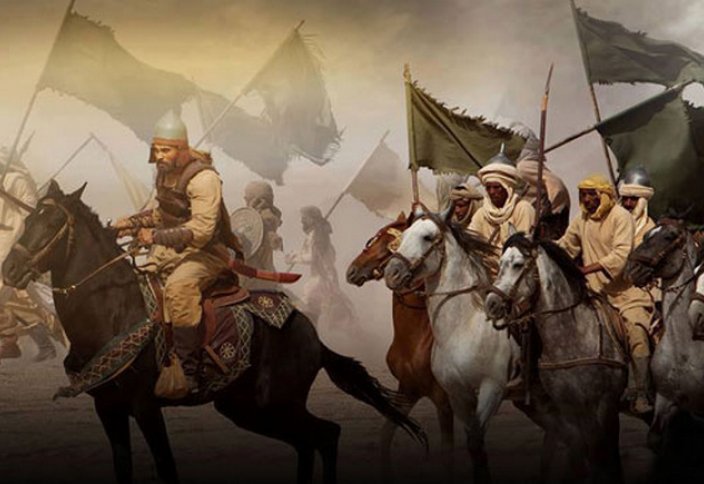
Baybars and his successors in power: Mamluk lawlessness in Egypt’s political life (The struggle of the Burjite corps against the Bahri corps)
Chapter 4
Baybars and his successors in power:
Mamluk lawlessness in Egypt’s political life
(The struggle of the Burjite corps with the Bahri corps)
It is believed that Baybars was born into a Polovtsian family. In 1241, his relatives fled from the advancing Mongols to Anatolia and were enslaved there.
The youngest (18 years old) Baybars was bought by one of the Egyptian slave traders. And he was resold to the Mamluk guard of Sultan as-Salih. He was well suited for the guard, because he was tall, slender, broad-shouldered and possessed great physical strength. Chroniclers said that Baybars could swim across the Nile, towing a raft with several Mamluks.
He showed his qualities as a commander at a young age. In 1249 and in 1250, he won two great victories over the Crusaders at al-Mansur and Farskur.
In 1250, it was Baybars who was one of the most active conspirators against Turanshah, the last sultan of the Ayyubid dynasty. It is said that it was he who dealt the Sultan the fatal blow.
But then Beyuars had to flee Egypt, as he was at odds with the Mamluk sultans Aybak and Kutuz. Facing the threat of danger from the Mongols, he reconciled with Kutuz. Then, in 1260, Baybars distinguished himself in a historic battle with the Mongols on the banks of the Jordan. For his valor, he was given command of the city of Haleb by Kutuz. But this was not enough for the ambitious Mamluk leader, because Baybars did not want to be content with second roles. In October 1260, he organized a conspiracy and during the hunt, his associates killed Kutuz. Baybars became sultan. He achieved his goal and reigned for 17 years.
Baybars attacked Syria and one by one subjugated some Syrian cities, including Haleb, knocking out the Mongol troops. So he took the fortress of al-Karak, the most important strategic object.
In 1265, Baybars seized the fortress of Biru from the Crusaders. Then Caesarea was taken, then Jaffa, and Haifa.
In 1268, Baybars was knitting Antioch. Moreover, the Mamluks got fantastic loot. They didn’t even count the money, but measured it with drinking cups. And slaves were sold for 12 dirhams, and these were boys, and a girl cost only five!
In 1271, Baybars took the assassins’ castles one by one and forced them to submit to his rule. And conquering the proud assassins, these fearless killers, was not easy.
In 1273, Baybars crossed the Euphrates with his corps and inflicted several more defeats on the Mongols.
In 1276, Baybars made a victorious campaign in the Sudan.
In 1277, he attacked the Mongols again and defeated them at Elbistan. After this victory, he proclaimed himself Sultan of Rum. He could have founded a great empire, but did not receive support from the local Turkic tribes and retreated to Damascus.
The brave Baybars died on June 1, 1277.
After the death of Baybars I, the Mamluks proclaimed his son Barak sultan. He wanted to strengthen himself on the throne and protect himself from unpleasant surprises. He killed all his father’s associates as unreliable — they could change him for another one at any moment. But that didn’t help either. As they say, it’s not fate. During a campaign against Armenia in 1280, the Mamluks rebelled and elected Kalun, a friend of the late Baybars, as their leader. They occupied Cairo and deposed Barak. His younger brother Salanish was made Sultan. He was a very young boy then, and Kalun became his regent. But the second role did not suit him for long, and after a few months, he himself became the sultan of Egypt.
This ruler of Egypt was a strong and brave warrior and was in no way inferior to Baybars in his talents.
In 1281, the Mongols again invaded the Mamluk possessions. They wanted revenge. This time, under the command of the Mongol commander, Prince Genghisid, Mengu-Temir, there was an army of 150,000 people, according to some sources (although I personally strongly doubt this number of the Mongol army).
Kalun went to meet the Mongols and the battle took place at the fortress of Homs. The Mongols launched a massive attack on the right flank of the Mamluk army. But they reflected it. And after that, Kalun attacked the enemy himself and pushed his Mongol left flank towards the center.
But at that time, a catastrophe occurred on the left flank of the Mamluk army. The Mongols broke through the front there and drove the Kalun warriors to Homs. The warriors of Mengu-Temir pursued the fugitives and ruthlessly destroyed many.
Kalun did not flinch or lose his presence of mind. He ordered drums to be beaten and gathered the remnants of his army to him. The Mamluks, having heard the call of their leader, gathered into a fist again. And then Kalun threw his troops into battle again. This time, the Mongols could not withstand the fierce attack and fled. The battle was won.
After repelling the Mongol invasion, Kalun turned back to the Crusaders. In 1289, he took Tripoli from them.
Kalun’s son and successor Khalil seized Acre from the Crusaders in 1291. After that, Beirut, Tyre, Sidon, and Haifa came under his rule. But the power of this sultan did not last long. There was no stability and continuity of power in the Mamluk state. That was his weakness at that moment. In 1294, Khalil was killed by his own soldiers. They proclaimed Khalil’s infant brother Muhammad I as the new sultan. But in 1295 he was dethroned by the Mamluk Emir Kitbuga. And this warrior (Mongol by nationality) was sold into slavery in 1260, after he was captured in a battle with the same Mamluks.
Kitbuga quickly adapted and resettled many Mongol refugees to Egypt in 1296. He wanted to form a guard loyal to himself from his fellow tribesmen. But at that time, people from the Caucasus began to play an important role in the political life of Egypt, then they were all called by one word — Circassians. Their barracks were located in the Cairo fortress of Burj, and therefore the Circassian corps was called Burjites. They did not allow the Mongol Kitbuga to strengthen.
In 1296, Kitbuga abdicated and another Mamluk Turkish emir named Lajin became sultan. But he no longer had absolute power in the country, but shared it with other Mamluk leaders.
In 1298, when Lajin tried to cut the maintenance for the Mamluk guard, he was stabbed and installed on the throne by the son of Kalun Muhammad I. But even under him, the real power was still in the hands of the emirs of the Mamluk guard. Back then, the big figures were Bahritov Salar, the leader of the Mamluks, and Baybars, the leader of the Burjit Mamluks.
Salar and Baybars had to fight the Mongols again. In 1299, they invaded Syria and became a real threat to Egypt. Once again, the battle took place near Homs and the Mamluks, led by the Salaram, were defeated.
But in 1300, the Mongol military leaders, having learned that the Mamluk army was ready in Egypt again, decided not to tempt fate and voluntarily left Syria.
In April 1303, a new battle between the Mamluks and the Mongols took place in the Marj as-Suffar valley, south of Damascus. The Mongols attacked the right flank and the center of the Mamluks, but did not achieve success. The battle lasted all day, and by evening the Mamluks managed to push the Mongols back to Kholim, where there was no water. There, the Mongol warriors and their horses spent the night suffering from thirst, and the next day the battle resumed.
The Mamluks achieved victory, and the Mongols no longer invaded Syria. But if the Mongol threat was lifted, then the inner limits of power continued. Sultan Muhammad I, the son of Kalun, took up the task. After the Burjit corps elected its commander Beybarsk II as the new sultan, he turned to Salar, the leader of the Bahrit corps. He supported Muhammad I and Baybars II was forced to abdicate.
Soon he was killed by order of Muhammad I. Repressions fell on the Burjids and many soldiers of this corps were killed then, and the Circassians lost their political significance for a long time.
And then the sultan ordered Salar to be killed as well.
The reign of Muhammad I after that lasted from 1309 to 1340. And this reign can be called one of the most peaceful during the entire stay of the Bahri Mamluks in power.
But as soon as he died, it all started again. Within 6 years, all 6 sons of Muhammad I managed to visit the throne, and blood flowed abundantly again. In 1346, the Mamluk Emir Circassian Gurlu became regent under the young Sultan Hadji I. He began to promote his tribesmen from the Caucasus to all important positions. But soon Gurla was executed and the Burjit (Circassian) corps was completely disbanded.
But the Burjites left the political arena for only a short time. Their corps did not disintegrate at all and was waiting in the wings. In 1351, when Sultan Salih ascended the throne, their commander, Circassian Taza, became the first person in the state. In response to this strengthening of the Burjites, the Bahrits launched an uprising in Syria. Taza stood up to them and won. But he could not gain a foothold on the throne.
In 1354, Sultan Salih was overthrown by the Bahri leader and his brother al-Hassan was installed on the throne.
But in 1382, the Circassians won again, and since then, for a long time, all the sultans of Egypt came only from among the Circassian Burjites. The first sultan of the Mamluk Burjit dynasty was Emir Barkuk. Under him, all command positions were occupied only by Circassian slaves.
But after the death of Barkuk and the accession of his son Faraj, the Mamluk groups launched a fierce struggle for power. And this situation continued throughout the reign of the Circassian emir dynasty.
This enabled the Turks, who achieved great power in 1517, to defeat the Mamluks and subjugate Egypt to the Ottoman Empire for a long period.