
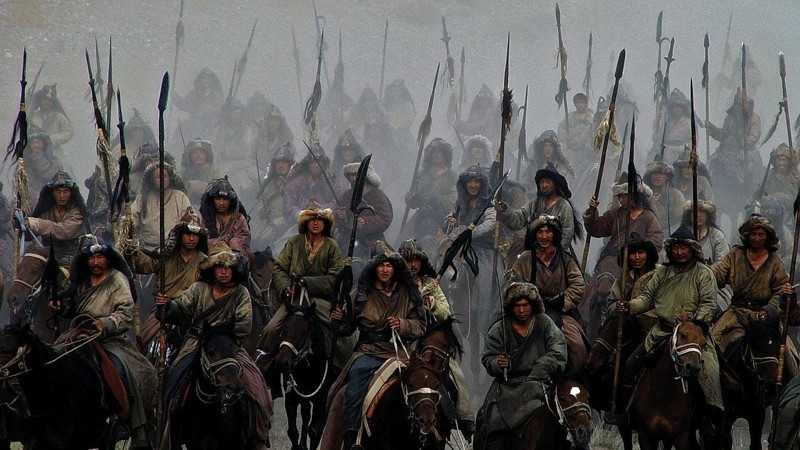
For centuries, historians have debated the same question: how did nomads from the steppes—without cities, universities, or a standing army—sweep through Rus’ as easily as a knife through butter? The answer they most often give sounds unconvincing: there were simply so many of them.
But that is not an explanation. It is an excuse.
At the beginning of the 13th century, Ancient Rus was not a unified state, but dozens of appanage principalities that fought each other more often than they fought external enemies. It was at this very moment that the army of Khan Batu, Genghis Khan’s grandson, arrived from the east. Frozen rivers became roads. Cities fell one after another. And within three months, the horde had reached the Volga.
Over three centuries of yoke, Rus’ lost several generations of development. That is a fact. But what was the cause—numerical superiority or something entirely different?

Thirteenth-century European chroniclers wrote of a half-million-strong horde. By the 19th century, historians no longer believed this: it was too many. In the 20th century, Soviet scholars calculated more accurately: the Mongols were led by 12–14 khans, each commanding a tumen of approximately 10,000 warriors. Total: 120,000 to 140,000. But this conclusion was also revised over time. Today, most researchers cite a figure of 30,000 to 60,000 people.
Thirty thousand. Not half a million.
To understand the scale: today in Mongolia, half a million nomadic families keep about two million horses—roughly four per person. In the 13th century, the ratio was no less, but rather greater. Each warrior took four to six horses on a campaign. This meant an army of 180,000–360,000 animals—without a single fodder depot, without logistical support in the modern sense.
It was the horse that was the true secret of the Mongol army.
The book On the Horse, published in 1952 and edited by Marshal Semyon Budyonny—a man who understood horses better than most historians—states the following: an ordinary Mongolian horse, without much strain, covers 70–80 kilometers a day under a rider, day in and day out. On single-day marches—up to 120 kilometers.
This is not a horse. It is a living logistics machine.

Stocky, with a cylindrical body and a thick coat of wool, the Mongolian horse stored up enormous reserves of fat by fall. In winter, it didn’t need a watering hole—it ate snow. It knew how to find food under the snow on its own, digging it up with its hooves. Unlike European breeds, it didn’t need stables, barley, or the care of specially trained servants.
The Mongols set out on their campaigns toward the end of winter—usually in March. This was no coincidence. At this time, the first young grass was sprouting. The horses found their own food. But the objection that it was impossible to feed such a large herd of horses falls apart as soon as you look at a map: the campaign proceeded across unoccupied steppes and through conquered territories, where there was plenty of forage.
At the same time, the warriors were almost entirely independent of supply trains.
The Mongols carried dried meat, dried curd, and millet—previously roasted over a fire until crisp, something like modern popcorn. Such food weighed little, cooked in a cauldron in a few minutes, and provided enough energy for the march. When it was impossible to stop, the warriors would cut a vein in the horse’s neck and quench their hunger with a few sips of blood, after which they would bandage the wound. The horse survived, and the rider moved on.
If a horse fell, they ate it. Driven hunts replenished meat supplies on the move.
But there was one more thing that is often underestimated: the Mongols knew how to make iron.

In the popular imagination, nomads and metallurgy are incompatible concepts. The imagination conjures up blast furnaces, mines, and entire cities of metalworkers. Meanwhile, the technology for smelting iron was far simpler. Bog iron ore was extracted from swamps and shallow pits, mixed with charcoal, placed in clay pit furnaces, and blown with leather bellows. When the furnace cooled, it was demolished and the bloom—a lump of metal—was retrieved, which was then worked with a hammer.
Tribes across Africa and Eurasia used this method. To call it inaccessible to the Mongols is to not know what this method is.
In the oldest Mongolian literary monument, The Secret History of the Mongols, there is an entire legend about a blacksmith who, with the help of seventy leather bellows, melted a mountainside and opened a path for the people out of the gorge. Since then, the festival of fire and blacksmithing has become one of the most important for the Mongols. The Khan personally placed a piece of iron on the anvil and struck it with a hammer.
Their sabers were quite real. And tempered.
The army moved at an average speed of about 50 kilometers a day—without rushing, conserving their strength. At this pace, it reached the banks of the Volga in three months. The supply trains kept pace: they carried collapsible siege engines, supplies, the wounded, and loot. These were not heavy European trebuchets, but light devices modeled after Chinese weapons—such as the “xuan feng pao,” simplified rope-powered catapults. Plus arbalists—huge crossbows mounted on carts, capable of firing even while moving.

Just as the supply train had briefly broken away from the main forces, the Ryazan boyar Evpatiy Kolovrat and his retinue launched a daring raid against it. According to the chronicles, it was a handful of men against an army. In response, the Mongols deployed catapults.
This was no barbaric raid. It was a military operation with logistics, supplies, intelligence, and siege engineers.
This is what truly broke Rus’: not hordes, but a system. Not savagery, but discipline. Not chaos, but calculation—from the timing of the campaign to rations on the march, from the breed of horses to the method of smelting steel.
There were never half a million barbarians in Rus. There was a well-oiled military machine that, at that moment, simply had no equal.
History loves simple explanations. But simple explanations are rarely the truth.