
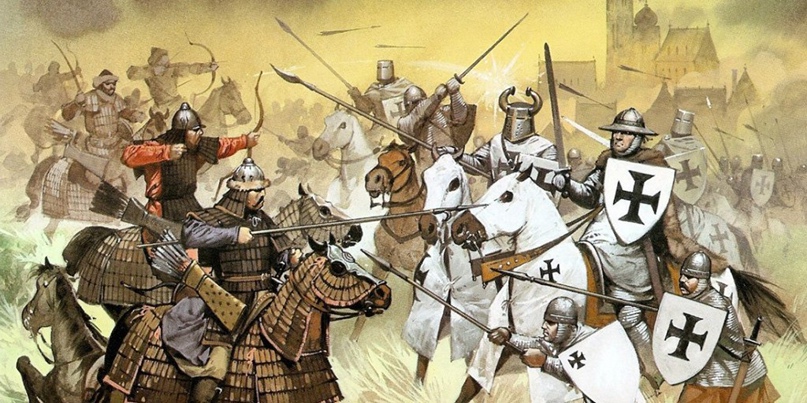
April 9, 1241. The steel-clad Templars and Teutonic Knights against the elusive steppe archers. We examine one of the most brutal battles of the Middle Ages, where European pride clashed with the iron discipline of Genghis Khan’s army.

Picture the scene: spring 1241, Silesia (modern-day Poland). The pride of Europe has assembled on the field near Legnica. Heavily armed Polish and German knights, Templars clad in armor, stern Teutonic Knights, and Hospitallers. They are confident. Their tactics are simple and deadly: a battering ram charge by armored cavalry, designed to crush any barbarians.
But standing opposite them were not just barbarians. Standing opposite them was the perfect military machine of its time—a Mongol tumen under the command of Baidar, the grandson of Chagatai himself.
For the Europeans, the Battle of Legnica was more than just a defeat. It was a shock that demonstrated that head-on attacks do not work against ingenious tactics. Let’s examine exactly how the steppe warriors destroyed the united army of the West.
Reconnaissance by combat: who gathered on the battlefield?
The European army was commanded by the Silesian Duke Henry II the Pious. Under his banners gathered, according to various estimates, between 8,000 and 25,000 men. The core was elite heavy cavalry—the tanks of the Middle Ages.
The Mongols numbered roughly the same (about 10,000–20,000), but their army was radically different. It consisted of highly mobile light cavalry armed with powerful composite bows capable of striking at a considerable range.

A deadly confrontation: mass and armor versus maneuverability and range
The “false retreat” tactic and a smoke screen
The battle began in a manner typical for Europe: Henry launched his heavy cavalry into the attack. The first wave of knights crushed the Mongol vanguard. The Europeans were emboldened—it seemed the nomads had faltered and begun to retreat.
The knights rushed in pursuit with shouts, breaking their own formation. And that was their main, fatal mistake.
The Mongols employed their favorite tactical maneuver—a feigned retreat. As soon as the heavy knightly horses began to tire and the formation turned into a stretched-out crowd, the steppe warriors turned around.
But Baydar had another surprise in store. To cut off the knights from their infantry, the Mongols set fire to the reeds and used smoke bombs (they likely brought this technology from China). Thick, acrid smoke blanketed the field. The infantry couldn’t see what was happening to the knights, and the knights were blinded by the fog.
A veritable meat grinder began in the smoke. The Mongols shot at the knights with bows from a safe distance. Armor-piercing arrows pierced the chain mail and wounded the sluggish horses. When a horse fell, the knight clad in iron became easy prey.

Nine sacks of ears and a head on a spear
The defeat was total. The infantrymen, left without cover, fled, but it was impossible to escape the light cavalry in the open field.
Prince Henry II the Pious himself tried to break through with a handful of bodyguards, but his horse was killed. The prince was taken prisoner, forced to kneel before the corpse of one of the Mongol commanders, and then beheaded.
Later, the Mongols impaled Henry’s head on a spear and rode up to the very walls of Legnica, demonstrating to the city’s defenders the fate of their leader.
A gruesome historical fact: To count the number of enemies killed, the Mongols cut off one ear from every dead European. According to chronicles, they collected nine enormous sacks of ears, which they later sent to Khan Batu as a report on the work accomplished.
Prince Henry’s head became a terrifying message to all of Europe

After Legnica (and the defeat of the Hungarians at Mohi two days later), the path to Central and Western Europe was open. Panic swept through the entire Holy Roman Empire all the way to France. Western kings hurriedly prepared for the worst.
It was not military might that saved Europe, but logistics and politics. In distant Karakorum, the Great Khan Ugedei had died. Batu and other commanders turned their tumens around and headed east to participate in the kurultai—the election of a new ruler.
The Battle of Legnica went down in history as a harsh lesson. It showed that personal bravery, heavy armor, and noble lineage were worth nothing against iron discipline, mobility, and cold tactical calculation.
What do you think: if it weren’t for the death of Khan Ugedei, could the combined forces of Western Europe have stopped the Mongols, or would Paris have shared the fate of Kyiv and Ryazan? Share your thoughts in the comments!