
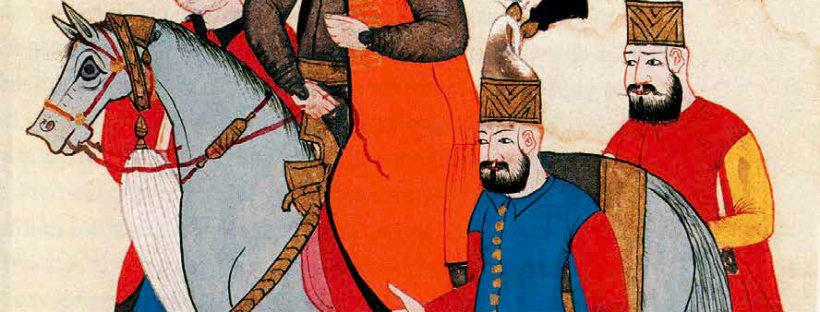
Sultan Ibrahim and Jinji Khoja
Contrary to popular belief, Sultan Ibrahim was not crazy. Perhaps he had a panic fear of death, inherited from living in a Cage. In addition to Kesem Sultan, there was another iconic name for the era of Ibrahim’s rule: Jinji Khoja, whom Khalil Inaldzhik called the Ottoman Rasputin.
August 1648. On this hot day, the strange 8-year reign of Sultan Ibrahim ended, horses saddled on the contrary walked in front of his coffin, and behind him, silent viziers dressed in black walked with bowed heads. Ibrahim was buried not with his father Ahmed I, but with his uncle Sultan Mustafa, who is considered to be insane. This corresponded to the message presented to the society: the Padishah had been killed, and it was necessary to find a suitable explanation for this.

If we look at the events that took place before Sultan Ibrahim ascended the throne (and his reign was difficult and, from the point of view of astrology, unsuccessful) or at the beginning of the 17th century as a whole, we will see a panorama of military and administrative transformations and successive coups, the cause of which was the Padishah himself, the guarantor of Imperial power. who is unable to cope with his duties, and his harem, constantly trying to interfere in the management of the state.
The main reason for the fall of the Padishah’s authority was the residence of Shehzadeh, who had stopped traveling to sanjaks, in Kafes, the increasing influence of harem ags and the attempts of the Valide Sultans to govern the state on an equal basis with the Rulers. It is believed that this was the reason for the insurmountable crises, the weakness of the government, the uprisings in Anatolia and, as a result, the depletion of the state treasury.
This historical period is also marked by not particularly unsuccessful Sultans in power: those who ascended the throne at a tender age (Murad IV, Mehmed IV, Admed I), a madman (Mustafa I), with a troubled psyche (Ibrahim), inexperienced and trying to reform at the wrong time (Osman II). This led to the emergence of the “female sultanate” and the “sultanate of harem ags”, which weighed heavily on the shoulders of the state. The period of dictatorship and fear (under Murad IV), in which the authority of the government was restored at least a little, was replaced by the “Sable Era» (under Ibrahim); Four Sultans ascended the throne one after another, two of them were executed. This undermined the authority not only of the Ruler himself, but also of the Grand Vizier, who ceased to be the “absolute authorized representative” of the Sultan and turned into a pawn of Dariussaade ag and Valide Sultansh. This resulted in the weakness of power structures, the inability to make decisions or make decisions that benefit a certain group of people. When the Sultan’s authority was finally undermined, not only members of the harem made their way to power, but also military groups, which were supported afloat by financial injections from the Valide Sultansh. Sometimes the latter benefited from it, but sometimes it cost them a lot. Among the growing military, there were scuffles about the jules, the organization of permanent juluses became prohibitively expensive, and the state was approaching default. During Murad’s reign, the military was removed from government, and the Empire seemed to be filled with life again after a prolonged illness, as things improved in the treasury. But the overthrow of the previous Sultan Osman II due to the failure in Khotyn and his attempts at military reform, as well as the increased costs of the flotilla during the Cyprus crisis under Ibrahim, left the country at a broken trough from a material point of view. During this period, several progressive Grand Viziers came to power who wanted to change the established order (for example, Sofu Mehmet, Ipshir, Kara Mustafa), but they could not cope with the harem and, accordingly, could not implement anything planned, and some even lost their very lives. It was during this period, after a series of depositions and enthronements, in an atmosphere of executions, bribes, corruption, brilliant victories and bitter defeats, that Sultan Ibrahim ascended to the throne in 1640.
He was pitiable. It was said that his clothes in the Cage were so pathetic that anyone who saw them would undoubtedly feel sorry for Ibrahim. He lived in fear. When the aga came to him at midnight to inform him of his status change, he said, “What do you want from me? May Allah grant my brother good health, but I have no need for the throne,” which forced the Sultan to summon Kesem. Ibrahim could not believe that Murad IV was dead, they even tried to convince him to look at the dead body. For decades, Ibrahim lived in anticipation of the death of such a cruel Sultan as Murad IV, such an existence left him with nothing but a constant panic fear of execution. The new Sultan had to be literally dragged to the julus from Shimshirlik. He uncovered his late brother’s face several times, trying to believe what had happened, which provided food for detailed descriptions of various kinds of pen workers. It was really difficult for him to believe in the death of Murad IV, and it would have been a mistake to expect otherwise. Sultan Ibrahim never forgot how panic rose in the palace during the execution of Shehzade, who had long since passed out of adolescence, how Kesem Sultan saved him from a silk lace at the last moment, how they were able to save his life without showing his eyes to anyone, so that Murad IV would not remember him. Memories that could not be eliminated ruled his entire life. According to the traveler Du Loire, Murad IV wanted to kill Shehzade Ibrahim, already on his deathbed. Kesem Sultan barely managed to dissuade the ags who came — she gave them significant bribes and assured them that Murad IV was living out his last hours. When Murad IV was dying, he wanted to put an end to the Ottoman dynasty or, in his opinion, one of the glorious representatives of the Crimean Khanate should have come to power, we will no longer know, but Shehzade Ibrahim survived. He ascended the throne as the only surviving shahzade and without having a single heir.

An engraving by Paul Ricol, in which Kesem Sultan shows his son Ibrahim the body of Murad IV.
Shimshirlik was like a prison. The long years that Ibrahim spent there not only shook his mental balance, but also deprived him of a decent education. The treatise of Kochi Bey Gyumurdzhinsky is an important source for understanding the epoch. At a time when state institutions were becoming obsolete, many writers took up the pen and, without hesitation in their expressions, poured out their worries about the future of the empire on paper. If you carefully follow the text of this treatise, the difference in the education of the two Padishahs will be clearly visible. The treatise presented to Murad IV dealt with the causes of the troubles that had arisen, the incompetence of personnel, the necessary transformations and the search for various solutions to bring the state out of crisis. And the treatise offered to Sultan Ibrahim advised the Padishah how to properly give orders to the Grand Vizier, how to behave with theologians and what the court servants are like. That is, judging by this treatise, it can be concluded that the Sultan did not even know the list of employees of the palace in which he himself lived, which in itself is an excellent reflection of the reign of Sultan Ibrahim. The “Sable Era» began, with power largely concentrated in the hands of Grand Vizier Kara Mustafa Pasha and Kesem Sultan. Fate smiled on Kesem again, as it had already been in the early years of Murad IV’s reign. Kochi Bey’s edification had an impact on the Sultan at the beginning of his reign, and everything went well until Kara Mustafa Pasha was appointed Grand Vizier, who was later executed. Among the archival documents there is a ferman written by Sultan Ibrahim and addressed to Qadi: “Take control of the artisans,” or “Resolve popular complaints, restore the course of akche,” addressed to the Grand Vizier. Judging by these documents, historians are painting a portrait of a completely different Ibrahim. But the witnesses of those events, such as Naima or Karachelebizade, and the information that was submitted to Kesem Sultan, shed light on the real state of affairs.
Panic fear of death
It would be more correct to divide Ibrahim’s sultanate into two periods. During the first period, the life of Grand Vizier Kara Mustafa Pasha, who served under Murad IV, was safe. This Sadrazam was trying to solve the problem of devaluation, which caused great unrest in the state. Despite his failure in this field, he managed to at least strengthen the authority of the Sultan, and thanks to systematic accounting— he prevented corruption. However, this period lasted only four years. Ibrahim’s psychological state began to worsen, and a paralyzing panic fear of death was increasingly coming over him. Despite the absence of an official regency institution, Kesem Sultan took over the affairs during such periods. As we now know, Ibrahim was a descendant of 17 of his predecessors and the ancestor of 18 subsequent Sultans. But at that time, the situation was delicate: there were no heirs, but the dynasty had to continue. For the sake of the birth of heirs, it was decided to resort to a love spell, magic, proofreading and blowing. Thus, the gates of happiness opened to the most interesting person in Ottoman history.
The courtiers called him Huseyin Effendi, but he went down in history as Jinji Khoja. The historian Khalil Inaldzhik did not call him the “Ottoman Rasputin» in vain. Ironically, the person most familiar with Jinji Khoja was Evliya Celebi. The following tells about the proximity of Sultan and Khoja Celebi:
There was no one closer to his Padishah. He was even closer to the Sultan than the Grand Vizier or the Waleed. If the Sultan got into the carriage, they would certainly get in together. If he was sitting on a palanquin, then they certainly sat together.

Evliya Celebi describes in his characteristic manner how he studied at the Hamid Efendi madrasah with this Sheikhzade, who arrived from Safranbolu, and how he rose to the court in a short time.
Huseyin Efendi was born in Safranbolu in the family of a sheikh, but he himself traces his genealogy back to the Seljuk rulers and even Mevlana himself. He was a madrasa student and a student of theology, and then decided to take up blowing — according to some sources, following in his father’s footsteps, according to some — thanks to the blessed gift that God gave him. When Sheikh Efendi, under whom he served, was appointed qadi, he did not want to take Huseyin Efendi with him, as the interest of the uneducated masses of the people had increased towards the latter. Upon the intervention of some respected hodges, Sheikh Efendi blurted out: “Hey, Efendi, we have the honor! Or should we take along a sorcerer who blows away children and women, who has nothing else to do, so that we can be ridiculed in the civil service?!”
During his panic attacks, Sultan Ibrahim could not find a common language even with his mother. Kesem somehow managed to cope with her son and the situation, but what was happening in the harem began to be gossiped about outside of it. One of Ibrahim’s wives, Shekerpara, was injured by Kesem in a harem brawl, and later Ibrahim exiled his wife to the island of Sakyz (Chios), and all her property was nationalized. The process of seizing acquired wealth is a perfect illustration of the reign of Ibrahim. 16 chests and 250 pouches, that is, 25 million silver acces, were found at his former wife. Ibrahim’s reaction shocked those who heard: “That’s a jerk! And she told me that she didn’t even have anything to eat! It’s all my blood!” It is believed that during the time of Ibrahim, positions were given out for bribes: for sables and ambergris, which supported male strength, on which the Padishah introduced an additional type of tax. Ibrahim came up with a new type of dress, embroidered on the outside with sables and buttons made of precious stones, this outfit cost 8000 kurush, i.e. approximately 6000 gold. Government officials were ordered by the sultan’s farmers to bring sable furs to the court. This angered theologians and made the people laugh. The capital began to be full of rumors. Meanwhile, Jinji Khoja continued his activities and became more and more famous. Even the employees at the court began to feel like they had no hands without him, and they began to buy and sell positions only with his approval. He quickly began to climb the state ladder.
Jinji Khoja was also close to Kesem Sultan.
First, an order was issued appointing Jinji Khoja to the post of muderris (professor) at the Kharij Madrasah. While this appointment was being discussed, Khoja was appointed Muderris at the Sahn madrasah as the new Ferman, and a few days later he was given the post of muderris at the Suleymaniye madrasah, and in addition, he was given the position of mentor to the Padishah and Qadi Galata. All these appointments were made despite the protests of the wise Sheikhulislam Yahya Efendi. Yahya Efendi even lost his life because of this. Meanwhile, Ibrahim had heirs, 5-6 haseki were granted allotments, the profits of which were paid by the state; the income from them increased to 100,000 kurush, which means that the expenses of the state also increased. At this time, the Venetians blocked the Canakkale Strait. Jinji Khoja succeeded in removing important politicians from power due to his proximity to Sultan Ibrahim and Kesem Sultan. The oblogy of Crete, begun in 1645, continued. Part of the palace was sheathed in sables. It became difficult to find sable fur, and prices for the available ones went through the roof, Russians and Cossacks did not have time to supply sable, spreading rumors about bribes caused unrest among government officials, the military and the people. Sultan Ibrahim’s latest folly was an attempt to build a boat decorated with precious stones. With this, preparations for the uprising were begun. The leader was an experienced agha janissary, Kara Murat Agha. The Grand Vizier invited the Janissary captains to one of the palace weddings, but they did not come, fearing that it was a trap.
It was planned to deal with the person responsible for the “madman” first Padishah Sadrazam Ahmed Pasha, and then win over Sheikhulislam to his side, securing the favor of theologians. On August 8, 1648, the armed janissary ags and janissaries gathered in the Ortajami mosque, Sheikh Islam took the side of the rebels. Grand Vizier Ahmed Pasha was also invited, but he did not show up. The rebels gave Sadrazam’s post to former defterdar Sofu Mehmed Pasha. When Ibrahim was informed of the uprising, he ordered the rebels to disperse. But the mufti conveyed that those gathered were not going to disperse without the extradition of the Grand Vizier. The rioters also sent a message to Kesem Sultan, saying that they demanded the execution of Sadrazam, the deposition of Ibrahim and the proclamation of Sultan Shehzade Mehmed. At this time, Ibrahim delivered cannons to the palace, mobilized and armed bostanji, preparing for the confrontation. But the Grand Vizier was found and strangled, and his body was thrown onto Atmeydany (Sultanahmet Square). He managed to make a fortune of 7,000 floris. Due to the fact that his body was torn to pieces, the Grand Vizier went down in history as Hezarpare (a thousand pieces) Ahmed Pasha.
Janissary aga and ulema gathered in Sultanahmet Square. Bostanji unlocked the palace gates without offering any resistance. Mehmed Shehzade, who was only 7 years old, was immediately sworn to allegiance. Ibrahim was again locked in a cage with two concubines, who were supposed to spend this time with him. Although Mehmed IV was enthroned, the inhabitants of Enderun began to be indignant: “How is it possible to “bury” Is the Padishah alive?! It’s worth releasing it!” There were also dissatisfied soldiers, and the reaction of the people was not long in coming, and rumors began to spread, so the executioner, Kara Ali, strangled the Padishah with a silk cord. Thus, on that hot August day, the Sable Era came to an end.
The palace healer, about whom Evliya Celebi wrote, “If the Sultan got into a carriage, Jinji got in after him,” began to lose influence at court in the last years of Ibrahim’s reign. He was appointed to the post of Anatolian Cadet several times intermittently, but in the end he was finally removed in 1646 and expelled from the palace. At first he was exiled to Izmit, later he was still allowed to come to Istanbul, then Sultan Ibrahim, unable to control his anger, sent Jinji Khoja to Galipoli. He returned to Istanbul a couple of weeks later, but there was no trace of his influence, he continued to practice blowing. With the overthrow and execution of Ibrahim Jinji, Khoja was left without a patron. When Mehmed IV ascended the throne, it turned out that the treasury was empty, Jinji was approached for a loan, but he refused to give the money. His house was searched and chests filled with gold, sacks full of jewelry, and more than fifty sable furs were found. All this was confiscated in favor of the state. Fearing the remnants of his influence, Jinji Khoja was exiled to Sanjakbey Ibrim, which was part of Abyssinia (Ethiopia), but on the way there he fell ill, first he was given shelter by the Crimean Khan, then he was allowed to return to Istanbul. In the capital of Jinja, Khoja complained to everyone he met about his fortune being taken away from him, which eventually brought upon himself an untimely death.