
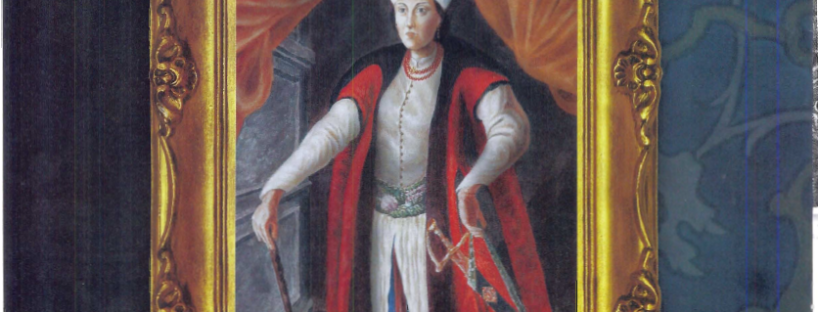
It all started with the fact that the Slavonian Hatice got into the harem as a concubine at the age of 12 and attracted the attention of Sultan Ibrahim. Turkhan Sultan, who gave birth to Mehmed IV in 1642, directly ruled the Empire for 30 years. Thanks to her, such significant buildings as the Seddülbahir and Kumkale fortresses in Canakkale and the New Mosque complex in Istanbul were erected.
Until recently, the concubines of the Ottoman Sultan, his sisters and mothers, that is, all the women of the Ottoman harem suffered a lot from historians. In the historical writings of the early years of the Republic, women who lived in the Ottoman harem in the 16th and 17th centuries were mentioned as one of the factors that led to the decline of the Empire. However, historians who later studied the Ottoman Empire claim that the numerous changes that took place in the state after the reign of Sultan Suleiman Kanuni are extremely difficult to describe with a primitive model of «dawn and dusk.» To get to know Ottoman women and understand what kind of factor they were in the development of the Empire, we carefully studied the Ottoman archives. All the information we found there plays into these women’s hands. Just like the men of the ruling dynasty, they were involved in politics, acted together with their retinue like padishahs, conducted diplomatic correspondence with the dynasties of Europe, the Safavids and Baburs, often visited various parts of the Empire, supported the army, patronized the development of architecture and built mosques, khans, imarets, libraries, madrasas, turbas, fountains and fortress walls. They were as generous as men in social projects, and a third of the waqfs in 16th-century Istanbul were created by them.
If we take a broad look at Istanbul today, we can understand what a significant part of its landscape was created by Ottoman women at one time: we will see the massive and still operating imaret in Eyup, built by Selim III’s mother Mihrishah, the mosque complexes widely spread in Uskudar, erected on the orders of Nurban and Mihrimah, Buyuk Walide Khan Kesem Sultan on the descent of Chakmakchylar.

The son of Hatice Turhan Sultan Mehmed IV (Hunter) stayed on the throne only 4 months after her death.
Most of the market buildings that we see walking through the Egyptian market were built as part of the voluminous architectural project of Hatice Turhan Sultan, the mother of Mehmed IV, which was carried out at this busiest point of the Golden Horn embankment and which also included the complex of a New Mosque (Yeni Jami Kullye). Undoubtedly, we owe a lot to these charming ladies, and we can begin to pay tribute to them, at least by studying their stories in more detail and more impartially. One of the most significant figures among them was Sultan Ibrahim’s wife and Sultan Mehmed IV’s mother, Hatice Turhan Sultan.
We know that Hatice Turhan was about 12 years old when the Tatars captured her during one of the raids on the steppes of the Russian Empire in search of slaves and sold her into a harem as a «concubine.» At first, it was given as a gift to Ibrahim’s mother Kesem Sultan, and soon to Ibrahim’s sister Atika Sultan. If at that age she still could not sew, embroider, sing, play the saze and dance, then most likely she had already been taught all this in a new language for her – Ottoman Turkish. She was also taught religious lessons since she converted to Islam.
No artist was allowed to visit the harem and depict the women who lived there, so the portraits we see now are all fiction, we don’t know what Hatice really looked like. But in 1953, the Turkish historian Kadirjan Kafli presented this Slavic woman to us as a blue-eyed, fair-skinned brown-haired beauty. Unfortunately, the only engraving available to us is also fiction, it was created after the death of Turkhan Sultan, and the portrait of Valide Sultan is far from the image offered to us by Kafla.
The daily life of the girls in the harem was far from those exotic scenes painted by the 19th-century French orientalist Jerome, most likely, it was more like a strict boarding house.
Ottaviano Bon, a Venetian merchant who lived in Istanbul at the beginning of the 17th century, described how young girls spend their adolescence locked in cramped harem rooms.: «Their lives are similar to the lives of nuns in large monasteries. These innocent girls live in large rooms, and there are about a hundred of them in the bedrooms.»
One day, Hatice attracts the attention of Ibrahim and gives birth to Mehmed IV on January 2, 1642. Her status in the harem instantly rises, as Turkhan is now the mother of the future Sultan. However, in fact, a stage had begun for her, at which she had to protect her future status as Valide Sultan and her son’s life from the intrigues and attempts of other Haseki, who also had sons. This danger to his son’s life would increase in August 1648 with the overthrow of Ibrahim from the throne and his death. 6-year-old Mehmed will become the Padishah, and Turhan Sultan, who was in her early 20s at the time, will turn into the most powerful woman in the Ottoman Palace, Valide Sultan. In the way of Hatice Turhan Sultan stood a woman with a difficult character, who complicated her life from the first minutes of her new status, Walide Sultan: mother–in-law Kesem Sultan, or as she was addressed by government officials, Walide-i Muazzama (Great Walide). When her son, Kesem Ibrahim, died, she was about 60. She was a Valide with her two sons.: Murad IV and Ibrahim. Everyone believed that with her 20 years of experience in power, she served state policy.

View of the late 19th century of the New Yeni Cami Mosque, built by order of Turzan Slutan in 1650-1655 on Eminenyu
The confrontation between the two Valides – the young and the elderly – led to the fact that they entered into alliances with two polar factions: the palace ags and the janissaries, and this, in turn, led to palace intrigues and a dramatic ending. Turhan and Kesem’s rivalry ended with the latter’s terrible death (they say she was strangled by Hatice Turhan’s henchmen). One of the ichoglans, Bobovius, a Pole by birth, who served as a musician at the palace and at the same time as a messenger to the ladies, describes the doors in which Valide Sultan appeared for the last time after the successful assassination attempt as follows: «the doors through which the Ichoglans dragged out Ibrahim’s mother, the elderly Valide Sultan.» Kesem Sultan was tortured and strangled with her own hair in 1651.
During the reign of Turkhan Sultan, many more difficulties arose on her way. But now, while her son Mehmed was alive, her status as Valide Sultan was unshakeable. It is not difficult to guess that Turkhan Valide Sultan moved to Topkapi into spacious apartments with rooms for her retinue and servants, a bedroom, a small chapel, a throne room/official reception hall with a dome, a fireplace and a balcony overlooking the Golden Horn. Next to these rooms was a finely crafted hammam decorated with Iznik tiles. Among the valuable items that belonged to her (now in the collection of the Topkapi Museum) was a mother-of-pearl seal, which reads «Valide Gazi Sultan Mehmed.»

Turhan Sultan mother-of-pearl seal, on which is engraved the inscription «Valide Gazi Sultan Mehmed»
Sultan Mehmed, depicted in one of the European engravings riding a brave horse, was a minor when he ascended the throne. Therefore, the responsibility to make important decisions fell to Turkhan Sultan herself and reliable people from her entourage, such as the chief harem agha Suleiman Agha and the Grand Vizier of Keprul Mehmed Pasha.
Turkhan Sultan tried to resolve numerous crises, which were reported to her by the Grand Vizier and the Admiral of the Fleet (Kaptan-s derya). To emphasize his authority and legitimacy, in letters and decrees that came from her pen, she addressed her son as «My Lion.»
The first thing Turhan Sultan focused on was the order in Istanbul and in the country and the protection of state borders from aggression, primarily by the Venetians, who attacked Ottoman ships, harassed pilgrims and merchants, attacked Ottoman possessions in the eastern Mediterranean and even at one time held the Canakkale Strait under siege, leaving Istanbul without supplies of provisions.
Measures to restore order in the country (and protect the capital from devastating fires) also included banning fireworks, which are adored by ordinary people. The long siege of Candia and the incessant attacks of Venice on the Mediterranean were the reason for Hatice Sultan’s first major architectural project, the construction of two fortresses at the entrance to the Canakkale Strait.: Seddülbahir in Europe and Kumkale in Asia. Ottoman historians of the time spoke warmly enough about the desire to protect this strategic channel, through which Muslim pilgrims went on Hajj and on which Istanbul ports and markets were vitally dependent. Valide Sultan sang laudatory odes. We learn from the waqf records that funds were donated for the repair of the 15th-century Canakkale, Kilitbahir and Kale-i Sultaniye (Chimenlik) fortresses built by Fatih Sultan Mehmed, the construction of two new fortresses Seddulbahir and Kumkale, which also included a double hammam, a mosque, a school, military barracks and several trading shops. Turkhan Sultan.

Nicholas de Fer’s 17th-century map showing
the Canakkale Strait (Dardanelles) and the Seddyulbakhir and Kumkale fortresses built by Hatice Turhan Sultan
Evliya Celebi, who visited the fortresses with Turkhan Sultan and her entourage, claims that Seddülbahir had a port for at least 80 ships, and the ditches were so deep that attempts to look down were terrifying. Today, Seddülbahir and Kumkale are in a deplorable state, so it would be difficult to imagine that these two fortresses, which Abdi Pasha spoke with great enthusiasm about as «venerable guardians of the western borders», protected the Ottoman Empire with cannons «resembling huge dragons spewing flames» from the dangers that arise in its path. But before the First World War and the Canakkale war, both fortresses were in pretty good condition.

Seddülbahir Fortress, 2015
After the attacks of the Venetians began to subside, and Küprülü Mehmed Pasha (later his son Fazil Ahmed Pasha) became entrenched in power, Turhan Sultan fully concentrated on Istanbul and began to work on a project that would become an invaluable contribution to urban planning: the New Mosque complex in Eminenü (Küllie Yeni Jami). In addition to the mosque itself, which is now located in the very heart of the city, next to this well-known building there was a tomb, a market building (Egyptian Bazaar), an elementary school, a compact palace (Hunkyar Kasry) and a large fountain (sebilkhane).
To build her own complex, Turhan Sultan chose a place that belonged to Safiya Sultan, the mother of Mehmed III. Safie «retired early» after the death of her son in 1603, so she was forced to move to the Old Palace in Beyazit, and was unable to complete what she had begun. The Safiye Sultan project raised many questions, because for its implementation it was necessary to clear most of Eminenyu and evict the residents and shopkeepers, who for the most part were representatives of the long-standing community of Karaite Jews. The chroniclers of that time hinted that the eviction was unfair and dishonest.
The project was completed in 1655, for this it was necessary to carry out a large-scale resettlement, Evliya Celebi claims that everything was done conscientiously: «It was a demonstration of justice, not oppression and coercion, but justice.» Inscriptions in the mosque and the description of the project in the documents of the Waqf Turhan Sultan indicate that the ideological inspiration There was a teacher of his son and a preacher of the Eminenyu mosque, Vani Efendi, a member of the intolerant and traditional views of the Kadizadeli movement, and the project itself was planned as a small «victory» over the Ghavours.
Undoubtedly, the trade potential of the customs and port of the Golden Horn, which were supposed to provide profit for Cullier, did not escape attention. The majestic Egyptian bazaar also confirms the commercial organization of Cullier.

Hyunkyar Kasry
In addition to the Valide Turbe, in which Turkhan Sultan and her son Sultan Mehmed IV are buried, there was also a Khunkar Kasry, where Valide Sultan and her entourage stayed during Ramadan or when she wanted to visit Kullye. The masterpiece of architectural thought of the 17th century, Hunkyar Kasry, is decorated with detailed inscriptions and expensive Iznik tiles, while its windows offered a view of the entire Kullye, and one could also observe a restless anthill near the Golden Horn, which flickered when merchant ships arrived at the port with goods for sale on the Egyptian market.
Until the end of her life, Hatice Turnkhan Sultan was involved in politics and played an active role in the administration of the Ottoman Empire. When Candia was captured by the Ottoman Navy in 1669, in an attempt to plant Ottoman culture on the island, it converted churches into mosques. By her order, some buildings were erected.
Despite all of the above, she was unable to raise her son Mehmed IV to be the same glorious warrior and statesman as his ancestors Mehmed II or Sultan Suleiman. Everyone knows that Mehmed IV did not like Istanbul, he preferred to live in a palace in Edirne and often look into the hunting grounds of Rumelia – his main passion was hunting, for which he was nicknamed «The Hunter» (Avji).
Turhan Sultan died in August 1683 at the age of 60, shortly after the Ottoman army launched an unsuccessful campaign to besiege Vienna in June 1683. When her 30-year leadership ended, the Empire’s economy and military affairs plunged into chaos and turmoil. The Grand Vizier and other statesmen advised a radical way out of the crisis – the deposition of Mehmed IV from the throne.
The Ottoman historian Silakhdar described the feelings that lived in the heart of the people after the death of Turkhan Sultan as follows:
The skeleton of the state collapsed.