
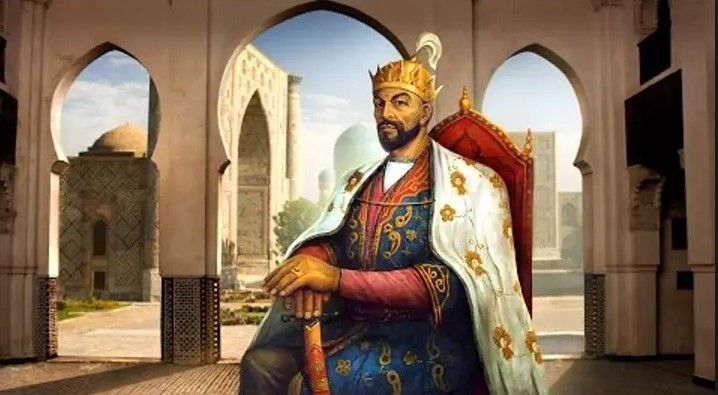
In 1395–1396, Timur launched his second invasion of the Horde’s territories. This time, he did not march on the eastern uluses, which had been ravaged by his previous invasion, but instead headed for the wealthy Volga region. Passing through his Transcaucasian holdings, the “Iron-Legged” ruler advanced to the very heart of the Golden Horde.
Tokhtamysh, as a wise ruler and military leader, decided not to let the enemy penetrate deep into his territories and therefore blocked his path at the border—on the Terek River, where on April 15, 1395, one of the largest battles in the former Mongol Empire took place.
The size of the armies was apparently roughly equal, and so the battle was marked by fierce resistance. Both leaders of the opposing forces—Timur and Tokhtamysh—personally took part in the battle. For most of the battle, the initiative lay with Tokhtamysh. However, despite his tenacity in this battle, the Khan of the Horde was defeated.
However, he was not to blame for this: Timur’s military genius determined his victory in the battle. The defeat of the Golden Horde was complete: the khan’s army practically ceased to exist, and Tokhtamysh himself fled, with no word of him for several months.

Tamerlane’s Cavalry
After defeating Tokhtamysh in the Battle of the Terek on April 15, 1395, Timur set out in pursuit of Tokhtamysh to capture him and finish off the remnants of his army. Timur fully understood that, thanks to the vastness of his territories and the abundance of resources, Tokhtamysh would eventually be able to gather new forces and resume the fight.
The Iron Lame One advanced relentlessly, but Timur never caught up with Tokhtamysh. The ill-fated Khan of the Golden Horde fled to Bulgar with literally only a few close and loyal followers. Timur’s army, having advanced up the Volga, halted quite far from Bulgar, where it destroyed the city of Ukek. After that, Timur turned westward.
Tamerlane decided to head for the western uluses of the Golden Horde toward the Dnieper, since some of Tokhtamysh’s emirs who had participated in the battle on the Terek had fled there. Upon reaching the Dnieper, Timur plundered and ravaged these lands, after which he turned toward the Don and unexpectedly marched north toward Russian cities and districts. What drew Timur to the lands of Rus’?
Like other rulers of Central Asia and Iran, Timur was poorly informed about Russian affairs. Although he was thoroughly familiar with the geography and history of Central and Near Asia, as well as Muslim countries and peoples, Timur lacked even the most basic understanding of Rus, the Russian principalities, and Moscow. Historical and geographical conceptions of the land of the Russians, which to some extent corresponded to reality, did not reach the Central Asian East and did not extend beyond the Golden Horde.
This is why in 15th-century Muslim (Persian and Arabic) historiography—so rich in factual material on the history of Muslim countries and even Christian Transcaucasia—we find nothing of interest or value regarding the history of Rus. We will not even find correct geographical nomenclature in it, including the correct names of Russian cities.
Let us return, however, to Timur’s campaign against Rus’. Eastern sources report that Timur invaded the region of the city of Mashkav, i.e., Moscow, where he wreaked havoc and carried off a vast amount of booty. Eastern chroniclers had a poor understanding of the geography of Rus’ and confused the Ryazan region with the border districts of the Moscow principality. Let us turn to the more precise accounts of Russian sources.

According to the Nikon Chronicle, Timur invaded the Ryazan region with a massive army and captured the city of Yelets, “seizing the Prince of Yelets, taking the people captive, and slaughtering others.” Grand Prince Vasily Dmitrievich, upon learning of all this, gathered numerous regiments, marched toward the city of Kolomna, and occupied the crossings over the Oka River. Timur did not dare to engage the Russians and, having plundered the Ryazan region, withdrew southward.
Apparently, the tales of the Battle of Kulikovo had impressed him, and he did not dare to engage the Russians in battle. With a great haul of booty, Timur headed for the Lower Volga region. He moved through the lower reaches of the Don and, along the way, decided to capture the city of Azak (Azov). The city was completely plundered; on Timur’s orders, the Muslims were separated from the rest of the population, who were then subjected to the “sword of Jihad,” that is, all were exterminated.
From Azov, Timur headed toward the Kuban. An Eastern chronicler recounts that the Circassians set fire to the pastures between Azov and the Kuban. For 7–8 days, Timur’s horses literally suffered from a lack of fodder. Enraged, Timur ordered revenge against the Circassians and the devastation of their entire ulus. Instead of following his planned route to the Lower Volga region, Timur unexpectedly turned toward the North Caucasus, where he captured a number of mountain fortresses.
Of particular interest is the account of Timur’s campaign against Khadzhi Tarkhan (Astrakhan) and Saray Berke in the winter of 1395. Having failed to destroy Saray Berke and Astrakhan during his first campaign that summer, when he was pursuing Tokhtamysh, who had fled from the banks of the Terek, he now marched with a large army to put an end once and for all to these two major centers of wealth and power of the Golden Horde.

Timur’s Campaign of 1395
It was a harsh winter; the Volga was frozen over, and it was possible to approach Khadzhi-Tarkhan from the river. The city had strong fortifications only along its landward side. A high wall, apparently reinforced with towers, surrounded the entire city, starting at the riverbank at one end and ending at the other. There was no wall on the river side. Here, armed ships served as a defense.
Since the ice on the river made it possible to approach the city from this, its most vulnerable side, the inhabitants of Hajji Tarhan began cutting out chunks of thick ice and stacking them to form a wall. At night, they poured water over the stacked blocks. “Having thus constructed a high [wall],” writes Sharaf al-Din Ali Yezdi, “they connected the city wall to this wall with a single block of ice and erected a gate. Truly, this is a marvelous contraption, and that is why it is recounted here.”
Despite the strong walls, Haji Tarhan offered no significant resistance. Timur first imposed a tribute on the city’s inhabitants in exchange for sparing their lives, and then handed everything over to his army to plunder. Before leaving, Timur ordered all the inhabitants to be expelled and the city set ablaze.
Having dealt with Astrakhan, Timur set out for Saray Berke, which was unable to offer him any resistance. Saray Berke, just like Hadji Tarhan, was handed over to Timur’s soldiers to be completely plundered. The devastated capital of the Golden Horde was set on fire and, apparently, burned down for the most part.
Timur’s victory over Tokhtamysh, the plundering and burning of Astrakhan, and especially of Saray Berke—the capital of the Golden Horde—in 1395 were of immense significance not only for Central Asia and southeastern Europe at the time, but also for Rus’. Without realizing it, that very Temir Aksak, who had plundered and ravaged the Ryazan region, objectively rendered a service to the Russian lands through his victory over Tokhtamysh, although his actions left him with a well-deserved bad reputation among the Russian people.
S.M. Solovyov also wrote: “After Tamerlane’s defeat, the Golden Horde posed no threat to the Prince of Moscow for a long time; over the course of 12 years, the chronicler mentions only three instances of border skirmishes between predatory Tatar detachments and the Ryazanians, with success mostly on the side of the latter.”