
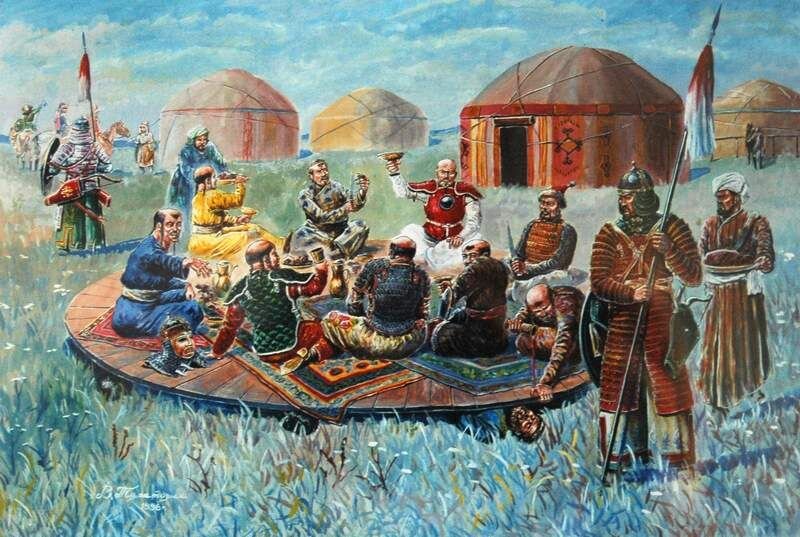
The Diet of a Kazakh Warrior in the 17th–19th Centuries
The Kazakhs did not have a standing army. Instead, a popular militia was assembled as needed under the leadership of the khan, sultans, and batyrs. Its basic structural unit was the “kos”—a group of people who ate from a single cauldron (sharing a common household). The person responsible for preparing and distributing food was called a “kazanshy” or “as bashy.” They were appointed at military councils before a campaign.
FIELD PROVISIONS
Nomads did not have supply trains like sedentary peoples. Usually, horses and camels were driven behind the army. Fresh meat was most often boiled. It was placed in bags that were attached to the saddle. When food ran out, hunger was sometimes staved off with a piece of horse or camel tendon. The expression “Sіngіr toq qylady” — “Tendon satisfies hunger” — has survived. Horse meat provisions were also convenient on long campaigns: shuzhyq, kazy, karta, zhal, zaya, as well as dried and smoked meat.
In “Historical Legends of the Batyry of the 18th Century,” recorded
by Shokan Ualikhanov, there is a description of camp food: “During the pursuit of the Torguts, the Kyrgyz (Kazakhs) set up camp, cooked dried horse meat in their camping pots, and mixed kurt with water in their tursuks; in short, they had breakfast and stocked up for the whole day.”
TUIEMESH AND KUIRYQ MAI
A special type of field ration was tuiemesh—ground meat that was dried and stored in a sheep’s stomach. When cooked, it produced a hearty, rich broth. Boiled sheep’s fat tail (quyryq mai) was also used. In cold weather, it was worn as a belt—it served both as a food supply and as protection from the cold. If necessary, the fat tail was also given to horses if their feed ran out. They also roasted and baked horse liver, spleen, kidneys, and large intestine on a spit, which was atypical for ordinary nomadic life.
A RIDING HORSE—NOT FOOD?
In wartime, in exceptional cases, the meat of fallen warriors’ riding horses was used for food. In everyday life, the nomads did not consider riding horses to be food. Eating one’s own steed was considered reprehensible, a “disgraceful, highly unethical” act. And eating the horse of a defeated enemy was perceived as a deliberate act of desecration.
THE WARRIORS’ INDISPENSABLE FOOD
Kymyz and shubat were an essential part of the Kazakh warriors’ diet. They quenched thirst and hunger, and also provided the body with necessary vitamins. They also consumed liquid fermented milk dishes made from sheep’s milk: katyk, ayran, and shalap. Kurt was an indispensable food for the campaign. Its importance in the daily life of the nomads was so great that it was reflected in the expression:
“Jarty kurtty jarip jeu” — “They share even half a kurt with each other.”
This was said of close friends ready to support one another in times of need.
WHAT THEY ATE WHEN FOOD RAN OUT
When food supplies ran out, they used gathered foods—roots and seeds of wild plants, mostly starchy ones: leaves, stems, bulbs, and berries. Researcher Grigory Potanin noted:
“Cirsium esculentum (edible thistle)—the spindle-shaped root is eaten raw or boiled with milk. Alisma plantago (common water plantain)—the rhizome is eaten, baked in ashes; Rumex acetosa (sour sorrel)—the sour leaves are eaten, and after May, when the leaves have dried, the sour stem is eaten.”
“THE ENEMY’S BELLY” — A WARRIORS’ RITUAL DISH
The name of the ritual dish “Zhau Jumyr” can be translated as “the enemy’s belly (kidneys)”.* The meat of the slaughtered animal was placed in its own stomach and baked in ashes. Apparently, the consumption of this dish had a symbolic and magical meaning: it was as if one were eating the enemy’s vital organs and was supposed to contribute to victory in the upcoming battle. This assumption is linked to the fact that in the traditional beliefs of many Eastern peoples, male strength was associated with the kidneys.
*Some sources record the dialectal name “Zhau buirek” (buirek — “kidneys”).
Source: “The Specifics of Food in the Military-Nomadic Lifestyle of the Kazakhs,” N. Zh. Shakhanova, “Ethnographic Aspects of the Traditional Military Organization of the Peoples of the Caucasus and Central Asia” (1990).