
The Crimean Tatar and Nogai tactics of fighting in the mounted formation in the XVI − mid-XVII centuries. «Tulgama»
A tulgama is a tactical device that involves covering the enemy’s flank(s) with access to the rear and delivering a massive beam strike on his formations. The name of the technique comes from the Turkic verb «tulgamak», that is, «surround», «wrap», «turn», «circle», «twist». Unlike other nomadic tactics, tulgama has not been the subject of special scientific research for a long time. As a rule, this maneuver was mentioned by the authors of general historical works devoted to the peoples of the Great Steppe of the XV-XVI centuries, but without a detailed analysis of its military and tactical features. As a result, in the modern scientific literature, the tactical technique in question has received a wide variety of interpretations, up to the most exotic. This is all the more surprising, given that the content and meaning of this maneuver were described in detail by contemporaries of the events.
A classic description of tulgam can be considered the message of the famous descendant of Timur, the ruler of Ferghana (and later the founder of the Mughal Empire) Zahir al-Din Babur, who encountered this tactic of the Dasht-i Kipchak nomads in the battle of Khoja Kardzan in 1501. A detailed description of the maneuver allows us to reconstruct all the main stages of its execution: «As the ranks drew closer, the enemies began to enter our rear from the edge of the right flank; Then I turned to face them, and our vanguard, which included all available Yeghits who had seen battle and fought with a sword, was on the right hand; there was not a single person left in front of it [the vanguard]. Nevertheless, we repelled and pushed back the enemies who came forward, and pressed them to the center… The enemy’s right flank, having pushed our left flank, went to our rear. Since our vanguard also remained on the right hand, our front was exposed. The enemy’s men attacked us from the front and from behind and started shooting arrows… We attacked the enemy several times and pushed him back with a fight.; Our vanguards also went on the offensive. The people who came to our rear also approached and started shooting arrows directly at our banner [i.e. towards the command headquarters]; they attacked from the front and from behind and our people faltered. This very «tulgama» is a great art in Uzbek combat. There is no fight without a tulgama.»
Thus, at the beginning of the maneuver, the nomad troops, taking advantage of the advantage in speed, bypassed one of the flanks of the enemy’s army, while simultaneously delivering a powerful beam strike at his formations. Covering the flank forced the enemy commanders to begin a hasty turn of their military units to face the attackers, which led to a violation of the battle formations, but did not solve the tactical problem, as the nomads continued to shower arrows from the front, flank, and rear on the enemy soldiers who were rebuilding. If necessary, the nomads repeatedly outflanked the enemy’s troops, which further increased the confusion in his ranks. The defenders’ counterattacks did not lead to the desired result, as the light steppe archers escaped from the enemy cavalry and then returned to the battlefield. At the same time, enemy troops, forced to make turns and rearrangements unforeseen by the battle plan under a shower of arrows, inevitably disrupted the formation. Ultimately, this led to a confusion of ranks and the retreat of enemy troops.
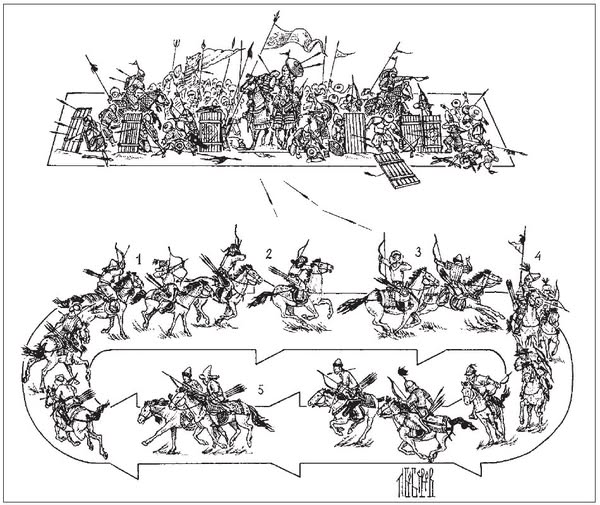
The main role in the performance of the classical tulgama (as in the «round dance») was given to massive archery. There is no mention of any «ramming» strike mentioned by some modern authors in the sources. Hand-to-hand combat was not excluded when performing the maneuver, but it was not an obligatory element of it. The main difference between the «roundabout» and the tulgam was that in the second case, priority was given to maneuver, and the enemy was shelled not only from the front, but also from the flank and from the rear. However, it cannot be ruled out that the tulgama could include (as components of the attack) and «round dances» of mounted archers. It should also be emphasized that the tulgama could be carried out both by flanking detachments and by the entire army.
It seems possible to distinguish three main varieties of the considered tactical technique: right-flank, left-flank and paired (double) tulgama. The most typical was the right-flank tulgama, in which the nomads attacked the enemy’s left wing with their right flank. The dominance of this type of maneuver is understandable, since in this case the attacking archers could freely fire at the enemy from the most convenient position (left-forward, left, and left-backward), which would be difficult if the enemy was to the right of the attacking cavalry.
A concise but very accurate description of the right-flank Crimean Tatar tulgam was left by M. Litvin (1550): «In battles they [the Tatars] are braver than the Muscovites, although their weapons are worse; at the beginning of the attack they always try to bypass the enemy’s left wing in order to more conveniently shoot arrows.» However, in some cases, in order to surprise the enemy, the maneuver was carried out by the left wing of the nomad army. However, due to the above reasons, the left-flank tulgama, all other things being equal, was less effective than its right-flank counterparncise but very accurate description of the right-flank Crimean Tatar tulgam was left by M. Litvin (1550): «In battles they [the Tatars] are braver than the Muscovites, although their weapons are worse; at the beginning of the attack they always try to bypass the enemy’s left wing in order to more conveniently shoot arrows.» However, in some cases, in order to surprise the enemy, the maneuver was carried out by the left wing of the nomad army. However, due to the above reasons, the left-flank tulgama, all other things being equal, was less effective than its right-flank counterpart. For example, during the November battles of 1655, the Crimean Tatars repeatedly repeated the left-flank tulgama, attacking the right flank of the Muscovites, however, they failed to achieve a solution to the tactical task.
Technologically, the most difficult was the double (paired tulgama), in which the flanking detachments bypassed the enemy’s army from two sides, closing it into a ring, after which they attacked from different directions. In some cases, the encirclement ring did not close to the end or even opened on purpose, provoking the blocked enemy to flee along this «saving» corridorhnologically, the most difficult was the double (paired tulgama), in which the flanking detachments bypassed the enemy’s army from two sides, closing it into a ring, after which they attacked from different directions. In some cases, the encirclement ring did not close to the end or even opened on purpose, provoking the blocked enemy to flee along this «saving» corridor. As soon as the enemy broke formation and rushed into the open passage, the nomads attacked and exterminated him. This technique required a high level of coordination of the flanking units, speed and accuracy of the maneuver.
An example of the effective implementation oxample of the effective implementation of the paired tulgama in the Crimean Tatar version is the second stage of the Konotop battle, which Muhammad Giray and Karach Bey played out in exact accordance with the Mongolian and Horde traditions of the XIII-XIV centuries. While the Cossacks and Poles tied up the Muscovite troops with a frontal battle at the crossing of the Kukolka River, the Tatar detachments crossed the river at Saranovka and, having made a right-flank attack, attacked the Muscovites from the flank and rear. At the same time, another Tatar-Cossack detachment crossed the river at Popovka and bypassed the enemy’s right flank. The paired tulgama has once again demonstrated its exceptional effectiveness and, according to the accounts of the participants in the battle, had a decisive influence on the outcome of the battle.
The Pole T. Korchevsky: «A considerable part of the army had already crossed the ferry, where only Moscow troops were stationed, and the khan bypassed them at another ferry to the rear. As soon as the khan passed behind them, confusion immediately became between them.» Don Cossacks E. Popov and E. Panov: «At that time, the Tatars, coming from both sides, struck at the sovereign’s military men and mixedThe Pole T. Korchevsky: «A considerable part of the army had already crossed the ferry, where only Mosco troops were stationed, and the khan bypassed them at another ferry to the rear. As soon as the khan passed behind them, confusion immediately became between them.» Don Cossacks E. Popov and E. Panov: «At that time, the Tatars, coming from both sides, struck at the sovereign’s military men and mixed up the sovereign’s military men.» «Advice from the camp»: «On the right wing and on the left, the horde crossed and captured the rear of this crossing from the Muscovites, who defended it.» Hetman I. Vygovsky: «The horde, attacking from the rear, mixed them up so much that there was almost no order left, they began to run away, and we drove them on their shoulders for a mile and a half all the way to Konotop, covering the fields with many corpses; and few of them escaped to the camps, as the languages we took confirmed to us.»
The double tulgama was used very successfully by the Crimean military leaders in the battle with the Ottoman army at Karasubazar in 1624. While the Zaporozhian Cossacks connected the Turkish Janissaries in the center with a remote battle,The double tulgama was used very successfully byhe Crimean military leaders in the battle with the Ottoman army at Karasubazar in 1624. While the Zaporozhian Cossacks connected the Turkish Janissaries in the center with a remote battle, the Tatar and Nogai cavalry bypassed the Ottomans from the flanks and began to bombard them with arrows. The threat of encirclement became one of the reasons for the flight from the battlefield, first of the Ottoman cavalry, and then of the infantry, a significant part of which was exterminated by the Tatars during the persecution. Faced with the Moscow, Cossack and Polish camps on the battlefields, the Horde tried to adapt the tulgama to fight them. For this purpose, the Tatar cavalry trotted or galloped around the enemy Wagenburg over and over again, showering it with simple and incendiary arrows. At the same time, both flat and mounted shooting was used, which made it possible to hit the enemy’s soldiers and horses inside the field fortifications: «A myriad army silently went to the camp, and when the distanc
Along with the tactical, the Crimean Tatar commanders also used an operational pair of tulgama. During the battle across the Oka River in 1572, Devlet Girey tied up the main Muscovite forces with an artillery duel, while the Shirins of Divey Murza and Nogai Tyagriberdi Murza crossed to the left and right of the unfolding battle, which eventually forced the enemy troops to begin retreating. The question of the manifestation of tulgam in the military art of the Nomads remains open. It can be assumed that its history goes back to the periods of late Antiquity and the early Middle Ages. However, the first detailed and reliable information about the use of tulgam by steppe military leaders dates back to the period of the Great Mongol Conquests of the 13th century.
It was difficult to find a remedy for tulgam within the framework of traditional medieval tactics. Relying on their superiority in terms of mobility and remote combat, the nomads could repeat the maneuver over and over again with impunity, slipping out from under the enemy’s counterattacks and raining down arrows on him. In the military-historical realities of the XIV-XVI centuries, it was possible to resist the tulgama only with the effective use of numerous flank guards («kanbul») in combination with autonomous reserve corps (the Battle of Kondurcha in 1391, the Battle of the Terek in 1395), as well as using significant ambush groups. Other methods of countering the light arched cavalry of the nomads (frontal attacks, flank breakthroughs, front reversal, etc.), as a rule, did not lead to the desired result (the battles of Vorskla in 1399, at Khoja Kardzan in 1501, etc.). The effective use of tulgam during the campaigns of the early 16th century became one of the key military factors that allowed the «nomadic Uzbeks» to defeat the Timurid armies and establish their control over Transoxiana. According to Z. Babur, who had considerable experience fighting the Dasht-and Kipchak nomads of the late XV– early XVI centuries, it was the tulgama that lay at the heart of the tactical art of the Turkic nomads of the region: «This very «tulgama» is a great art in the battle of the Uzbeks. There is no fight without a tulgama.»
At the other end, Dasht and Kipchak successfully used an identical tactic by the Crimean Tatars. At the same time, the local steppe commanders very skillfully combined this maneuver with other basic nomadic tactics. The most effective combination was a tulgama with feigned flight and ambushes (see continued). Evliya Celebi describes an example of using a tulgam to cut off an advanced cavalry detachment of the enemy, who risked pursuing the Tatars, who had run away.: «And while the infidels were advancing on us, the Tatars gradually bypassed them and reached the place where the despicable infidels left their camp with their marching camp two hours ago… At first, many thousands of their well-armed [Muscovite] horsemen set their horses on the khan’s troops, but the Tatars began to advance on them like the waves of the Indian Ocean and struck their quivers with their hands. There were shouts of «Allah! Allah!» and the clink of quivers. And the two armies converged with each other.» Another striking example is the first stage of the Battle of Konotop on June 28, 1659. At the very beginning of the battle, the advanced Tatar detachment attracted elite units of the Moscow cavalry under attack by the main Tatar forces hiding in an ambush. As a result of the right-flank assault, the Horde moved to the flank and rear of the Russian cavalry. The khan’s main forces and Adil Giray’s detachment closed the encirclement ring, as a result of which S.R. Pozharsky’s detachment was completely defeated.
Summarizing the information provided, it can be concluded that the main reasons for the high effectiveness of the Crimean Tatar tactical tulgama technique in the military realities of the XVI-XVII centuries were:
1-A rapid (often hidden) maneuver to cover the enemy’s flank(s) and enter the rear of enemy troops.
2-The advantage in speed (due to the numerous and high-quality horse park), which allowed the maneuver to be performed extremely quickly, making it sudden for the enemy’s military leaders.
3-The massive use of powerful compound bows in the equestrian system, which generally surpassed pistols and (to a lesser extent) carbines of Russian and Polish cavalrymen of the mid-17th century in range, accuracy, and firing speed. It was extremely difficult to resist tulgama in such conditions. Nevertheless, the commanders of the settled agricultural peoples gradually managed to find the right «key». The main way to combat the Tatar and Nogai tulgama was field fortifications and, first of all, the same fortified camp, behind the walls of which both cavalry and infantry units armed with firearms could hide.
Another way to fight the tulgama was to try to train cavalry capable of fighting the nomads on equal terms in a maneuverable steppe battle. However, for a long time such attempts ended in failure. It was risky to conduct dynamic equestrian combat at medium range, being inferior to the Tatars in the art of archery. Among the soldiers of the Russian cavalry of the «hundredth service», Polish and Lithuanian «Cossack» («pan-Siberian») banners, there were archers capable of fighting on equal terms with nomads in remote combat. The advantage of Russian and Polish mounted riflemen was reliable defensive armament. However, in large battles, there were several Tatar archers for one good Moscow or Polish archer, which immediately equalized the chances of opponents, or even gave odds to the steppe people. Dismounting and using firearms, the Cossacks and dragoons could drive away the Tatars, but it was simply impossible to overtake or, even more so, destroy the Tatar detachment by constantly dismounting.
As a result, the rule worked once again.: «There is no reception against scrap if there is no other scrap.» The Kalmyks have become such a «crowbar» in the hands of Moscow. The swift attacks of the Oirat spearmen significantly reduced the capabilities of the classic tulgam. The entry of the Kalmyks into the Russian-Polish war in the «Black Sea» and «Ukrainian» theaters of operations significantly changed the course of the steppe confrontation and played an important role in the successes of the Muscovite troops in the military campaigns of 1661-1665. As the Don, Yaitsky, and Zaporizhia Cossacks adopted the Kalmyk experience (mounted spearmanship, discharged formation, lava, etc.), their effectiveness in cavalry battles with the Tatars steadily increased.
In the middle and second half of the 17th century, the traditional tulgama began to change rapidly. Under the Oirat influence, the arc strike during a flank attack began to be increasingly complemented by a «spear launch», the role of which became more and more noticeable and effective as part of the maneuver. In this modernized form, the tulgama remained in the military practice of the Crimean Tatars until the middle of the 18th century. As for the Ukrainian Cossacks, they replaced bows and arrows with pistols and carbines and continued to develop and improve this tactic up to and including the 19th century.