
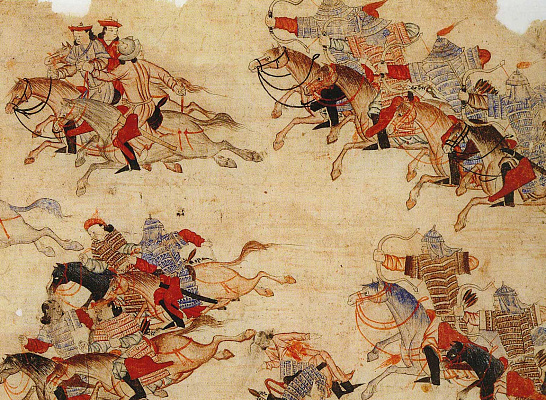
The Uighurs are well known in Chinese history. These are the descendants of Gaoju, who themselves came from the Xiongnu group. They have long had relations with the royal court of the Celestial Empire, which more than once assisted them in the fight against the Turks and instructed them to manage the «wild northern lands.»
Historians describe the new barbarian people as people «of low stature, proud and cruel, excellent horsemen and archers, more greedy than all the other steppe tribes.»
In 742, the Uighurs, Karluks, and Basmals rebelled against the Turks of the Second Khaganate and defeated them. By that time, they had already experienced the influence of China, borrowed the Chinese administrative system and became loyal allies of the Chinese.
The Uighurs came to power in the person of the Bilge clan leader from the Jaglakar clan, and 745 can be considered the year of the founding of the Uighur Khaganate.
They built their state on different principles than the Turks. Ten clans made up the Toguz-Oguz tribe, which was the leading but not the dominant one. The Uighurs subjugated the Basmals and Karluks and accepted them into their midst as equals; the six Tele tribes – Butu, Hun, Tayyrku, Tongra, Siche and Kibi – were equated with Toguz-Oguz in rights and duties.
The khan’s headquarters was located between Khangai and Orkhon. In the east, the borders covered Western Manchuria, in the west – Dzungaria. After the defeat of the Karluks, their eastern nomads on the Black Irtysh became part of the Uighur Khaganate. The Uighurs did not seek territorial gains: They’re tired of the upheaval.
Kagan Bilge recognized himself as a vassal of the empire. His son Mayanchur, who came to power in 747 through the resistance of the people who turned to the Khitans and Tatars for help, suppressed the uprising and crushed the enemy. In general, he was too eager to compromise, and this probably explains his successful conclusion of the civil war.
Mayancur has formed a mobile, well-trained army. The Arab historian Kuzhama wrote that ten Uighurs could handle a hundred Karluks. Mayanchur built up his power with his usual energy: in the spring of 750, he defeated the Chiks in the upper reaches of the Yenisei; in the autumn, the Tatars in Northwestern Manchuria; the following year, the Kyrgyz in the northwest. At the same time, some representatives of the defeated tribes joined the Uighurs, and they called them «guests.»
The Kyrgyz, who bordered the Uighur Khaganate in the north and who will be discussed later, resisted until 758. And although they were defeated and submitted, paying tribute to the Uighurs with sables, they did not lose their self-government. The western borders did not allow the Pecheneg Uighurs to expand, whose nomads at that time spread to the Lower Volga.
In 755, one of the commanders of the Chinese army, An-Lushan, a native of a noble Turkic family, raised in Sogdian culture, one of the most famous condottieri of Asia, led a strong detachment consisting mainly of Turks, rebelled against the imperial government and captured both capitals – Luoyang and Chang’an. The Son of Heaven had no choice but to turn to the Uighurs.
Mayanchur sent his son, Yabgu, to China. He defeated the usurper and returned to his country to participate in a campaign against the Kyrgyz (758). But in 761, civil war broke out again in Northern China. The Tang dynasty, ahead of its opponents, who were also going to appeal to the Uighurs, enlisted the support of the latter by paying in gold. Kagan Idigan personally, at the head of four thousand professional and ten thousand auxiliary soldiers, entered the territory of the empire and during the period from 762 to 770 restored order and saved the dynasty. I had to pay for it. The Chinese paid even more for the saviors to leave. The Turks have always been reluctant to leave the occupied Chinese lands. But the Uighurs left. And they returned only once more, in 790-791. An important page in history has been turned over.
A new page has opened. In 762, Yidigan met Sogdian-speaking Manichaean preachers in Luoyang, converted to their faith, and opened the doors of his kingdom wide for them. He took them with him and turned his capital into a magnificent walled city. The city built by the Uighurs on the banks of the Orkhon, the «city of the royal camp», then it was called Ordu-Balik.
It should be noted that after the fall of the Second Khaganate, Asia entered the era of a change of faith: nomads began to borrow culture and worldviews from the West, and not from China at all. The Uighurs adopted Manichaeism from Iran, the nomads adopted Nestorianism from Syria, Islam from Arabia, and theistic Buddhism from Tibet. True, Buddhism was adopted later, but the principle of borrowing remained the same – «anti-Chinese.»
Let us recall that the religion of Mani, Manichaeism, based on the opposition and coexistence of a good, bright principle and an evil, dark principle (both creative), was born in Babylon in the third century and spread throughout the world, including even North Africa, where it was preached by the future Saint Augustine before his conversion to Christianity. It came to Europe, giving rise to the Albigensian heresy, and to the Iranian world, which pushed it even further, to the Far East. The Uighurs made Manichaeism their state religion, and it had a strong civilizing effect on them. It should be emphasized that in some respects Asia was three hundred years ahead of Europe: Tibet became a theocratic power in the seventh century, and Uyguria became one in the second half of the eighth century. Manichaeism was closely linked to Sogdian culture, and Sogdian became the second official language of the empire along with Turkic, starting with the inscription in Sevray (762), which glorifies the happy outcome of the Chinese campaign and an equally happy conversion.
Gradually, a new writing system came into use, less adapted to their language than the old system used by the Turks, but transmitting many vowels. It originated from Sogdian graphics and existed for a long time in parallel with the Turkic runic script, to which the national religion gravitated. It was with runic signs, using a brush, that inscriptions would be made in the middle of the 8th century on the dangerous pass that leads to the Khoytu Tamir valley, and later several manuscripts would be written in the oases of Tarim. But in the end, it was replaced by a new alphabet and for several centuries was the basis of the first great national literature in the Turkic language. Even later, this script, which was called Uighur, was adopted by the Mongols and passed on to the Manchus.
Thanks to the Sogdian language, this still wild people came into close contact with the refined thought of Iran, and through it with the whole world of the Mediterranean. Of course, it is an exaggeration what is said in the inscription in Kara Balgassun (circa 810): «This country of barbaric morals, full of the smell of blood, turned into a country where vegetables were grown; this country, where they killed, became a country where they learned to do good.»
No religion has ever been able to completely turn its adherents away from their natural inclinations, in particular from violence. The history of the Uighur Khaganate is by no means peaceful and peaceful. At least two kagans fell at the hands of assassins, the fifth in 790, the eleventh in 832, and the twelfth committed suicide in 839 as a result of a rebellion organized by his minister. But meditation and religious life distracted some people from aggressiveness or weakened it, and large aggressive campaigns were followed by the flourishing of agriculture and trade.
By 800, it was an extremely important milestone for the Uighurs: colonies were founded in Serinda, Karachar, Beshbalik, Turfan, i.e. in the rich oases of Tarim, which were a kind of guarantee of the future.
As for relations with China, although they were peaceful, they cannot be called fruitful. After the campaign of 762-770, the Uighurs began to communicate on equal terms with their powerful neighbor and even treat him with contempt. If they provided invaluable services to the Chinese, for example, in the fight against the Tibetans, then they had to pay the price of a harsh Uighur protectorate, which was hardly tolerated by Chinese nationalists, priests and conservatives. The Uighurs demanded – and received – princesses as wives, imposed Manichaeism, and, even worse, introduced a system of exchanging livestock for silk at such a rate that a horse, which was not really needed by the Chinese, cost twice its real price, in other words, it was nothing more than a demand to pay tribute.. Intensive horse breeding in Uighuria involved either war or the export of horses. China preferred peace, and to a minister who complained about the hopeless situation in the country, the emperor once replied: «The people are constantly suffering from the lack of horses…» A truly royal answer!
No matter how sincere the Kagans’ conversion to the new faith was, no matter how strong their conviction, Manichaeism turned the masses away from their ancient beliefs no more than Buddhism did at the beginning of the era of the Turkic Empire. The relationship between Manichaeism and shamanism remained mysterious, although tolerance and cooperation were present in them, despite the fact that these two religions were inspired by completely different ideals. Perhaps the dichotomy of ancient shamanism, with all its parallels such as «heaven—earth», «east—west», «blue—black», was only reinforced by Manichaeism, which may explain a certain tendency towards dualism in some subsequent religious beliefs of the Turks. Anyway, it was in the Manichaean monastery in the tenth century that the book of prophecies «Irik Bitig», which dates back entirely to the traditions of the nomads, was written, similar to runic signs. The magnificent Oguz epic «Oguz-nameh», which is kept in the National Library in Paris and glorifies Turkic paganism. Finally, the great Uighur origin myth, which appeared in the Manichaean environment, but reflected traditional religious beliefs, became so widely popular that it was repeatedly mentioned by the Chinese, the Muslim Juwayni in the Mongol era, as well as another great Iranian historian, Rashid al–Din, Marco Polo; this myth He influenced the Oghuz, Caymans, Onguts, Kalmyk and Oirat Mongols, and many others. According to this myth, Idigan Kagan was born from a tree fertilized by a ray of light. This suggests that we are not talking about the primitive myth of the Uighurs, led by the Jaglakar clan, faithful to the Turkic traditions, but about a later myth that was finally formed at the beginning of the 9th century, during the change of dynasty and ascension to the throne of the Ediz tribe.
Let’s turn to the political relations between Uighuria and its powerful neighbor China.
In 778, Dezong, who was not friendly to the Uighurs, ascended the throne in China.
Yidigan Kaghan, knowing this, decided to force the new emperor to submission, and in the same year attacked Northern China, but the war ended with the retreat of the Uighurs. This loss was due to the fact that in 15 years, i.e., from 764 to 780, the population of China grew by half a million souls, which allowed the creation of an army of 768 thousand people.
After the defeat, the Uighurs were allowed to live in the capital as «guests», but in 780, Dezong expelled them from China. However, at the border, it was discovered that the Uighurs were taking Chinese girls away in travel bags. Border troops cordoned off the Uighur camp, took away the girls, and executed the «guests.»
The emperor, realizing that the Uighur kagan would demand Chinese blood, sent an ambassador with explanations and apologies.
At that time, power in Uighuria was usurped by Kutlug, and in 781 the new kagan (from the nobles) took a ransom for the death of the «guests», and in 783 a peace treaty was concluded on the following terms: 1) the kaghan was called a vassal of China; 2) the embassy of Uighuria should not exceed 200 people; 3) no more than a thousand horses were brought for forced bargaining; 4) it is forbidden to take Chinese abroad. The treaty was sealed in 788 through marriage and alliance against Tibet.
In 789, Uighuria became an elective monarchy, and in fact it turned out that it was not the Uighurs who depended on the Chinese, but the Chinese who depended on the Uighurs.
The Uighurs went to war with Tibet, and for three years they prevented Tibet from advancing into northern China. The Uighurs won a three-year campaign, but when they returned to their native steppes, they needed to suppress pro-Tibetan sentiments among the Karluks, the Turgesh, who were part of the Uighur Khaganate. In addition, the Kyrgyz revolted in the rear of the Uighurs, who retained their autonomy in 758. Chinese sources note: «Kutlug managed to suppress the Kyrgyz, subjected their country to defeat, and their state affairs stopped, there were no living people on their land.» This is obviously greatly exaggerated, but nevertheless, after the defeat for 20 years, that is, until a new generation grew up, the Kyrgyz were not heard of.
Once again, the Uighurs joined the war with Tibet. They remained victorious, and the city of Beshbalyk again passed to them, then the Uighurs killed the Tibetan corps under the Pile. However, the Chinese of Kuchi turned out to be ungrateful and began to bargain about the amount of tribute for the release. The Kagan went against the miserly allies, who were defeated and fled all the way to Ferghana. On the shores of Naryn, the Uighurs overtook the fugitives and robbed them clean. The survivors «tearfully begged and begged» to accept tribute from them, to which the Uighur kagan graciously agreed.
Thus, the remnants of Chinese possessions in the west became part of the Uighur Khaganate.
Further, the Uighurs defeated the western and eastern Karluks and the Tibetan army supporting them. All these events took place from 795 to 805.
Thus, the Tibetan army was unable to crush the Uighur-Chinese coalition. In 816, the Tibetans launched an army against the Uighur capital of Karakorum. They timed it well: a Kyrgyz uprising broke out in the rear of the Uighurs, this time successful for the latter.
China took advantage of the humiliation of the Uighurs and in 817 expelled the Uighur embassy, consisting of the Manichean clergy. The Confucians waged an active struggle against both mysticism and nomadic culture, but here both were evident. The expulsion of the embassy meant the breakup of the Sino-Uighur alliance. But since Tibet continued to be a formidable enemy, in 821 the union of China and Uighuria was restored and sealed by marriage. In the same year, the Tibetans asked for peace, and a treaty was concluded with some losses for Tibet.
Meanwhile, Uighuria was tied hand and foot by the war with the Kyrgyz, whose leader Azho declared himself khan and told the Uighur kagan: «Your fate is over. I will soon take your golden horde, place my horse in front of it, and plant my banner. If you can compete with me, then come immediately, if you can’t, then leave immediately.»
The question arises: why did the Uighurs encounter much stronger resistance from the tribes that were part of the khaganate than all the other Turks? It is quite obvious that religious intolerance has become a sign of the era not only in Tibet and the Arab Caliphate, but also in India, China and Uighuria.
The Chinese teachings of Taoism, Confucianism, and even Chan, contemplative Buddhism, were not assimilated by the nomads. Islam was the religion of their enemies, the Arabs. The cult of Mitra, bon, was experiencing severe persecution in Tibet at that time and did not at all respond to the sentiments of the Uighurs. But the steppe people liked Christianity and Manichaeism.
At one time, the Turks simply demanded submission and tribute, and these states forced the vanquished to break the whole structure of their psyche and the whole way of their lives; they imposed on the nomads such ideas that they could neither understand nor accept. Therefore, Uighuria was surrounded by enemies, and reconciliation was impossible.
For example, Manichaeism considered the highest virtue to be dissatisfaction and even rejection of life, irreconcilability with everything carnal, the combination of asceticism and debauchery, as a result of which the family was not blessed. How could this be explained to the common people? Therefore, only aristocrats could be genuine Manichaeans, while the rest were only called them. As a result, there was a gap between the people and the nobility.
The wars with the Tibetans, Karluks, and Kyrgyz became a struggle for faith.
But the most disastrous consequence of Manichaeism was the destruction of the family: the family began to degenerate.
The process of degeneration is not fast – it takes at least three generations, i.e. 80 years. That’s how long Manichaean Uighuria lasted. However, there were positive aspects to Manichaeism, such as familiarization with Western culture. Historians, in particular Ibn Khordadbeg, describe Uyguria as the most extensive and cultured of the Turkic countries. The weakening of the power of the Uighur empire is indirectly indicated by the fact that no major events took place there before 839.
So, by the middle of the 9th century, the power of the Uighurs was already in the past. The tribes fell away from the Uighurs: in 794 the Chateau tribe departed, in 835 the Tatabs. And of course, the worst thing for the Uighurs was the Kyrgyz uprising.
Already in 841, the entire Khalkha, Karakorum, and all the treasures of the Uighurs were in the hands of the Kyrgyz, and only the militant spirit of the Uighurs pushed them to further resistance.
It is important to emphasize here that the defeat of Karakorum was an event of the same magnitude as the fall of Constantinople in 1453, and the Uighurs were as talented, receptive, and heroic as the Byzantines of the Paleologian era.
So, in 842, China mobilized an army against the Uighurs, and they were defeated and driven back from Ordos to Manchuria, but the Kyrgyz khan, having learned that the Uighurs were sheltered by Tatars, came to Manchuria and destroyed the fugitives.
The destruction of the Uighur empire was not only a military and political action: after its defeat, the Chinese set fire to all the «books of the jews», and their property was taken to the treasury. The defeat of Manichaeism later opened the way for Buddhism.
Nevertheless, in 861, a small Uighur principality was created. Eventually, they settled in the northwest of China, in the present-day province of Gansu, mainly in the area of today’s Turfan, where they founded two independent small appanage principalities; the first, in all likelihood, was headed by the old imperial dynasty of Orkhon – Jaglakar.
Following the fall of the Uighur Empire, the extermination of a large part of the tribes, and migration to the oases, there was a prolonged confrontation with the Tibetans. The latter exerted strong pressure on the entire Tarim basin after the Battle of Tafei Chuan (679). Now the Uighurs could afford to maintain only a small army to deter the attacks of their neighbors: from the north they were threatened by the Karluks, the masters of present-day Dzungaria, from the west by the Yagma and Chigili tribes, about whom fragmentary information left by the Muslims remained. by the authors.
China maintained peaceful relations with the Uighur principality of Gansu and treated it with respect for a long time, especially since the Uighurs regularly paid tribute and were officially dependent on China due to the Chinese fortified area centered in Dunhuang. However, these ties gradually weakened. The Chinese accused the Uighurs of riots, robberies, and thousands of other sins of all kinds. Finally, in 1028, the Tanguts, who were close to the Tibetans, seized the lands of the Uighurs in the most brutal way and thus put an end to the existence of their principality. However, some of the population remained in place, although they ceased to play a political role, but retained their language and some cultural traditions. Another found refuge nearby, in the south by the Wang Shan, and settled among them.
The Uighurs of Ganzhu were sometimes called Sary-Uighurs (yellow Uighurs), or also «Uighurs with a yellow head.» They received this name, which they retained, «because of their Buddhist faith.» However, it should be noted that some Turkic peoples specifically specified their name by a «color attribute»: blue, red, black, yellow, and these definitions always had mythical or mystical meanings in shamanism, in connection with the sun and moon. In fact, the Sary Uighurs are Turks who have converted to the Buddhist faith, tribes that are more «Uighurized» than real Uighurs.; They are natives of the Middle Tarim basin, who were gradually displaced to the east as a result of the advance of Islam and mixed with the true Uighurs of Gansu after the Tanguts destroyed their principality. In the XI century . they lived in the area of Khotan; in the 14th century– between Tsaidam and Cherchen; only in the 17th or 18th century did they settle south of the route leading from Si Cheu to Ganzheu.
The Uyghur principality of Xinjiang remained in great isolation from China, from which it was separated by the Uyghur Gansu, which later became the Tangut state of Gansu. The Chinese chronicles mention only a large embassy sent from there in 951, but the details of this enterprise are unknown. However, Xin-Kian’s fate turned out to be happier. It flourished until the era of the Mongol Empire, to which it joined, and the Mongols not only spared it, but also showed it great favor. Once this principality was under the influence of the Khitans, and then, on the contrary, it laid the foundations of the culture of the Mongol Empire and supplied it with administrative personnel. As a result, it outlived the empire itself for many years.
The fact is that the cultural level of the Uighurs was much higher in the oases at the end of the 9th century than in Northern Mongolia, higher than in later times. Already in the first half of the 9th century . They have fully experienced the beneficial effects of civilization. There is no reason to believe that they made any attempts to reduce its impact or transform civilization altogether. They turned out to be good students and even became mentors in some ways. At least, the famous art school of Central Asia continued to exist, as it had existed before their appearance. They inherited it. They took her into their care. In Southern Kashgaria, such centers as Tumshuk, Kyzyl, Kumtura, Shortuk, Beshbalyk, Murtuk, were once milestones on the way of advancing Buddhism to the east. In Dunhuang, Gansu province, where there were more achievements and where there were no signs of decline over the long period between the fifth and 13th centuries, the Chinese brought nothing new, and when the Uighurs settled the city and the entire province again, they found nothing new. It was the same with art.
The situation in literature was similar. There were almost no original works, but there was an abundance of translations. They occupied a very respectable place in the works of Turfan writers, and the most ancient works date back, perhaps, to the 8th century. Later, dating from the 10th century, represent the first texts of Dunhuang, which is explained by the Tibetan occupation of the oasis, which lasted until the 9th century, as well as the absence of Turkic colonization.
To the Tangut invasion in 1028, we owe a rich collection of paintings and multilingual manuscripts, mostly Chinese, as well as Turkic, which were kept in the archives of a monastery in a cave that served as a shelter in Dunhuang, and discovered in 1900.
In 1907, Sir Orel Stein visited here, and in 1908, Pelliot; today, the British Museum and the National Library have thousands of pages, most of which have not yet been published. They belong to a wide variety of genres, and are often written in the form of personal notes, exercises, or business letters; however, there are also edifying tales and religious treatises, most of them translated from foreign languages such as Chinese or Sanskrit.
Plastic arts and literature attest to the vitality of Buddhism. There is reason to believe that the Manichaeism of the Uighurs gradually gave way to Buddhism, although it still remained. We owe him a significant collection of religious texts found during German excavations in Turfan and Dunhuang, as well as the so-called «Collection of Penitential Prayers», written, as was customary in that era, in simple and clear language.
As for Buddhism, he also gave us many manuscripts in Turkic, Uighur graphic, Sogdian and Indian (Brahmi) languages. Among them, one can single out the «Tale of the Good and Evil Princes», inspired by Chinese legends: it was studied already in 1914.
Along with Buddhism, Manichaeism, and shamanism (it should be remembered that they all existed simultaneously and independently of each other), other religions were widespread in Xinjiang and Uighur Gansu, in particular Nestorian Christianity. It is known that Nestorianism, the doctrine of Nestor, Patriarch of Constantinople, asserts that two people lived in Christ, corresponding to his dual nature or two different natures. After this faith was condemned by the church council in Ephesus in 431. and after the persecution she experienced in the Mediterranean countries, Nestorianism found refuge in Sassanid Iran and directed its missionary efforts to the east. We do not know when it penetrated into Central Asia, but it appeared in China in 635 and did not last long. But it has firmly established itself in Tarim, which has become its apostolic center aimed at large nomadic states: its success in Mongolia is obvious. Muslim sources mention the existence of Christian communities in the tenth century. in Xinjiang, German expeditions collected many Nestorian texts in the Turfan area that resemble texts discovered by Pelliot in Dunhuang Cave, such as «Praise of the Holy Trinity.»
Mazdaism and Judaism have left fewer traces in Central Asia. The presence of the former in Turfan is confirmed by Muslim sources, and the Chinese mention Zarathustra and the existence of sacrificial altars dedicated to fire. The presence of the second one is more reliable, as proved by Judeo-Persian documents from Kashgaria and a Hebrew manuscript from about 800, which Pelliot found in Dunhuang. However, their activity was limited. Finally, Islam, which was supposed to triumph in these regions, was still poorly represented at that time, although Muslim merchants, messengers and Sufis had long been roaming the country.
In short, it was an amazing company! In the same city, which was not a megalopolis at all, adherents of at least three great world religions – Manichaeism, Buddhism and Christianity – lived side by side, not counting the animal cult, the ancient national religion of the Turks; Jews, Muslims and Zoroastrians freely preached in the streets and squares, while simultaneously engaged in trade. One can only admire the fact that tolerance and ecumenism, imbued with inevitable skepticism or relativism, were more popular than strict and unbending sectarianism. We do not know of a single example comparable to that of the Uighurs, and obviously this can only be found in other Turkic or Mongolian societies related to the Uighur.