
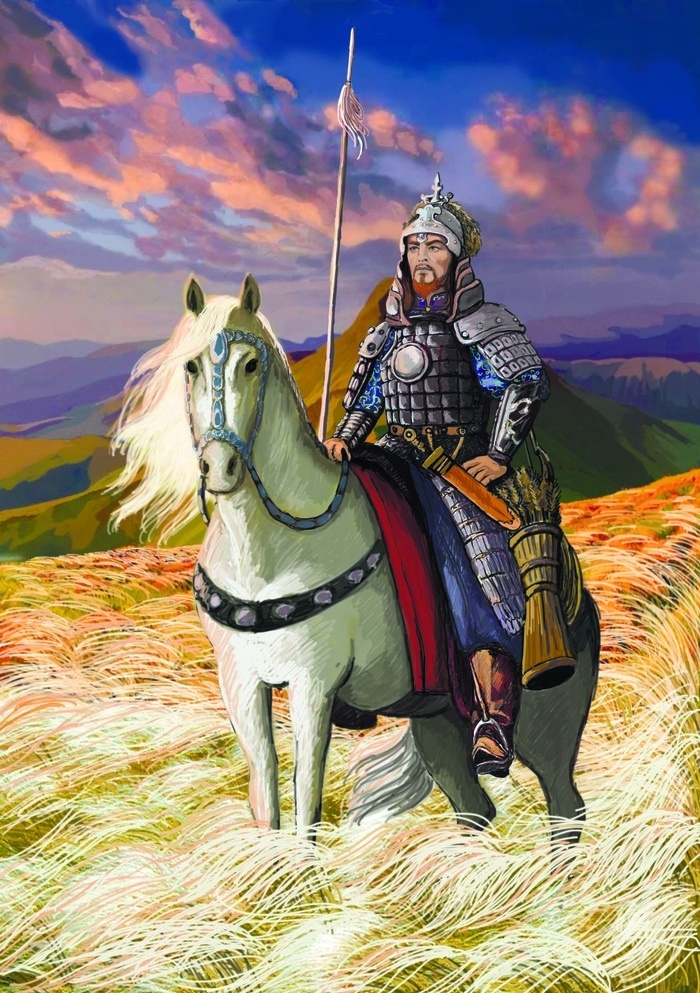
«Symbolic battles» for «national heroes» between historiographies of different countries have long been known in history
Moreover, supporters of different national schools a priori record these heroes in the camp of their symbolic ancestors, attributing to them a clear national identity. Moreover, according to adherents of this approach, national identity dominated religious and tribal identities. In my opinion, in the pre-industrial era, on the contrary, tribal and religious identities dominated. Russian Russians and Ukrainians consider the ruler of Kievan Rus, Vladimir Krasnoe Solnyshko, to be one of their own, although in fact he identified himself more with his family (Rurikovichi) than with modern Ukrainians and Russians. The same applies to Edige, whom Nogais, Kazakhs, Tatars, Karakalpaks, and others consider their «ancestor,» but in fact he was dominated by both his ancestral identity (from the Mangyt clan) and his religious identity (Muslim). An interesting character who had such a borderline position was Zhalantos-batyr (in Uzbek sources he is referred to as Yalangtush). His position can easily be described as «One of his own among strangers, a stranger among his own.» Kazakh historians call him the Kazakh batyr, who, together with his father, left at the end of the 16th century to serve the Uzbek khans. Uzbek historians deny Yalangtush’s ties with the Kazakhs, believing that he did not serve the Kazakh khans for a single day, but on the contrary devoted half his life to fighting the Kazakh khans and sultans. These two polar points of view exist in parallel, with Uzbek historians ignoring Russian sources, and Kazakh historians unaware of information from Central Asian sources (for example, Bahr al Asrar).. Unfortunately, in Kazakhstan, the figure of Zhalantos has been overgrown with all sorts of myths and legends (for example, episodes from the youth of Zhalantos, etc.), which distort the true picture. At the same time, Kazakh historians do not know much about the political activities of Zhalantos and his wars with the Kalmyks, Iranians and Indian troops. In this article, we wanted to show the real life story of Zhalanthos. Below we will use the spelling Jalantos, despite the fact that the spelling Yalangtush is more correct, this choice is due to the fact that no one knows Yalangtush Bahadur in Kazakhstan, and the spelling Jalantos is well known.
Below we will outline the main milestones of Zhalantos’ biography.
1. Zhalantos came from the Golden Horde family of Alshin. He was a descendant of Seitkul, the son of Tokban, the son of Oraz, the son of Karamashak, the son of Alim, the son of Kayyrbai, the son of Kuduar, the son of Alau. Thus, Zhalantos was a descendant in the 8th tribe of the Golden Horde Emir of Alau, a contemporary of Khan Janibek (1342-1357). According to Radik Temirgaliev, Alau’s son Kuduar is a well-known character in Russian folklore, the robber Kudeyar, who was mentioned even by Nekrasov N.A. in the poem «Who lives well in Russia»:
There were twelve robbers,
Once upon a time there lived a Kudeyar chieftain.
The robbers spilled a lot
The blood of honest Christians.
2. The etymology of the name Zhalantos is interesting. According to one version, this name can be translated as «Smooth stone». In our opinion, this name can be translated as «Bare chest». Most likely, this is a nickname, and it was received for the fact that in battle, apparently in his youth, he was without armor (perhaps due to poverty) covering his chest. As we will see below, the Muslim name of Zhalantos was Nizam ud-din.

3. According to Uzbek sources, Zhalantos’ father was called Boykhoja, in Kazakh shezhir he is named as Seitkul. In fact, this contradiction can be easily explained. The steppe people often had several names. For example, the famous Kabanbai batyr is also known as Yerasyl and Daraboz. It often happened that a person’s name was replaced by a nickname. The same situation could have been with Zhalantos’ father. Boy-khoja (Bai-khoja) could be a name, and Seitkul («Seyid’s slave», i.e. «a slave of a man from the descendants of the Prophet Muhammad») was an insulting nickname received for serving Khoja Hoshim Dagbedi (a descendant of Makhdoom Agzam). As is known from Shejir, Mahmud Agzam (the ancestor of Khoja Hoshim Dagbedi) came from the family of Seyid-Khoja, a subdivision of Kilishty-Khoja. Therefore, the nickname Seitkul meant «a slave of a man from the Seyid family» (Khoja Hoshima Dagbedi). The classic examples of Muhammad-Hanafia Valikhanov (better known as Shokan Valikhanov) and Ibrahim Kunanbayev (better known as Abai Kunanbayev) also testify to the existence of such a tradition when the nickname replaced the official name.
4. The political biography of Zhalantos is very interesting: As we know, Zhalantos was the emir of Bukhara, who served the Uzbek khans. In 1607, he was appointed atalyk of Tashkent under the Kazakh Genghisid Shah Said. In the first half of the 1610s, Zhalantos fought against the Kazakh khans and sultans.
At the end of 1614, Zhalantos raided Iran. Zhalantos’ troops ravaged the outskirts of Mashhad. Without receiving reinforcements and permission from Imamkuli to engage in battle with Shah Abbas, Zhalantos retreated to the Bukhara Khanate.
In 1619-20 (according to another version, in 1622-23), the pretender to the throne, supported by Iran, invaded the Bukhara Khanate. Some time later, Zhalantos came out against him with his army and Khazar allies. Zhalantos set off to pursue the pretender, but could not catch him, while he was able to capture the rich booty, which he sent to the Bukhara Khanate.
In 1623, Zhalantos built the Chatur fortress near Ghazni (modern Afghanistan), from which tax collectors could collect taxes from local Hazaras. In the end, it ended in a war with the Indian Emperor. In 1628, Zhalantos participated in the siege of Kabul, after which he rebuilt the Bamyan fortress.
In 1628, after the death of Ishim Khan, Abuli Sultan seized power in Tashkent, who began to recite the khutbah in his own name. Imamkuli summoned Zhalantos from Balkh, who had just returned from Bamyan. Abuli fled to Kashgaria. Zhalantos captured Tashkent. In 1632-33, Zhalantos, together with the future Khan Abd al Aziz, participated in a campaign against Khorasan.
In 1635, Zhalantos was sent by Khan Imamkuli against the Kazakhs. Zhalantos besieged Murat Sultan (son of Tauekel Khan) in the city of Pskent. Murat recognized the power of Imamkuli, after which Zhalantos captured Tashkent.
In 1638, Jalanthos sent gifts to the Emperor of India in the amount of 10,000 rupees, after promising to live in peace with the Moguls, the Emperor of India granted Jalanthos 20,000 rupees and 3,000 rupees to his envoy.
In the summer of 1638, Nadir Muhammad sent Zhalantos to raid Khorasan. In 1639, Indian troops attacked Bamyan and the Hindu Kush, Nadir Muhammad sent Zhalantos with 3,000 soldiers to scout the situation and confront the Indian troops. On July 2, 1639, in the first skirmish, the army of Jalantos defeated the Moguls, killing 80 people and capturing a large number of Moguls. On July 14, instead of congratulations, Zhalantos received orders to avoid battle. He was disappointed, but he had to obey the order. In the summer of 1640, the son of the Indian Emperor tried to raid the possessions of the Bukhara khans, but the instant reaction of Zhalantos forced the prince to leave the territory.
Zhalantos’ son emigrated to India in 1640. In August 1640, Nadir Muhammad promised the Russian tsar to send Zhalantos with 12 emirs and 50,000 troops against the Kalmyks. In February 1641, Zhalantos gathered an army to march on Khorasan. But the campaign did not happen because of the uprisings in Tashkent and Badakhshan. Jalanthos went to suppress them. After the suppression, the troops launched a raid on the Kalmyks in the spring of 1641.
After the accession of Nadir Muhammad, Zhalantos lost his lands in Afghanistan, but gained a high status in Bukhara, becoming the second person in the khanate after Khan.

In 1643, the Kazakh khan Dzhangir with 600 soldiers opposed a huge army of Dzungars (from 25 to 50 thousand soldiers) and asked for the help of the Bukhara Khan. He sent the army of Zhalantos from Bukhara, the army of his son Abd al Aziz from Samarkand and the army of Abdrakhman Uysun from Andijan to help him. By the end of the battle, only the army of Zhalanthos managed to approach. The arrival of the 20,000 troops of Zhalantos helped the Kazakhs to defeat the Dzungars. Having lost 10,000 dead and 1,000 prisoners, the Dzungars retreated.
In this operation, Zhalantos is recorded in Russian sources as an associate of Jangir Khan and a man who roams next to him. Moreover, it is worth noting that Russian sources link Zhalantos and Dzhangir. If the Dzungars are going against the Kazakhs, then they will definitely go against Jangir and Zhalantos. It is worth noting here that Zhalantos came from Bukhara to help Jangir, while Abdrakhman Uysun came from Andijan. At the same time, Zhalantos was faster than Abdrakhman. Apparently, this speed had other motives besides the khan’s order. If one agrees with the fact that some Kazakh nomads were «nomads of Zhalantos», then taking care of their nomads was an additional motive for such a rapid movement of the army of Zhalantos. Of course, these «nomads of Zhalantos» were the lands of the Alshin clan (apparently a subdivision of Bayuli-Alshin, which became part of the Kazakhs in the first decade of the 1600s), which recognized the leadership of the famous emir and a relative of Zhalantos (the leaders of Bayuli-Alshin were 6-8 cousins of Zhalantos, that is, by medieval standards, close relatives). Thus, Zhalantos had possessions both in different parts of the Bukhara Khanate (also in the Balkh possession on the territory of modern Uzbekistan and Afghanistan) and in the Kazakh Khanate (apparently the lands of the Alshin clan in the lower reaches of the Syr Darya River).
In 1647, Zhalantos fought with Abd al Aziz against the Indian troops. The Indian emperor decided to offer Zhalantos a bribe of 30,000 tumans (from 3,750,000 to 4,285,714 tangas or from 165 thousand to 257,142 rubles). In return, they demanded to leave Balkh province, but Zhalantos refused. After being refused, the Indian troops attacked. In a battle that lasted a whole week, Jalanthos lost a huge number of men. After that, Zhalantos began to ask for help from Abd al Aziz, also offering to make peace with the Kazakh Khan Dzhangir, so that the released military contingents would be transported to Balkh to help him.

After that, the Kazakh sultans join the army of Abd al Aziz and, together with him and Zhalantos, fight against the Indian troops. In the summer of 1647, Abd al Aziz sent Zhalantos as a negotiating ambassador to the Indian Emperor Aurangazeb. As a result, the Indians lost the war in 1647 to a united army led by Abd al Aziz, Zhalantos and the Kazakh Khan Jangir. After this war, Zhalanthos disappears from the pages of chronicles as an active political figure. He died in 1656. After the death of Zhalantos, his family began to lose «political weight.» Shortly after Zhalantos’ death, his close relatives belonging to the Alimuly-Alshin division became subjects of the Kazakh khans.
5. It is also worth noting that Zhalantos was very famous in Russian historiography as a philanthropist who built the majestic mosques Tillya-kari and Sher-Dor (Shirdar) in Samarkand.
6. The great-nephew of Zhalantos, Aiteke-biy, is known as an associate of the Kazakh Khan Tauke. Most likely, part of the Uzbek Alshins left during the early reign of Tauke (or during the time of his predecessor Khan Batyr) to the Kazakh Alshins (Bayuli division), who passed to the Kazakhs in the early 1600s from the Edisan Horde (part of the Nogai Horde). Interestingly, the mausoleum of Ayteke biya (1644-1700) is located in the city of Nurata in Navoi region of Uzbekistan, which shows the strong ties of Alshin-Alimuly with Uzbekistan. Today, the descendants of Zhalantos live in the Kyzyl-Orda region of Kazakhstan (the Tortkara clan of the Alimula subgenus of the Alshin family), in some parts of Uzbekistan. According to the Kazakh shezhirs, the descendants of Kudainazar, the son of Zhalantos, live in the Tamdyn region of Bukhara region. According to oral consultations of Uzbek researchers, the descendants of Uzbek Alchins live in the town of Juma in the Pastdargam district of the Samarkand region. Also, apparently, some of the descendants of Ayteke biya live in the city of Nur Ata.
Summing up, it is worth noting that in Kazakh historiography, it is customary to consider Zhalantos as a Kazakh batyr from the Alshin-Alimuly-Tortkara clan. Whereas in Uzbek historiography, it is customary to call Zhalantos Uzbek. In Russian sources, Zhalantos is generally called a Tatar prince. In the pre-industrial (agrarian) era, there were always several identities, with the tribal identity dominating the political one at that time. In the 16th century, the Nogai Murzas, depending on different political circumstances, could become Kazakhs (subjects of the Kazakh khans), Crimean Tatars (subjects of the Crimean Khans), Uzbeks (subjects of the khans of Khiva or Bukhara) or remain Nogais (subjects of the Nogai biys), but they did not change their ancestral identity. Thus, the ancestral identity prevailed and dominated over other identities. Therefore, Zhalantos did not feel like a Kazakh or an Uzbek in the modern sense of these terms, he considered himself an Alshin (alchin), a descendant of the Golden Horde emir Alau, and only then did he manifest his religious (Muslim) and political identities (a subject of the Uzbek khans of Balkh and Bukhara). Zhalantos was originally an Uzbek emir (who fought with the Kazakh sultans and khans), later some Kazakh nomads (apparently of the Alshin family) came under his control, therefore he is also called the Kazakh batyr. We can call Zhalantos an Uzbek emir from the Alshin family, who spent most of his life serving the Bukhara and Balkh khans. But at the same time, at the end of his life, Zhalantos became an ally of the Kazakh Khan Dzhangir and was the de facto ruler of the Kazakh Younger zhuz (Alshin clan). Given the pre-national nature of ethnic formations in Kazakhstan and Central Asia, attempts to «privatize» and declare Zhalantos only an «Uzbek» or only a «Kazakh» statesman are not scientific. Of course, most likely two types of identity dominated Zhalantos (generic: Alshin and religious: Sunni Muslim). Politically, Zhalantos was for a much longer time an «Uzbek», that is, a subject of the Uzbek khans of Bukhara and Balkh, than a «Kazakh», a subject of the Kazakh Khan Dzhangir. Moreover, it is difficult to call Zhalantos a subject of the Kazakh Khan Dzhangir. Rather, in the fight against the Dzungars and Kalmyks, they were more allies, while in military terms, Zhalantos had slightly more forces than Jangir. Therefore, Zhalantos can be called a common character in Uzbek-Kazakh history, whose descendants live in both Kazakhstan and Uzbekistan (possibly also in India).