

The more you read about Batu Khan’s invasion, the more one peculiarity stands out—one that, for some reason, is rarely discussed openly…
Russian cities were literally littered with bodies after the sieges; archaeologists are still finding mass graves, but the oddity is that there are almost no remains of the Golden Horde fighters themselves near these sites. And the strangest thing is that we’re not talking about a single city, but all of them at once!
So where did the bodies of the non-Russian warriors who marched through half of Rus’ “vanish” to? Let’s take a closer look at this very strange story.
The Institute of Archaeology of the Russian Academy of Sciences conducted excavations in the historic center of Yaroslavl from 2004 to 2013, and returned again in 2017. Strangely enough, the findings there confirmed what the chronicles had been saying all along. In February 1238, the Mongol-Tatars did indeed ravage the city.
At the site of nine destroyed buildings, mass graves were found containing the remains of about three hundred people—men, women, and children—with multiple stab and hack wounds. There were no Mongol remains in these graves!
Neither in Yaroslavl, nor at the walls of Vladimir, nor on the ashes of Ryazan. The army that destroyed dozens of cities seemed to have left no dead behind, or were there none at all…?
The bones showed signs of stab wounds, blunt force trauma, and lacerations. Some, judging by the condition of the skeletons, were burned while still alive. It should also be noted that burials began only several months after the deaths. The city stood empty all that time—there was no one to do it. Evidence of a Mongol attack includes Asian-style arrows, the nature of the wounds, and the age of the victims found. DNA analysis showed that three generations of a single family lie in one of the pits. Among the hundreds of identified skeletons, anthropological data did not reveal a single Mongolian remains. Period.
These are the first archaeologically documented mass graves of this scale, the victims of the 1237–1238 invasion of Northeastern Rus.
So where did the Mongol remains go?
The explanation may lie in the very system of Mongol sieges. To understand this, one must know about a certain Mongol combat tactic. In medieval sources, “hashar” refers to captives whom the Mongols used during the siege of fortresses. They were rounded up from villages, hamlets, and previously captured towns and driven unarmed to the front of the walls. Rashid al-Din recorded in his Compendium of Chronicles that the prisoners were divided into tens and hundreds, with a Mongol placed at the head of each ten. Discipline was maintained through fear. If any prisoners returned, they were immediately beheaded.
Even before advancing into Rus’, in 1236, the Mongols had conquered Volga Bulgaria, and the inhabitants of that state had swelled the ranks of the hashars long before the first encounter with Russian cities.
The army approached Ryazan with a ready-made hashars from the Volga region—people captured during the conquest of Bulgaria and deliberately kept for siege work. According to historian V. N. Tatishchev, by that point there were more prisoners than Mongols themselves.
It is worth noting that this very same hashars did not merely perish beneath the walls. They built siege platforms, filled in moats, and dragged battering rams. The people were worn out even before the assault, from hypothermia and starvation, for the slaves were fed just enough to survive until the moment they were needed—and no longer.
This pattern repeated itself from city to city. So the hashars began long before the army reached the city walls. The Mongols approached Ryazan on December 16, 1237, and took it by storm on December 21. Mass graves were later uncovered there as well, and no Mongol remains were found among them. The same pattern.
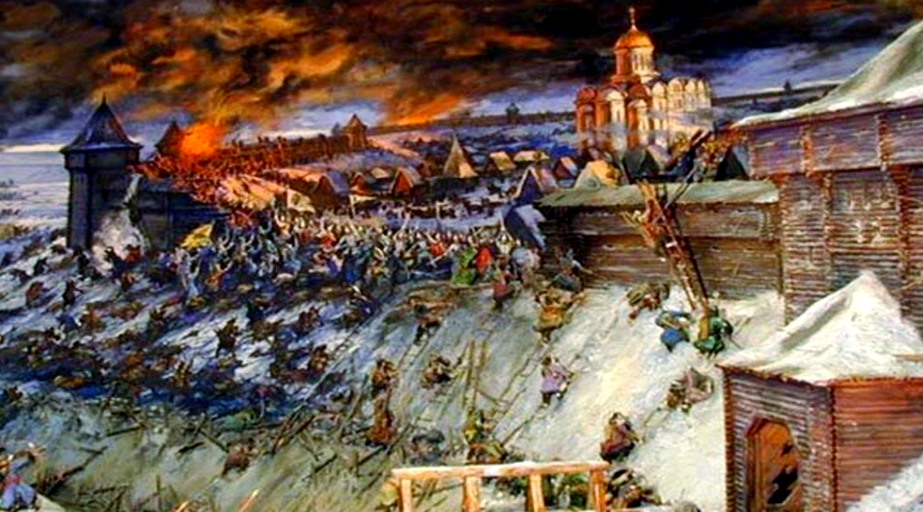
The reason for this repetition is simple. Without the hashar, the Mongols did not begin the assault on a fortified city. During the siege of Vladimir, Batu waited from February 3 to 7, 1238, until Burundai’s tumen captured Suzdal and brought the prisoners. The largest city of Northeastern Rus’ fell after a siege from February 3–8. The wait was not out of caution. Vladimir’s ramparts reached ten meters in height in some sections, and the walls at the Golden Gate later withstood the first barrage of Chinese siege engines. The Mongols did not need a mere human shield; they needed living workers to fill in the moats. As sad as that may sound…
When the people of Suzdal were driven to the walls, they were forced to fill the moats with branches and drag the battering rams into position. The Russian archers saw their own people before them. On the night of February 7, a palisade was erected around the city, and stone-throwing machines were positioned opposite the walls. This means that at the moment of the decisive assault, most of the people at the walls of the largest city in Rus’ were not under fire from the Mongol defenders.
Yet one siege broke this strict pattern. Kozelsk did not fit this pattern. It held out for seven weeks, setting a record for Batu’s entire campaign.
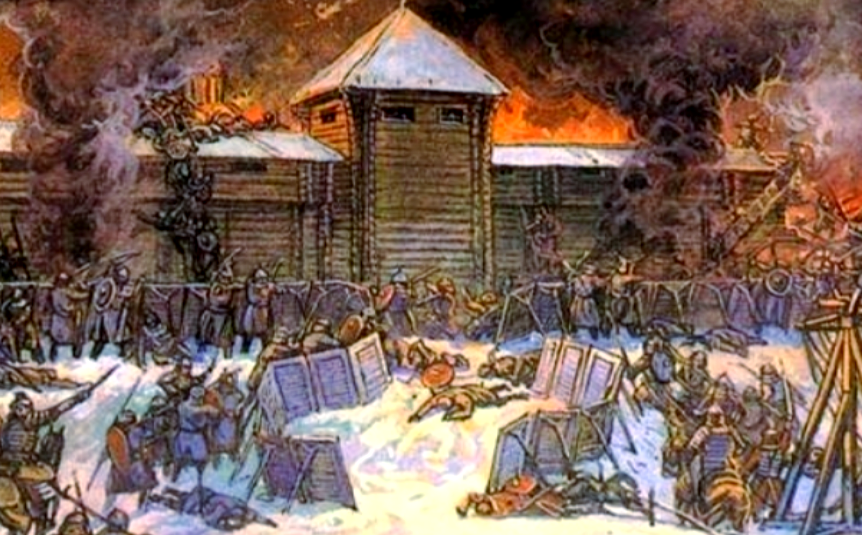
Ryazan and Vladimir held out for six days each, Pereyaslavl and Tver for five each, and Torzhok for twelve! The defenders, it seems, knew what to expect and, at the first opportunity, launched a sortie, striking not the Mongol cavalry—as many for some reason believe—but the siege engines.
One chronicler notes that the Kozlians’ first act was to destroy the catapults, “smashing their slings.”
As you can imagine, without siege engines, the Mongols could not breach the wall and proceed to a direct assault. The capture of the city cost them four thousand fallen warriors and no fewer than three sons of the temniks!
The sources offer no other explanation for why this small border town held out for so long.
What do we end up with?
It turns out that during every assault, the Mongols sent the Khashar to the front, which means that most of the bodies found today near the breached walls are not Mongolian at all. Those buried in mass graves had been captured earlier and driven to be the first to die under the arrows of their own people. This was no accident, but a system perfected in dozens of cities long before Rus.
And those few Mongols who did die in battle were buried with a meticulousness bordering on paranoia. Brother William of Rubruck, who traveled through the Mongol territories in 1253, was able to establish only one thing about their burials: the burial site remains a secret to all. A herd of horses was driven over the burial site of a great warrior several times, trampling the grass and leveling the soil with the surrounding ground. This was not merely a disguise. In the nomadic world, the desecration of strangers’ graves served magical purposes, and the Mongols guarded their departed friends as carefully as they guarded military secrets.
Historian G. A. Fedorov-Davydov noted that there are no burial monuments in Eastern Europe that could be linked to the Mongols.
The location of Genghis Khan’s burial site remains unknown to this day. According to one chronicle, a herd of ten thousand horses was driven over his grave.
Such methods of warfare brought the Golden Horde not only victories but also one of the most eerie mysteries of medieval battlefields, which archaeologists were only able to unravel centuries later.
Give it a thumbs-up if you’re also impressed by how meticulously the Mongols concealed even their own losses—and, of course, if you enjoyed today’s article.
Don’t forget to subscribe to the channel, because subscribing will not only help you stay updated on my new episodes but will also help me develop what I believe is a truly worthwhile project.
By the way, what do you think—how soon will Genghis Khan’s remains be found, and will they be found at all? Share your thoughts in the comments.