
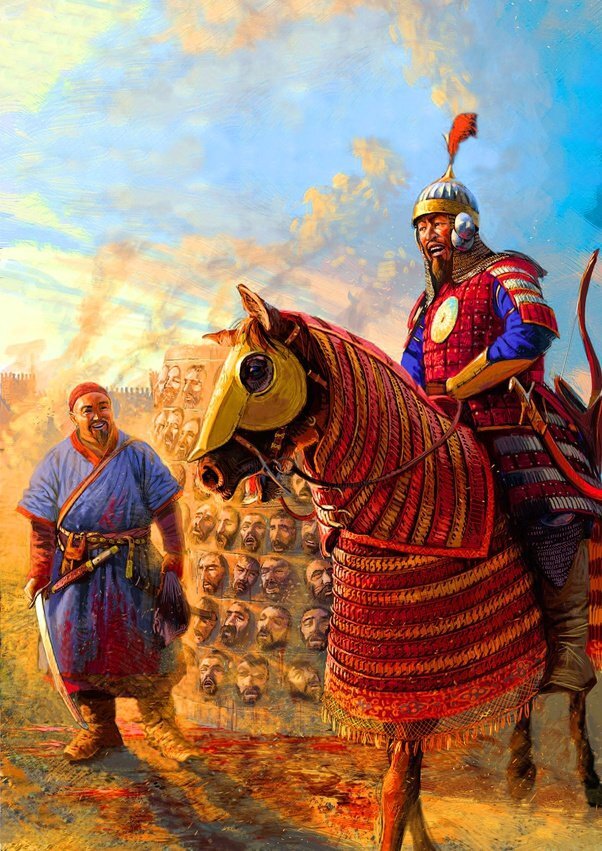
In 1395, the invincible commander Tamerlane set out on a campaign against Rus’. This could have ended disastrously for Rus’ as a whole and for each and every one of us in particular. The fate of Russia hung in the balance. Had Tamerlane won, Russia would have been reduced to ashes. Had Tamerlane lost, Russia would have been annexed by Lithuania, and we would never have grown into the Russian Empire.
To better understand the threat that loomed over the young Principality of Moscow and Rus’ as a whole, let’s take a closer look at who Tamerlane was and what kind of empire he built.
Tamerlane (or Timur, as his tribesmen called him) played a huge role in the history of Central and West Asia. His army adored him. Tamerlane was considered a visionary leader and a talented military commander. Tamerlane did not make emotional decisions—everything was logical and calculated. This is precisely why a man who was not a descendant of Genghis Khan became the most brilliant commander in the entire history of the Mongol Empire.
Tamerlane was, as we would say today, a real hunk for his time—muscular and fit. He was stronger than most fighters. Examination of his remains and subsequent genetic analysis showed that he was 172 cm tall (slightly above average for his era). He belonged to the South Siberian racial group. A similar genome is most commonly found among modern Kazakhs and Kyrgyz. Interestingly, despite the fact that he died at the age of 68, his skeleton and skull show no significant age-related changes. At 68 years old, Tamerlane’s biological age did not exceed 50!

Tamerlane
Tamerlane was wounded in his right leg, which earned him the nickname “the Lame.” But this did not prevent him from remaining a formidable warrior until the end of his days.
Tamerlane’s empire stretched across 4.4 million square kilometers and encompassed Iran, the Caucasus, Afghanistan, most of Central Asia, and so on. Over 40 million people lived within its borders—effectively half the population of the entire known world at the time!
Rus’, which by that point had essentially shrunk to the Grand Duchy of Moscow, was not the most tempting prize. Therefore, the conquest of Rus’ and the subsequent control of it would have been a waste of time and effort and was not part of Tamerlane’s plans.
Why, then, did Tamerlane march on Rus at all, given that the geography of his interests was entirely different? Tamerlane had a major falling-out with Khan Tokhtamysh. Tamerlane had been close friends with him and had helped Tokhtamysh lead the Golden Horde. But the former friend, as often happens, gathered an army and began ravaging Tamerlane’s lands.
In 1395, Tamerlane routed Tokhtamysh’s army, and Tokhtamysh fled to Russian lands. Tamerlane would have gotten lost, scouring the Russian forests in search of his former ally, and he, a steppe warrior, understood this perfectly well. Therefore, instead of chasing after Tokhtamysh’s army, Tamerlane decided to strike at his resource base—Rus. Essentially, Tokhtamysh’s main source of income was the tribute he collected from the Russian princes.
Tamerlane reasoned simply. He would destroy Tokhtamysh’s resource base, and the troops would scatter on their own. Or they would surrender their former khan to Tamerlane.
Tamerlane brought 400,000 soldiers to our borders. Across all of Rus’, there were just over 2 million people, and only a few tens of thousands were fit for combat and skilled in the use of weapons.
Tamerlane was a ruthless commander; he razed cities to the ground and completely exterminated the population. It wasn’t that he was maniacally cruel. He simply considered this the only correct tactic. And Tamerlane was utterly devoid of compassion and the associated emotions. “War is war,” the legendary commander believed.
Could Rus’ have put up a fight? In 1395, our country was in a dire state. Yes, we had experience defeating the Tatar-Mongols—in 1380, we defeated the enemy at the Battle of Kulikovo. But after that, we suffered the devastating invasion of Tokhtamysh. Moreover, the plague was raging in Rus, decimating entire towns and villages.
The history of Tamerlane’s campaign against Rus, thank God, is very brief. He invaded the Ryazan Principality and ravaged the city of Yelets. And, after staying near Yelets for two weeks, he unexpectedly returned to his capital—Samarkand.
Had Tamerlane not turned back, nothing good would have awaited Rus. In 1395, Rus did not have enough strength to repel the formidable commander. Even if—in the most fantastical scenario—Rus had managed to withstand the war with Tamerlane, it would never have been the same again. The Lithuanian prince Vytautas, summoned by Tokhtamysh, came to the aid of the Russian princes. And if the united army had repelled Tamerlane, it would have been Vytautas who would have led Lithuania, Novgorod, and the Principality of Moscow, becoming the sole ruler of the three Slavic states. And, in any case, we would certainly never have seen Russia in its current form and status.
What saved our country?
Historians are not entirely sure what motivated Tamerlane to make a sudden U-turn. They cite one main reason: news of uprisings within the country. The small, subjugated peoples regularly rebelled against Tamerlane’s rule. Could this have been what made the commander turn back? Absolutely! Rus’ was not a strategically important target. And he was no longer so angry at the defeated Tokhtamysh. Ten years later, he would, in fact, be conversing peacefully with his former enemy once again.
The second reason is purely my own speculation, not that of historians. Therefore, you are free to disagree with it. Here, our diplomacy saved the day. The ruler of Rus’, Prince Vasily, did not rush to withdraw his troops but sent envoys with gifts to Tamerlane. Some other princes did the same. If they had lined up in defensive formations, they would certainly have provoked Tamerlane into attacking and sweeping through the entire territory. But here, they brought gifts without a fight, without provoking aggression. Nor did they demonstrate loyalty to Tamerlane’s enemy, Tokhtamysh. Why waste energy crushing them, especially when there were urgent matters at home in Samarkand? A logical version? Quite so.
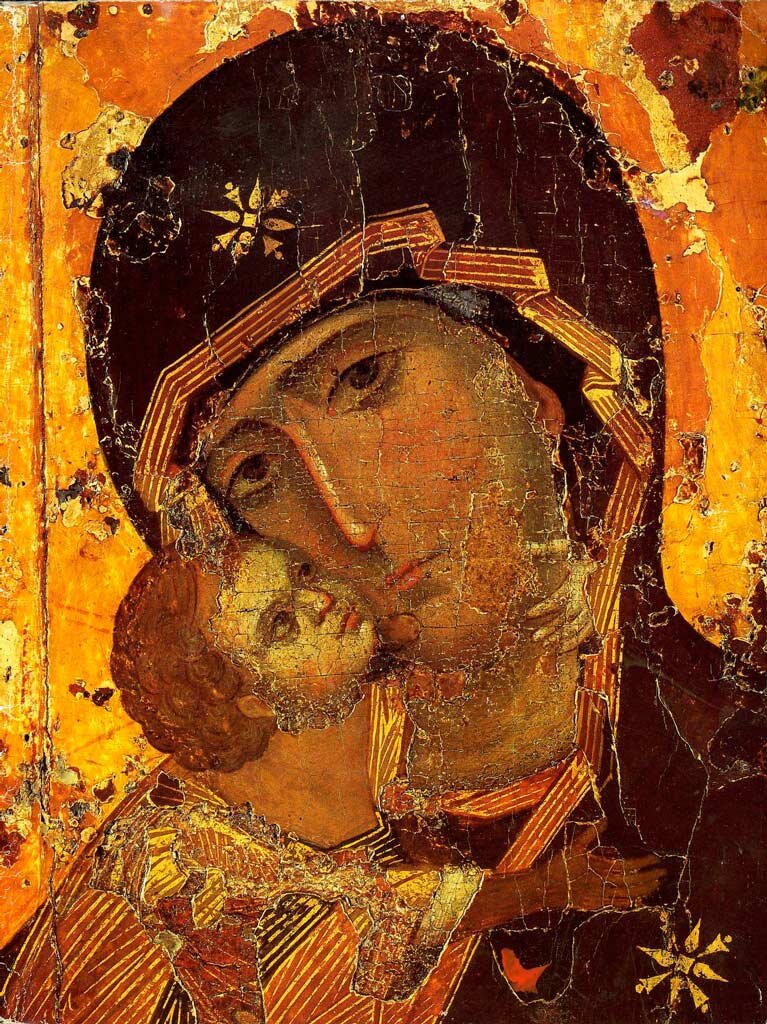
The Vladimir Icon of the Most Holy Mother of God
And Orthodox Christians would add a third argument here. On August 26, 1395, when Tamerlane turned back, the image of the Vladimir Icon of the Most Holy Mother of God was brought to Moscow. This icon is a gift from Byzantium, copied from icons painted by the evangelist Luke. Since then, the icon has been venerated as miraculous and is considered the patroness of Moscow. Today, the icon is kept in the church-museum at the Tretyakov Gallery.
The icon was brought here, and immediately—a truce. A coincidence? Perhaps. But there have been far too many of them in our history. On the other hand, our entire history is a chain of such random events, which led to the creation of a powerful state—the largest on the planet!