
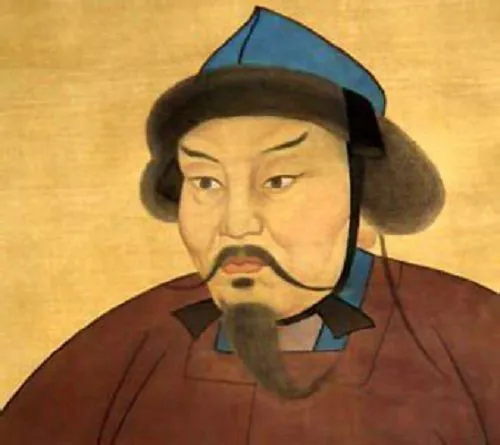
August 1227. Somewhere in his headquarters on the banks of the Yellow River, a man is dying—a man whose name had sent tremors across half the world, from China to the Caspian Sea. Genghis Khan is nearly seventy. The Tangut state of Xi Xia has just been virtually destroyed, and its capital is about to fall. And suddenly, rumors spread: the Khan is gravely ill. Eight days later, he is gone. The cause? This is where things get interesting. More legends have been spun about him than about all the khans combined. But what really happened?
The classic story: he fell from his horse
The Persian historian Rashid al-Din recorded that it all began with a trifle. In the fall of 1225, while hunting, Genghis Khan fell from his horse and was badly injured. He was ill all winter. One might think, for an experienced horseman—what could be simpler? But age and old wounds took their toll. It was officially believed that the illness following that fall led to his death two years later.
Skeptics objected: the khan remained a sprightly old man, led his troops himself, and a relapse of an old injury would hardly have manifested as a sudden fever. But the fact remained—Rashid al-Din recorded this version, Marco Polo did not reject it, and it became almost official. However, it was not the only one.
Far more sensational stories
Marco Polo, for example, thought otherwise. In his writings, Genghis Khan dies from a poisoned arrow that struck his knee during the final war with the Tangut kingdom.
Piano Carpini, the papal envoy, upon returning from Mongolia in 1247, reported a lightning strike. And that, by the way, isn’t such a bad death for the “Conqueror of the Universe.”
But the most exotic legend appeared in later Mongol chronicles. According to it, on the last night before his death, the khan took a captive Tangut princess—the beautiful Kyur-Beldishin-khatun—as a concubine. To avenge her desecrated homeland and her ruined husband, she bit through Genghis Khan’s carotid artery with her teeth during their intimacy. The great conqueror bled to death. It’s a beautiful, dramatic story—and, unfortunately, completely unsubstantiated.
There was also a version about a poisoned arrow that wounded the khan during a battle with the Chinese. But this, too, is merely speculation from enemies who wanted to diminish his victories, or from friends who sought to glorify his death.
A deadly fever: the plague?
In 2021, researchers from the University of Adelaide decided to set aside all these romantic tales and turn to the hard facts. The only more or less reliable source is the History of Yuan, a Chinese historical text from the Ming Dynasty. It states that from August 18 to 25, 1227, Genghis Khan developed a fever. He felt unwell and died eight days later.
Previously, it was thought to be typhoid fever. But the conqueror did not exhibit the symptoms typical of that disease: abdominal pain and vomiting. However, the climatic conditions, close contact with rodents on the steppe, and the fact that an epidemic had struck the Mongol army a year earlier—all pointed to one thing. The plague. Buboes, fever, a swift end.
“Given the general circumstances of the disease that struck his army as early as 1226, a more reasonable conclusion can be proposed—the plague,” the authors wrote.
Consequently, neither an arrow, nor lightning, nor even the passionate bite of a Tangut princess. An ordinary plague bacillus—that is what actually killed the creator of the greatest empire in human history.
Why we will never know for sure
All these debates would be unnecessary if scientists could simply exhume Genghis Khan’s remains and take a DNA sample. But here begins an equally interesting story.
Genghis Khan bequeathed that he be buried in secret. And the warriors carried out their lord’s will to the letter. According to legend, a herd of a thousand horses trampled the khan’s grave to level it with the ground. All the slaves who had prepared the burial were slaughtered. The guards as well. And to ensure the result, the guards killed everyone who crossed the funeral procession’s path. Legends even say that a riverbed was diverted over the grave. The burial site has still not been found.
In 2026, scientists came closer to solving the mystery by discovering a specific genetic marker—the C3 cluster—in burials in Mongolia, which may indicate descendants of Genghis Khan. But a direct analysis of his bones is still a long way off.
Conclusion: Nothing Heroic
The absurdity of Genghis Khan’s death lies in the fact that he—who destroyed armies and toppled empires, the conqueror of half of Asia—ultimately died from the most mundane of afflictions. From the plague. Or from the consequences of a long-ago fall from a horse. Or from other natural causes—no one knows for sure.
Legends and fabrications, as the Adelaide researchers noted, “are attributed to exceptional personalities.” But reality, as always, turns out to be more prosaic. And therein, perhaps, lies the main lesson of history: even the greatest conquerors die just as foolishly and inconspicuously as ordinary mortals.