
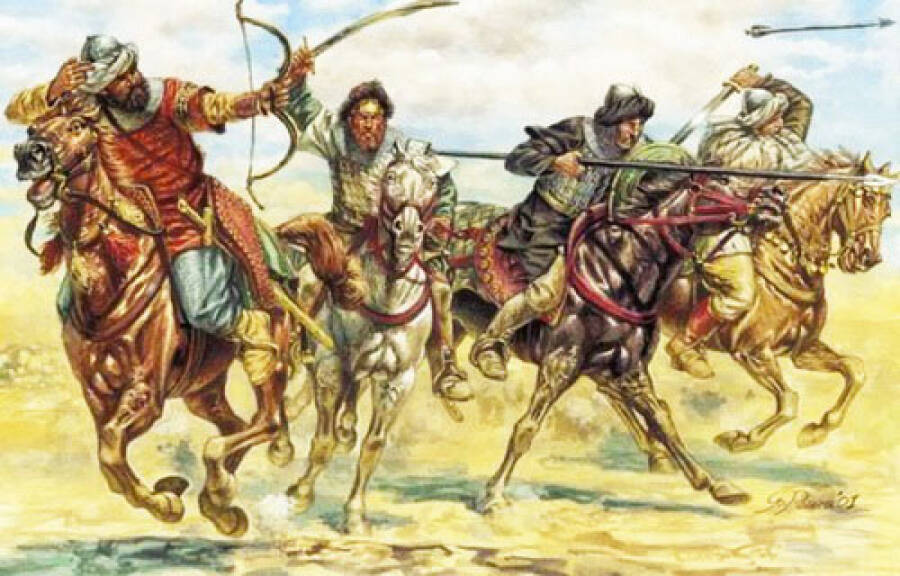
Thirteenth-century European armies dragged supply trains laden with provisions, fodder, and tools behind them. This slowed them down: the supply train set the pace for the entire army. Covering 40 kilometers a day was considered an excellent result.
The Mongol army moved three to four times faster—and with almost no supply train. This was no miracle. Behind it lay a specific system that the Mongols had refined over generations, and which gave them a strategic advantage unattainable by any opponent.
The Horse as the Foundation of Everything
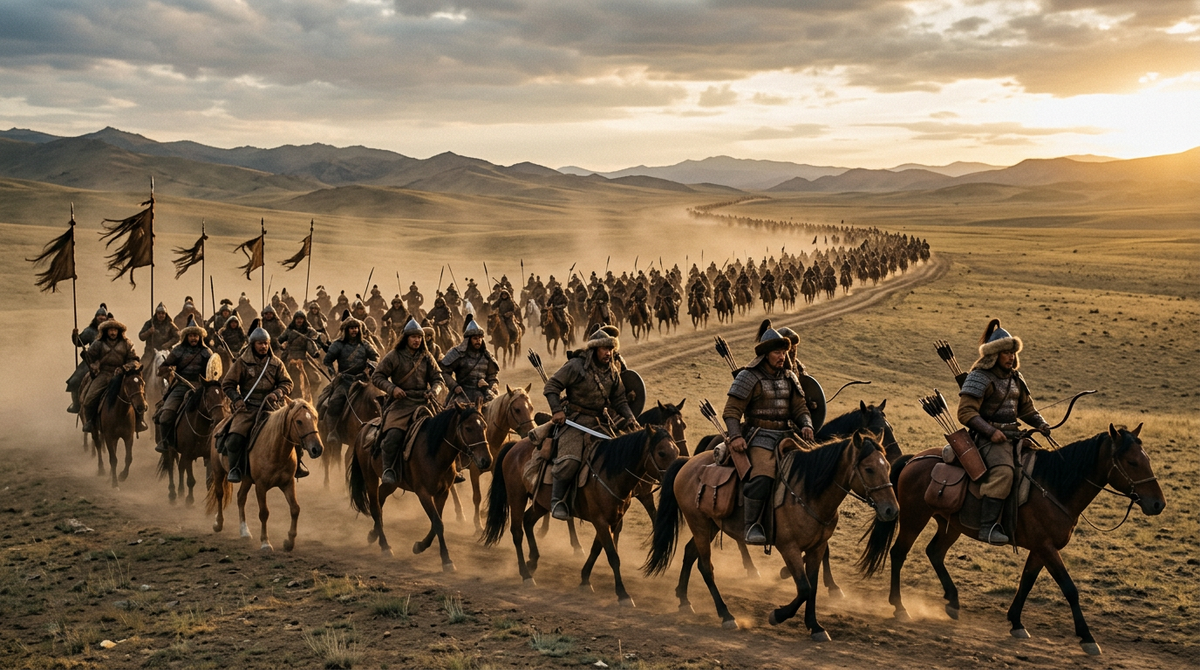
Every Mongol warrior brought not just one horse, but three to five. This is a key fact from which everything else follows. Horses were changed on the move: one carried the rider, while the others traveled unloaded. When a horse grew tired, they would switch to the next one.
According to historian Timothy May in his book The Mongol Conquests in World History (2012), this system allowed the column to cover up to 100 kilometers a day in extreme cases and a steady 60–80 kilometers under normal conditions. A European army with a supply train covered 15–25 kilometers in the same time.
-The horse provided more than just speed. It provided food and drink. Mongol mares were milked right on the march. Kumis—a fermented milk drink made from mare’s milk—was the staple of a warrior’s diet on the campaign. High in calories, it did not spoil quickly in the cold and required no fire to prepare.
Boortsoog, dried meat, and blood
The solid food of the Mongol warrior was designed for maximum nutritional density with minimal weight.
Boortsoog—bread balls fried in fat—kept for a long time and provided a lot of energy. Dried and cured meat—borts—was ground into powder: a pinch of this powder, mixed with water, produced a nutritious broth. This was the precursor to freeze-dried foods, which armies would not begin using until the 20th century.
-In extreme situations, a warrior would slit his horse’s throat, drink a few sips of blood, and bandage the wound. The horse would continue on. The Mongolian horse was small but exceptionally hardy—it could forage for food under the snow, drink salty water, and endure hunger better than European breeds.
Life from the saddle: no camp life
A European warrior needed a camp: a tent, a cauldron, a supply of firewood, and a supply wagon with belongings. A Mongol warrior carried everything on himself and on his horses. A leather bag, a felt mat, a bow, arrows, and a supply of dried meat.
Sleeping right in the saddle during the march is a documented practice. Marco Polo describes in his writings how Mongol horsemen dozed off on the move, letting their horses walk on their own. This is no legend: modern research shows that an experienced rider, with a certain riding posture, can relax to the point of dozing off while on the march.
A rest stop meant a few hours of sleep on the ground, unfolding a felt blanket—and back in the saddle. No pots or fires during a rapid march. Fires were lit only during extended stops.
Yam: Military Mail and Logistics
In the conquered territories, the Mongols established a system of postal stations—yams (from which the Russian words “yam” and “yamschik” are derived). Every 25–40 kilometers, there was a station with spare horses, food, and lodging.
A courier carrying a khan’s message could cover 300–400 kilometers a day, changing horses at each station. The army used the same network: advance units outpaced the main forces and immediately organized supplies from local resources in the captured territory.
-By the time the main forces entered a city or province, the advance units already knew where to find supplies. The conquered territory fed the army—this was a deliberate strategy, not random looting.
The Strategy of Devastation as a Military Tactic
Before a Mongol offensive, scouts—known as nuqers—would often enter the region to map grain reserves, pastures, and watering holes. This was reconnaissance for resources, not just military positions.
As they retreated, the Mongols deliberately devastated the territory: they drove off livestock, burned crops, and filled in wells. The pursuing army found itself in a scorched landscape devoid of resources. The Mongol army was prepared for this—their nomadic way of life had taught them to find sustenance where European soldiers saw only emptiness.
Historian John Man describes this directly in his book Genghis Khan (2004): the speed and autonomy of the Mongol army rendered the traditional strategy of “keeping the enemy at a distance” meaningless. While European generals were building defensive lines, the Mongols were already behind them.
Hunting as both training and sustenance
Great drive hunts—nerge—were held several times a year during peacetime. Thousands of warriors would surround a vast area, gradually tightening the ring and driving the game toward the center. This served as both military training and a means of gathering provisions.
The skill of drive hunting translated directly to warfare: encircling the enemy from the flanks, cutting off retreat routes, and coordinating movements over long distances without direct visual contact. Mongol warriors had been doing this since childhood—and on the battlefield, it appeared to be an innate tactical instinct.
-Game caught during the campaign was immediately dried or salted. The army fed itself on the march—this reduced dependence on pre-stocked supplies.
Why didn’t other armies do the same?
It’s a fair question. European commanders saw Mongol tactics in action—why didn’t they copy them?
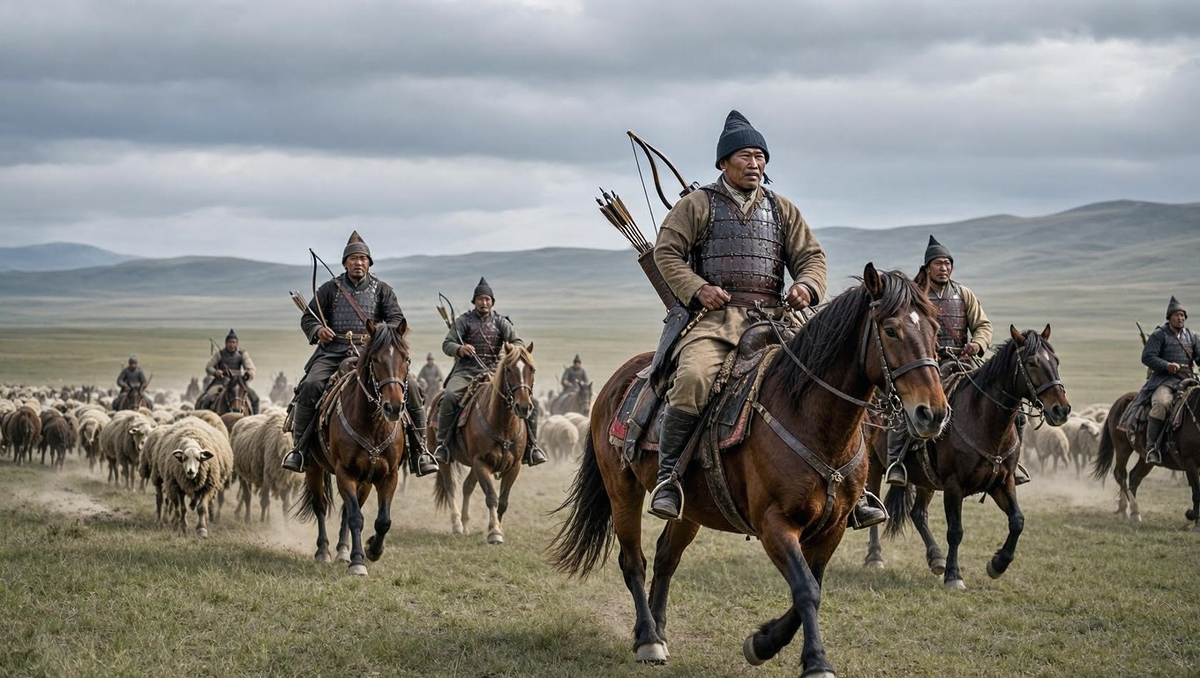
The problem is that the system cannot be copied piecemeal. It required people who had grown up in the saddle from the age of three, horses of a specific breed and temperament, a nomadic diet, and skills in hunting and survival on the steppe. A European knight or infantryman could not become a Mongol horseman in a single year of training.
-Attempts were made to create light cavalry modeled on the Mongolian style in European armies—the Hungarian hussars, the Polish uhlans. But they solved only part of the problem: speed of movement. Self-sufficiency in food supply remained a Mongolian monopoly.
The Legacy of the System
The Mongol logistics system influenced military thought far beyond the 13th century. Napoleon, who studied the Mongol campaigns, applied a similar principle: “the army feeds itself on the march”—troops did not wait for supply trains but seized provisions from the local population along their route. This allowed them to move faster, but it destroyed relations with the local population.
The German concept of Blitzkrieg in World War II inherited the same logic: speed is more important than logistical support. Tank columns pressed forward without waiting for fuel supplies, counting on seizing them from the enemy. When this worked, the army was invincible. When supplies ran out without replenishment, the system collapsed.
The Mongols solved this problem elegantly: their “fuel” walked on four legs alongside them. A horse could not be destroyed by bombing a warehouse.