
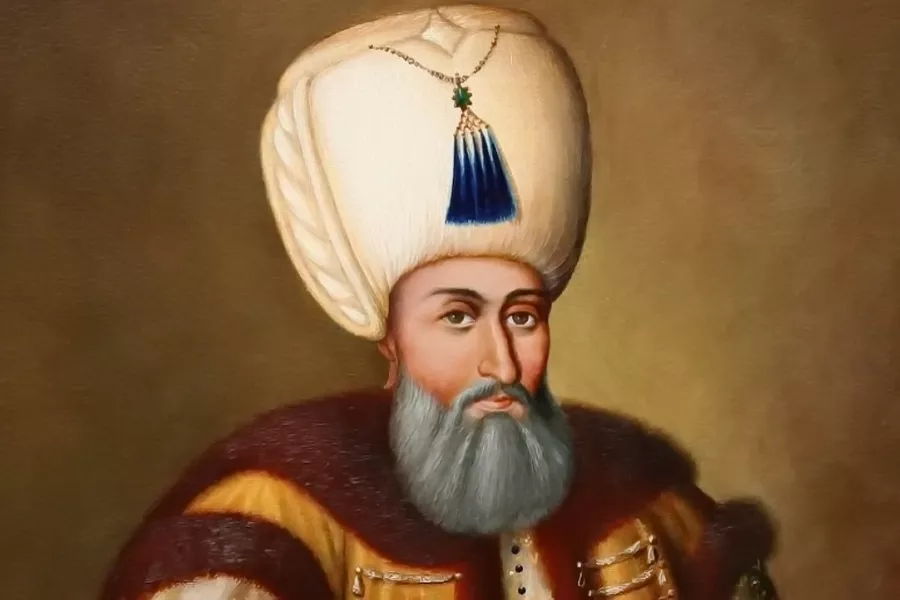
Imagine this: you arrive in the palace gardens in the morning, pick some roses, and trim the hedges. Then, in the evening, you’re handed a silk cord and told a name.
That’s what power looked like within the greatest Islamic empire at the height of its glory. On the outside—marble fountains, luxurious mosaics, and trade routes stretching from Algiers to Baghdad. On the inside—a system that chills the blood even five centuries later.
The history of the Ottoman Empire is far darker than it is portrayed in TV series.
Let’s start with a practice that was rarely discussed openly in Europe. It was called devşirme—“blood tax,” or, to put it bluntly, a tax on boys. Not all subjects paid it, only Christians: Greeks, Bulgarians, Serbs, and residents of the Balkan provinces under Ottoman control.
The scheme was simple and ruthless. Every few years, officials would tour the villages. From every forty Christian families, they demanded the surrender of one boy—the strongest, the smartest, the most promising. Typically, twelve to fourteen years old.
Families said goodbye forever.
Upon arrival in Istanbul, the boys were converted to Islam. Those who resisted were forced to convert. Most were enlisted in the Janissary corps: the elite infantry that was thrown into the front lines in every battle. “Cannon fodder”—a harsh but accurate term.
The particularly gifted were kept at court. And here the story takes an interesting turn.
A Greek boy from the provinces could rise to become Grand Vizier—effectively the second most powerful man in the empire. This is not a metaphor, but a documented fact: many of the highest-ranking officials of the Ottoman Empire were originally Christians from the Balkans. The system selected the best from the conquered peoples and made them the pillars of its power.
This was not cruelty for cruelty’s sake. It was cold calculation.
By the early 18th century, the practice had faded away: the Janissaries were allowed to pass their positions in the corps down through inheritance, and the need for a “blood tribute” disappeared on its own. Incidentally, Peter I implemented something similar in Russia: the conscription system, introduced in 1699, required peasant communities to supply a certain number of soldiers—and service was also for life.
Cruel systems often give rise to similar solutions in different parts of the world.
Now, about what was happening closer to the throne.
There was no law of succession in the Ottoman Empire. After the sultan’s death, any of his sons could claim the throne—and the infighting began immediately. Brothers plotted against one another, hired assassins, and defected to the enemy’s side.
When, in 1453, the twenty-year-old Mehmed II laid siege to Constantinople, his own relatives, led by his uncle, were among the city’s defenders. After the city’s capture, the sultan executed all his male relatives in the direct line.
There are reports that he personally strangled his infant younger brother in his cradle.
And as if that were not enough, Mehmed II issued a law explicitly requiring future heirs to kill all their brothers upon ascending the throne. Formally, this was for the sake of state stability. In essence, it was the preemptive elimination of rivals.
This was not an anomaly of a single cruel ruler. It became the norm.
Mehmed III, who ascended the throne in 1595, was forced to execute nineteen brothers. They say that when his youngest brother knelt before him and begged for mercy, Mehmed tore at his beard in grief—but did not revoke the order. Because the law was above personal feelings.
In 1617, the heirs came up with an alternative.
The new sultan, Mustafa I, refused to follow the fratricidal custom. All potential claimants were placed in a special pavilion of Topkapi Palace. Gilded chambers, servants, food, entertainment. Complete isolation from the world.
A golden cage—an apt metaphor. The pavilion’s inhabitants knew: at any moment, at the current monarch’s word, gardeners would enter through the door.
Gardeners, specifically. Not executioners.
There were no people listed on the Topkapi Palace staff with the title “executioner.” This function was performed by workers in the palace gardens—physically strong men, selected in part based on this criterion. By day, they tended to the cypress trees and fountains. By night, they received different orders.
It was forbidden to shed “blue” blood, that is, the blood of members of the sultan’s dynasty. Therefore, executions were carried out by strangulation. A silk cord—and no traces left behind.
In a secluded corner of the garden, there was a special fountain. There, the gardener-executioners washed their hands after work.
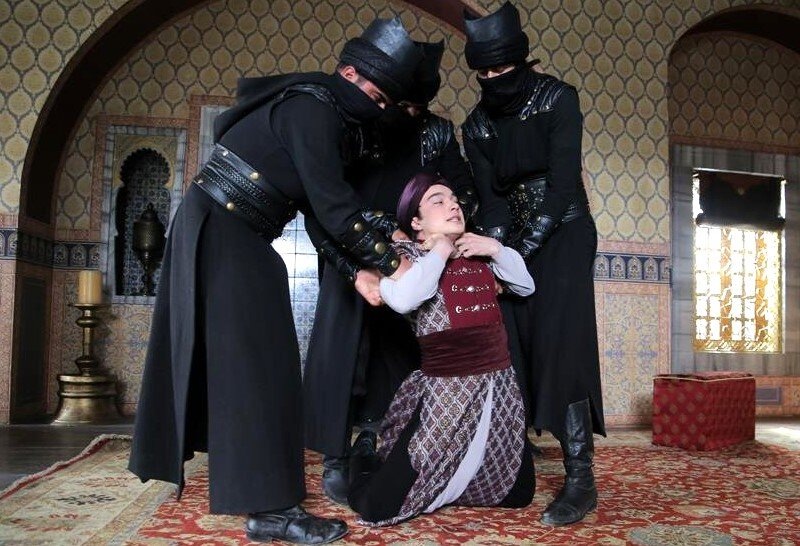
For everyone else—officials, guilty viziers—other methods were used. For example, under Mustafa III, a custom emerged that sounds like a cruel game. The condemned vizier was shown sherbet: white meant a reprieve, red—a race for survival. The condemned man had to run across the entire palace garden to the open gates. If he made it, he was pardoned. If he didn’t, it was the noose.
The gardeners, as a rule, were younger and faster.
Only one vizier is known to have managed to make it—a certain Hachi-Salih Pasha. That was the end of this practice. Whether by irony of fate or because it had become too awkward to continue.
The harem is a story unto itself.
The number of concubines in the harem sometimes reached several hundred. Some of the women lived there their entire lives without ever meeting the sultan in person. Being admitted to the harem did not mean becoming the chosen one. It meant being locked away in yet another cage, albeit a beautifully decorated one.
The harem was run by the chief eunuch—a figure of immense influence. He could lose his head if, due to his negligence, an outsider saw one of the sultan’s women. A random witness was lucky if they simply had their tongue cut out.
But the history of the harem is not just about restrictions.
From 1541 to 1687, the Ottoman Empire was effectively ruled by the sultans’ mothers. Historians refer to this period as the Women’s Sultanate. Kösem—mother of two ruling sultans—directed state affairs for nearly six decades. She specifically chose sons-in-law from among loyal officials. She formed coalitions. She held power more firmly than many men on the throne.
This is no accident. It is a pattern: in a system where men destroy one another, those whom the system does not perceive as a threat find a place.
It is worth mentioning separately how the empire treated the conquered peoples.
It is commonly believed that the Ottomans imposed Islam by fire and sword. The reality is more complex. Over four centuries under Istanbul’s rule, the Greeks preserved their Orthodox faith, language, and communities. Jews, expelled from Spain in 1492, found refuge in the Ottoman Empire—and no one touched their synagogues.
Moreover, ethnic Greeks held high administrative posts. Their share among officials was disproportionately large relative to their population.
But this tolerance had a clear limit.
When the Shiite population in the eastern part of the empire began to openly deny the religious authority of the Sunni sultan, Selim I carried out mass punitive operations in 1514. According to various estimates, as many as forty thousand people were killed.
When the Pontic Greeks began seeking autonomy in the early 20th century, pogroms took place in their villages. Not at the hands of the Janissaries, but of Albanian irregular forces.
Tolerance was a tool of governance. As soon as it ceased to serve that purpose—it was eliminated.
This is what lies behind the glamorous facade of “The Magnificent Century.”
Not the romance of palace intrigues, nor the exoticism of Eastern decor. But a coldly constructed system where every element—from the gardener to the concubine, from the Janissary to the vizier—existed only to the extent that it was useful. And no one was safe from the noose.