
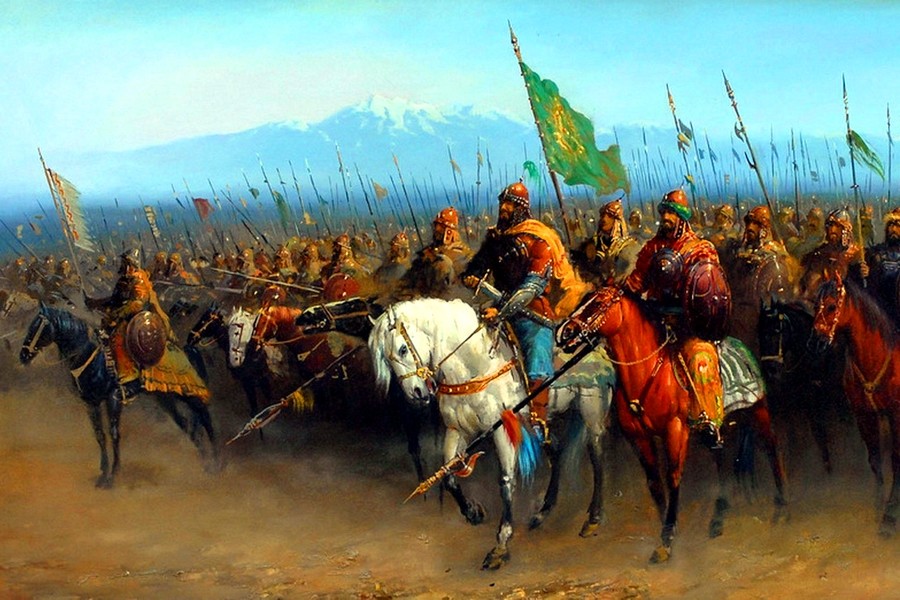
When we talk about Ukrainian culture, we immediately think of the vyshyvanka, lard, the bandura, and the “mova.” Meanwhile, this ethnic group, which considers itself one of the purest Slavic peoples, is in fact a fascinating blend of bloodlines and traditions. It was shaped not only by Poles and Lithuanians, but also by the nomads of the Great Steppe. The Huns, Avars, Khazars, Pechenegs, and Polovtsians—all of them left their mark on the genotype and culture. Sometimes to such an extent that it’s astonishing. Here are a few familiar things whose “Ukrainianness” is nothing more than a myth.
“Cossack” – a word from the East
The most resonant word in Ukrainian history—“Cossack”—has Turkic roots. Most historians agree: it traces back to the Turkic “kazak,” meaning a free man, a lone warrior who had separated from his clan. The Zaporizhian Sich grew out of the mixing of Slavic “nomadic people” with settlements of Turkic tribes (the Torks, Berendeys, and Black Klobuks), who served as border guards. Even the Zaporizhian camp was called by the Turkic word “kosh.”
The main character of Ukrainian folk art is “Cossack Mamai,” sitting with a bandura under a poplar tree. Everything here is foreign: the name is quite transparent, the poplar is a tree sacred to the Turks, but as for the bandura, it has been determined that its name derives from the Latin-Greek “pandura” (via the Polish language), so it is apparently a pan-European instrument.
Cuisine, fried to a Turkic shine
The main culinary know-how that distinguishes Ukrainian cuisine from Russian cuisine is frying ingredients in superheated oil, the so-called “smaženie” or sautéing. And it came from Turkic cuisine, where this technique was fundamental. It is precisely thanks to “smaženie” of vegetables that we get that very rich red borscht.
Even varenyky are not an originally Slavic dish. Modern culinary researchers claim that their ancestor was the Turkish dish “düş-vara” (or düsh-vara)—a kind of stuffed dumpling. At first, this dish evolved into varenyky with meat, and only over time did it acquire the characteristic Ukrainian fillings of cherries, cottage cheese, and potatoes. A similar story applies to dumplings, which are known among Turkic peoples as “manti” and “buuz.”
“National Costume”: An Import from the Soviet Era
Paradoxically, what is considered the standard of Ukrainian national dress—wide sharovary and crimson zhupans—was only adopted by the Cossacks at the end of the 18th century, during the twilight of the Sich. Where did this fashion come from? The sharovary originated from Turkic attire, only slightly adapted to local tastes.
Even the word “zhupan” made its way into the Ukrainian language from the same source. As for the girls’ wreaths with ribbons and puffy sleeves, modern costume historians assert that in the form we know from pictures, this outfit was designed as early as the Soviet era, when there was a pressing need for vibrant ethnic symbols.
Architecture: The Hata-Mazanka and the Karaite Legacy
The building traditions of the country’s south are also largely borrowed. The famous Ukrainian hata-mazanka was built from adobe. The word “adobe” has Turkic origins (meaning a mixture of clay, manure, and straw). The technology of adobe construction was brought to the steppes by nomads, for whom it was important to build cheaply, warmly, and using readily available materials. By comparison, the log cabins of central Russia were built using Scandinavian-Slavic technology.
Even today, in southern Ukraine, you can find houses with traces of Turkic architecture, “disguised” as Slavic traditions.
So what’s the bottom line?
Nothing terrible, really. The culture of any people is like a layered pie that has been baking for centuries. The fact that Ukrainians absorbed Turkic elements does not make them “less Slavic” or “outsiders.” It merely proves that the world in this part of Europe was open to migration and trade. Sharovary, Cossack Mamai, and cherry varenyky remain ours. It’s just that this friendship has a long and very interesting backstory, lying beyond the horizon of the Wild Field.