

The invention of the rigid-framed saddle and stirrups was the most significant event in the history of technology, one that largely defined the character of the era. The combat capabilities of horsemen expanded dramatically, and the striking power of heavy cavalry increased. Sitting in sturdy saddles with rigid frames and resting their feet on the stirrup bars, riders gained extraordinary freedom of movement, which immediately led to the creation of new types of weapons. This inevitably influenced combat tactics.
Saddles from the Scythian period consisted of two cushions stuffed with wool and horsehair, connected over the horse’s spine by a leather strap. At the edges facing the horse’s neck and hindquarters, they were thickened and adorned with thin arches and pairs of carved plates made of wood or horn. Such a saddle was secured on the animal’s back using a girth, breast straps, and tail straps. This design only slightly reduced the pressure of the rider’s weight and equipment on the horse’s back. Furthermore, the soft saddle provided the rider with no support during a head-on impact.
At the turn of the eras (1st century BCE – 1st century CE), rigid frames appeared, consisting of two narrow arches connected by several slats. Experts’ opinions regarding the purpose of these lattice frames differ. According to one theory, this structure served as the supporting framework for pack saddles; according to another, the wooden crossbars ran inside leather pads, forming the base of a soft saddle. In any case, such a frame can be considered the direct precursor to the rigid saddle.
In the next stage of its development, the cushions were replaced by two boards positioned on either side of the horse. At their ends, they were fastened together by wide, arched straps, believed to have evolved from the decorative wooden panels of Scythian saddles. The straps rested against the horse’s back. To avoid hindering the horse’s movements, the distance between them was kept to a minimum. Such a saddle literally clamped the rider in place, provided him with a firm support, and even protected him from a spear thrust to the groin.
The advantages of this invention are obvious—first, it ensured a high riding position; second, while sitting in such a saddle, the rider could wield a spear quite effectively without fear of falling from his steed if he made a wrong move. But mounting such saddle-locks while wearing long-tailed or armored clothing was extremely inconvenient. Then, a special footrest appeared on the left side of the saddle—the prototype of the future stirrup.
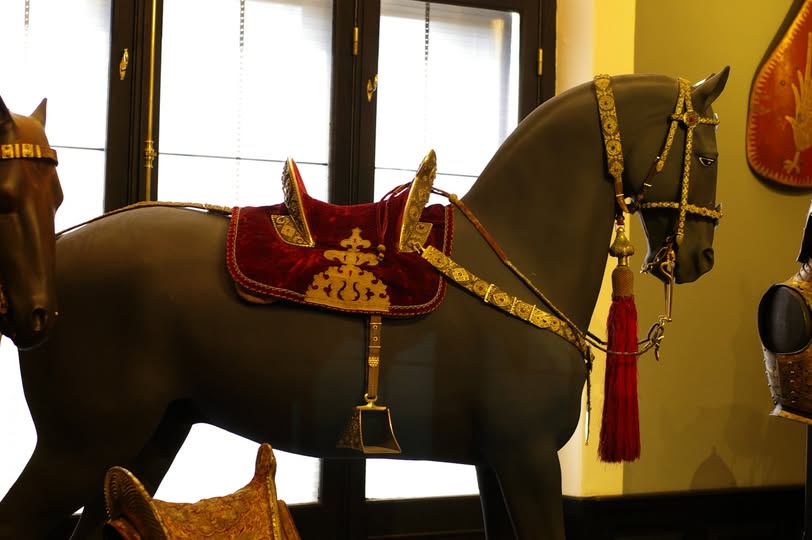
In the 6th century, the frame was further improved. The longitudinal planks between the arches were lengthened. Now the arches were simply placed on top of a wooden base, which took on a characteristic shape with a blade in the middle. Thus, the rider’s weight was distributed more evenly across the saddle, reducing the pressure on the horse’s spine. The protruding edges of the planks allowed the stirrups to be tied in front of the front bow, rather than, as had been done previously, throwing the rope connecting them across the saddle. A little later, the rear bow was placed at an angle to the horizontal and, like the front one, was made from a single piece of wood.
The rider gained the ability to lean in either direction, lean back, easily dismount to the ground, and, as they say, “take flight like a bird” onto the horse. The mobility of the cavalry increased significantly. The saddle described here first appeared somewhere on the border between the settled and nomadic worlds, in the contact zone between the pastoral and agricultural cultures of Northern China. From there, it began its triumphant march across the world.
Stirrups were also invented in roughly the same region. At first, pairs of wooden footrests were bent from a wooden rod and covered with iron or copper. It soon became clear that the wooden base was unnecessary. For a time, stirrups were made from flat iron sheets. However, the narrow plate cut into the leg, so the footrest (the lower part of the stirrup where the foot rests) took on a flattened shape. Later, stirrups were forged entirely from a metal rod.