
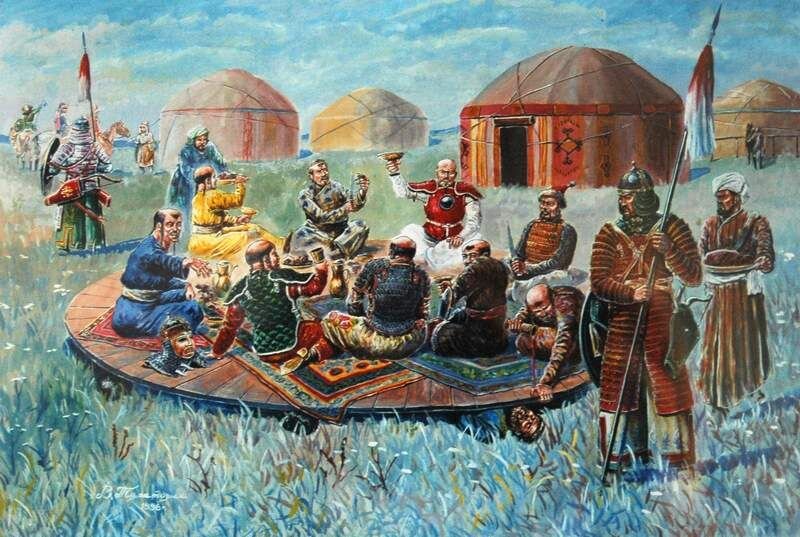
How did it arise and what connects it with the current Kyrgyz
In 840, a large nomadic state arose in Central Asia — the Kyrgyz Kaganate. References to him have been preserved in Chinese, Arabic and Turkic sources. But the history and legacy of this state remain one of the most hotly debated topics — scientific disputes have lasted for more than two hundred years. Often, the topic acquires a political connotation, becoming an instrument of ideological interpretation. Therefore, Qalam asked the Kyrgyz historian Azamat Alagoz uulu to talk about the most problematic and controversial aspects of the history of the khaganate.
Opinions differ diametrically on the issue of the origin, influence, and especially the legacy of the Kyrgyz Khaganate. The most controversial of them concern the origin of the Yenisei Kyrgyz and their connection with the ancient Ganguns, and whether the Khaganate was included in the list of «great nomadic empires» along with the Xiongnu, Turks and Uighurs. And, perhaps, the most pressing question is whether modern Kyrgyz are descendants of the Yenisei Kyrgyz.

Cities of the Kyrgyz Kaganate on the map of Muhammad al-Idrisi, branch number III, on the right / Wikimedia Commons
The ethnonym «Kyrgyz» was first mentioned in the descriptions of the Gangun tribe in the historical work «Shi Ji» by the famous chronicler of the Han Empire, Sima Qian, in the 2nd-1st centuries BC. It is mentioned among the peoples conquered by Shanyu Mode on the northern outskirts of the Xiongnu possessions. Apart from the Han mentions, no other reliable information about the «ancient Kyrgyz» (Ganguns) has yet been found in the sources. In Chinese sources
Various variants of the name are used — gegun, giangun, kigu, qigu, gegu, hagusy, hyagasy — which the Canadian sinologist Edwin Pulliblank and the Russian linguist Sergey Yakhontov consider to be simultaneous transcriptions of the same ethnonym — Kyrgyz.

Chaatas/Balbal in western Mongolia, Bayan-Ulgiy province in the west of Ulgiy city / Getty Images
The ethnonym «Kyrgyz» is mentioned in Muslim historical works, as well as in ancient Turkic runic monuments. However, only later sources of the Tang Empire (618-907) identify the Ganguns with the Yenisei Kyrgyz. It was this information that initiated the century-old discussions about the connection of the Yenisei Kyrgyz with the Ganguns. Although there were also pressing questions about where the Kyrgyz lived during the era of the Xiongnu Empire, and how they ended up on the Yenisei.
There are several hypotheses about where the homeland of the ancient Kyrgyz was located. According to one of them, back in the Xiongnu era, they lived south of the Yenisei River — in the area of Lake Kyrgyz-Nur (in Mongolian, Khyargas Nuur) in the north-west of modern Mongolia. Another hypothesis connects them with specific burials in stone boxes and domed crypts that began to appear at the end of the 3rd-2nd centuries BC in Tuva and the Yenisei. They belong to the Gyangun tribes, who lived north of the Wusun and Tien Shan.

Kyrgyz-Nur Lake (Khyargas Nuur). Western Mongolia, Uvs Province, Khyargas District / Getty Images
It is believed that after the Xiongnu expansion, the same Ganguni began to move westward and settled between the Irtysh, Lake Balkhash and the Tarbagatai range by the 1st century BC. On this basis, it was assumed that the Kyrgyz, who originally lived in East Turkestan
, later migrated to the Yenisei. Others believe that their ancestral homeland was the mountains of the Eastern Tien Shan, and they were pushed into the Minusinsk basin by the ancient Mongol tribes of the Zhuzhan.
KYRGYZ PEOPLE ON THE BANKS OF THE YENISEI
But since the 6th century A.D., quite a lot has been known about the Kyrgyz on the Yenisei, so the history of the «Yenisei Kyrgyz» begins from that time. According to the Chinese chronicle Zhou Shu, one of the brothers of the Turkic ruler Nadulu-shad founded a state between the Abakan and Yenisei rivers. With the resettlement to the Yenisei, the Kyrgyz also included some of the local tribes, and their cultural monuments spread to the Minusinsk basin.
There are descriptions of their appearance in the sources. Thus, in the historical chronicles of the Tang Dynasty, as well as the Persian historian Gardizi, the Kyrgyz were tall, with blue eyes and red faces. Later, based on these descriptions, some researchers advanced rather controversial conclusions about their origin and anthropological type, including «Eurocentric interpretations.»

The court of the Seljuk ruler Toghrul III / Wikimedia Commons
The historian Vasily Bartold, for example, believed that the Yenisei Kyrgyz were «renounced Ostyaks» — the indigenous inhabitants of Siberia, and the German scientist Wilhelm Schot considered them renounced Samoyeds. However, these hypotheses are not supported by linguistic analysis. Hungarian orientalist Lajos Ligeti suggested that the Yenisei Kyrgyz were of Indo-European origin, while French Turkologist Jean-Paul Roux, on the contrary, believed that even at that time the Kyrgyz language was uniquely Turkic. It is worth recalling here that most of these generalizations originated in an era of extremely limited information about the peoples of Central Asia.
Anyway, in the middle of the 6th century, when the Turkic kaghan Mukhan tried to subjugate the northern lands, the Kyrgyz ruler recognized formal dependence, in exchange for promising to supply them with famous weapons from the Minusinsk basin, an important metallurgical center of the kaganate. In 581, taking advantage of the collapse of the Turkic Khaganate, the Kyrgyz temporarily freed themselves, but later they again found themselves dependent first on the Eastern, and then on the Second Turkic Khaganate.
A special role in strengthening the position of the Yenisei Kyrgyz was played by Barsbek, who united the tribes of the Yenisei, formed alliances with the enemies of the khaganate and turned the Kyrgyz into a key force of resistance to Turkic rule. Subsequently, Kapagan, the khagan of the Eastern Turkic Khaganate, recognized him as the khagan and even gave him the daughter of his predecessor Kutlug Elterish. Thus, albeit temporarily, the Kyrgyz state became equal with the Turkic Khaganate. Barsbeck actively pursued foreign policy and sent embassies to China. Turkic epitaphs marked the Kyrgyz kagan as their main enemy, and in the winter of 710-711, the army of two great Turkic commanders Tonyukuk and Kul-tegin, passing through the Sayan Mountains, suddenly attacked, killing Barsbek in the battle of Cherni Sunga, subjugating his people.

Barsbeck / open.kg / Wikimedia Commons
Until the fall of the Second Turkic Khaganate in 745, the Kyrgyz did not participate in armed conflicts in the region and became more active only after its collapse, when the main threat became the growing Uighur khaganate. In 751, the Kyrgyz joined with the Chiks.
The Oghuz and Karluks opposed the expansion of the Uyghur kagan of Moyun-Chur. However, the Uighurs soon defeated the allies one by one and finally conquered the Kyrgyz by 758, depriving the ruler of the title of kagan and granting him a vassal rank.
WHAT ABOUT THE «KYRGYZ GREAT POWER»?
Uighur rule was the longest period of external subjugation in the history of the Yenisei Kyrgyz. It was only in 820 that they liberated the Minusinsk basin, and from that time on, the twenty-year war between the Kyrgyz and the Uighur khaganate began.
By 840, when the Uighur Khaganate was in crisis, the Kyrgyz launched attacks on its southern lands. The defeats increased the instability of the khaganate, and in the decisive battle, a hundred thousand Kyrgyz troops defeated the Uighurs. The capture of the capital Ordu-Balyk by the Kyrgyz put an end to the khaganate.
Academician Bartold calls this period the «Kyrgyz great power,» and the debate around it is still ongoing: is this an exaggeration and by what criteria did he evaluate it? It is reasonable to assume that by doing this he wanted to emphasize the scale of the Kyrgyz state, comparing it with other large state entities of Eurasia. In any case, as a result of the conquests of the Kyrgyz in the second half of the 9th century, the boundaries of their influence expanded from the upper reaches of the Amur River in the east to the eastern foothills of the Tien Shan in the west. Archaeological finds confirm the extensive geography of the Kyrgyz Kaganate. Burials with incineration and characteristic inscriptions have been found in Gorny Altai, Tuva, Eastern Kazakhstan and the Minusinsk Basin.

Tall stone menhirs at the site of an ancient burial. Khakassia / Getty Images
For the first time in the history of steppe Eurasia, immigrants from Southern Siberia created a steppe empire, and in the 11th and 12th centuries, the Kyrgyz Khaganate already bordered on Mongol-speaking tribes. It was only after the defeat of the Khitans that the Khaganate split into two principalities — Kem-Kemjiut and Kyrgyz.
CULTURE OF THE YENISEI KYRGYZ
The culture of the Yenisei Kyrgyz is a unique synthesis of ancient South Siberian cultures and traditions of the nomadic peoples of the Eurasian steppes. It is especially evident in the so—called «chaatas» (stone warriors), unique necropolises of a new type belonging to the culture of the Yenisei Kyrgyz of the 6th-9th centuries.

Uybat chaatas. Khakassia / Wikimedia Commons
The Runic script also occupies an important place in the culture of the Yenisei Kyrgyz. In the 7th and 8th centuries, the ancient Turkic states of Central Asia created their own writing system, known as the «Runic script.» The Kyrgyz version of the alphabet included 39 characters that were not interconnected in writing. These signs were perfectly adapted for carving on wood and stone. The inscriptions were usually applied horizontally and read from right to left. To date, in the Upper Yenisei valley, on the territory of modern Tuva and Khakassia, there are about 200 monuments of runic writing dating back to the time of the existence of the Kyrgyz Kaganate.
YENISEI AND TIEN SHAN: THE PATH OF ONE PEOPLE?
The connection between the Yenisei and Tien Shan Kyrgyz remains one of the most controversial topics in the study of the ethnogenesis of the Kyrgyz people to this day. The versions here are diametrically opposed — from the complete denial of continuity to the recognition of the Yenisei Kyrgyz as the most important component of ethnic formation.

Kyrgyz women. Kyrgyzstan, Subashi, 1930s / Getty Images
Back in the 18th century, German historian Gerhard Miller suggested the relationship of the Tien Shan Kyrgyz with the Yenisei. This hypothesis was supported by other researchers such as Carl Ritter and Julius Klaproth, pointing to the similarity of ethnonyms and the possible migration from the Yenisei to the Tien Shan at the end of the 17th century. On the contrary, Yakinf Bichurin considered the Yenisei and Tien Shan Kyrgyz to be different peoples, referring to Chinese chronicles and the lack of migration traditions, but his opinion did not prevail.
Proponents of the resettlement theory believe that part of the Yenisei Kyrgyz moved south in the 9th and 10th centuries, during the heyday of the Kyrgyz Khaganate. They rely on Tang sources about the campaigns in East Turkestan and the capture of Kucha, Beshbalyk and Uch-Turfan, as well as on Muslim chronicles of the 10th and 12th centuries, mentioning the Kyrgyz in the neighborhood of the Karluks, Uighurs and Yagma.
. Kyrgyz historian Omurkul Karaev argued that some of the Kyrgyz who settled in East Turkestan later became the ethnic core of the Tien Shan Kyrgyz, and the formation of the nationality took place already in the 11th and 15th centuries. Turkish scientist Ahmet Tashagyl believes that before and after the Mongol conquest, the Kyrgyz gradually began to move to the southwest, to the areas of their modern settlement.
According to another theory, the formation of the modern Kyrgyz people is associated with the Kimako-Kipchak component. Its supporters claim that the ethnic group was based on tribes displaced from Altai and Irtysh during the Genghisid civil strife. After migrating to the Tien Shan, they assimilated with the local Turkic and Mongolian peoples. This hypothesis denies a direct connection with the Yenisei Kyrgyz, but is criticized for not adequately assessing other factors in the formation of the ethnic group.

Vasily Vereshchagin. A Kyrgyz woman. The year 1873 / WikiArt.org
However, anthropological and cultural similarities with the Altaians could have arisen in Dzungaria or the Mongolian Altai, and archaeological evidence does not confirm the existence of the Kimak-Kyrgyz culture in the Irtysh or Tien Shan. The Kipchaks moved to the west, so it is believed that the value of the Kimak component could not be decisive.
The famous orientalist archaeologist Leonid Kyzlasov, for example, categorically denied the existence of an ethnogenetic connection between the Yenisei and Tien Shan Kyrgyz, arguing that the Yenisei was inhabited not by Kyrgyz, but by the so-called «ancient Khakas.» According to him, the ethnonym «Kyrgyz» was later borrowed by Turkic-speaking groups serving the Mongol rulers, and they settled on the Tien Shan only in the late Middle Ages. However, this hypothesis is also criticized for methodological weakness, erroneous linguistic interpretations of Chinese characters, and lack of archaeological evidence.
Since the middle of the 20th century, the idea of the complex and multilevel ethnogenesis of the Kyrgyz people has been established in science, based on waves of migration, assimilation and integration processes that took place against the background of the collapse of the medieval states of Central Asia. This process was based on a multi-layered tribal and cultural heritage spanning both the Yenisei and the Tien Shan.

A Kyrgyz woman. 1894 / Romanov empire
A special place in ethnogenesis is occupied by the Yenisei Kyrgyz, whose influence can be traced in various spheres. Linguistically, the modern Kyrgyz language retains archaisms and elements similar to the Orkhon-Yenisei inscriptions, as well as the vocabulary of the Khakass, Tuvan, Shor and Altai languages. Anthropological studies have revealed stable South Siberian characteristics in modern Kyrgyz. The continuity is also confirmed by ethnogenetic legends, in particular the myth of the forty girls, known both in the medieval traditions of the Yenisei Kyrgyz and in an Islamized form among the Tien Shan Kyrgyz. Ethnographically, common ethnonyms and cultural features with the Sayano-Altaic peoples are recorded.
In any case, it is important to remember that along with the Yenisei Kyrgyz, the Turkic and Mongolian tribes of the Tien Shan, as well as the former ethnopolitical formations of the region — the Karakhanids, the Chagatai Ulus and Mogolistan — played a significant role in ethnogenesis. Indeed, as early as the 15th century, Muhammad Haidar mentioned the Kyrgyz as the local population of the Tien Shan, which indicates the completion of key stages of their formation. Thus, the modern Kyrgyz people are the result of a long, multi—layered and multi-ethnic process in which the Yenisei Kyrgyz occupy a key but not exclusive place.