
Great Scythia revered the sun god Khors; it is not surprising that the cities named after him were scattered throughout its vast territory. Chersonesos in Crimea and Khorezm on the Amu Darya — both «cities of the Sun» were dedicated to one god.
The high level of culture of ancient Khorezm, an oasis in the Central Asian deserts, was well known in the Middle Ages. But this culture dates back to ancient, pre-Islamic times. However, little was known about these times from written sources. You bet! After the Arab Qutaybah took Khorezm in 712 A.D., there were no «springs» left. As the great Khorezmian Al-Biruni wrote, «and by all means Qutayb scattered and destroyed all those who knew the writing of the Khorezmians, who kept their traditions, all the scholars who were among them, so that all this was covered with darkness and there is no true knowledge of what was known from their history at the time of their coming to them.» Islam…»164
Archaeological excavations have provided a glimpse into Khorezm’s past. The city appeared at the turn of the 5th–4th centuries BC, almost simultaneously with the Northern Pontic «polis»; its foundation was preceded by migration to the Central Asian oases of the population of the Aral-Caspian steppes (Scythians-Massagetes). Initially, Khorezm was the center of an independent state that did not submit to any of the powerful empires that from time to time rolled into Central Asia from the south. Neither the Persian Achaemenids nor Alexander the Great captured Khorezm. Khorezm could resist the onslaught only by relying on the Central Asian Scythians, the Massagetae (or Saks, as the Persians called them). The city was a frontier fortress of the Scythian world, protecting it from expansion.
In the second century BC, the situation changed in favor of Scythia. From among the Saka Scythians came the Parthians, who established control over Iran, and from among the East Turkestan Scythians came the Kushans, who conquered most of Central Asia and Northern India.
Khorezm also entered the sphere of influence of the Kushan Empire.
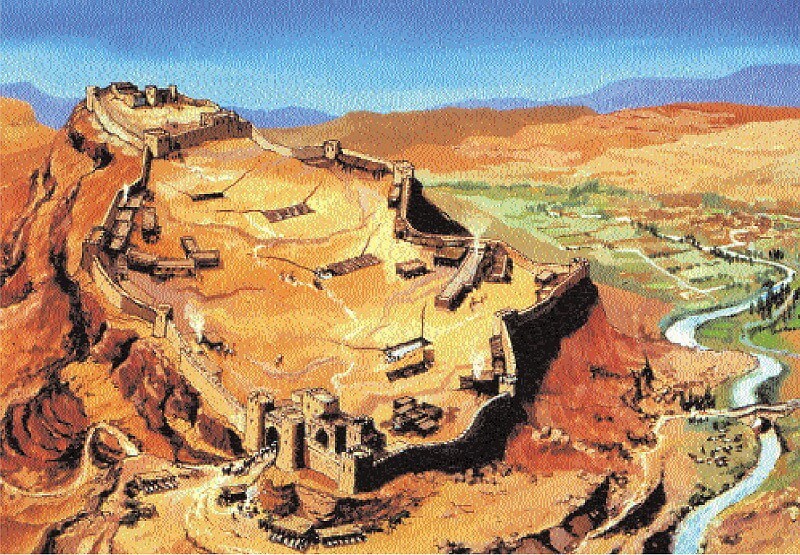
After the collapse of this state (in the 3rd century AD), Khorezm became an independent center and began to mint its own coin; its most striking monuments date back to this time. This is what the residence of the kings of Khorezm, Toprak-Kala Castle, looks like: «The grand castle-palace is overwhelming with its harsh grandeur. The huge large-family apartment buildings of the city seem dwarfed in front of him. The central massif of the castle rises 16 meters above sea level, and the three towers, each 40 x 40 meters square, raise their flat peaks by 25 meters.»165 The total area of the complex reaches 11 thousand square meters. m. Alabaster statues, monumental sculpture, high—quality wall paintings have been discovered in the castle — in general, everything that was typical of the developed civilizations of the south.
The style of Toprak-Kala painting is remarkable: there is something in common with Kushan-Gandhara images (which have absorbed the traditions of Northern India), but there is also something … Egyptian, and … North Black Sea, reminiscent of the Sarmatian paintings of the Kerch catacombs. Similar vivid paintings have been found in other Central Asian centers, for example, in the temples of ancient Panjikent (Sogdiana).

At the top is an archaic «roundhouse» of the early Scythians (according to a fresco from Kerch). In the steppe zone, where there was no forest, the Scythians made round houses, mud huts, familiar to the Indo-European Russians since 15 thousand BC. On the left is a children’s toy made of clay. This is what the wagons in which the Scythians migrated from one «camp» to another looked like.
It was claimed (and still is claimed) that the art of Central Asia is imported, from Iran, India and even Greece. Supposedly magnificent examples of painting, in particular the Medieval «Persian» miniature book, developed on the basis of southern traditions and were borrowed by the «northern barbarians». But the excavations of ancient cities in Central Asia tell a different story. «Now it is no longer possible to so shamelessly assert that Central Asia does not have its own distinctive culture: the facts not only refute this, but in some cases turn the issue and PRIORITY in favor of the Central Asian peoples. The monuments of painting of the ancient and pre-feudal era turned out to be rich not in Iran, but in Central Asia. Naturally, when deciding on the origin of the Persian miniature, ALL THE ARGUMENTS ARE IN FAVOR OF CENTRAL ASIA AS ITS HOMELAND. In the light of these facts, it is impossible not to reconsider the very term Persian miniature…»166 There is nothing surprising in this: the cultural level of Central Asia associated with Great Scythia has always been higher than that of the southern countries bordering it.…
…The short-term flourishing of independent Khorezm was soon replaced by decline. The «Sunny City» held on while it was connected with the Great Scythia by a thousand invisible connections. But in the III–IV centuries A.D., these ties were severed.… According to Al-Biruni, in 305 A.D., the capital was moved by Afrig, the founder of the new dynasty, from ancient Khorezm to the city of Kyat. Since the fourth century, the Toprak-Kala Palace was deserted, but the city lived until the sixth century. Since that time, the «thousand cities» of Central Asia have fallen into disrepair; they have been replaced by fortified castles. Castles were built not only by aristocrats, but also by peasants. Literally every family has turned their home into a fortress. Times were hard: hordes of barbarians descended on Great Scythia from all sides.
The expressive peasant «castles» in Central Asia of the early Middle Ages sufficiently characterize its social structure: «We are certainly not yet facing a serf peasantry, but a social stratum of farmers that the aristocracy has not yet opposed as an antagonistic class.»167 It was a state-communal system that united free community members and the military-cultural elite into an integrated system.
Unfortunately, the internal unity of Great Scythia was disrupted at that time, and she was unable to defend her southern frontier — the most dangerous, with few natural borders, the «soft underbelly». Barbarians, the «warriors of Islam,» were advancing from the south…
«During the 30s of the 7th century, the Meccan-Medina military-political community subjugated all of Arabia and began raids on the territory of the Asian possessions of Byzantium and Iran… In 651, the Arabs first appeared on the borders of Central Asia under the walls of Merv, Herat, Balkh, limiting themselves at first to concluding treaties and imposing significant indemnities. Merv and Balkh become operational bases for further predatory raids into the depths of Central Asia» (Tolstov, p. 192). The war lasted for a hundred and fifty years, until betrayal led to the capture of the country by the troops of Qutaybah Ibn Muslim (712).
However, even under the Arabs, despite the pogrom committed by Qutaybah, the culture of Central Asia remained largely at the same high level. Medieval Khorezm remained a major agricultural and commercial center connecting Europe, South and Central Asia. In the 12th century, Khorezm briefly gained independence; the population immediately increased. Here is what the famous traveler Yakut wrote about Khorezm in 1219: «I do not think that there are anywhere in the world vast lands wider than Khorezm and more populated, despite the fact that the inhabitants are accustomed to a difficult life and contentment with a few. Most of the villages in Khorezm are towns with markets, food supplies, and shops. As a rarity, there are villages where there is no market. All this with general security and complete serenity…»168 This «serenity» did not last long: already in the 1220s, the agricultural oases of Central Asia were subjected to a total pogrom… (Here the author refers to the notorious «Tatar-Mongols.» This is a logical mistake and the main bogey of Western propaganda about the «unhistorical nature of Russians.» There were no «Tatar-Mongols». The Tatar-Bulgars lived peacefully in the Volga region. The Mongols grazed their horses peacefully in Mongolia and never left it. The expansion of the 13th century was the work of the pagan Russians of the mighty and vast Scytho-Siberian world, the very one about which the author of this book writes. And we must not conceal this fact. — Note by Yu. D. Petukhov) … The previous level of the economy was restored and surpassed only in the 20th century, when Russia returned to the Central Asian region.
But under the Arabs, the culture of Central Asia still shone with the reflected light of the ancient culture of Great Scythia and shared this light with the outside world. It is enough to recall such natives of Khorezm as the outstanding mathematician of the late VIII — early XX centuries. IX c., the creator of algebra al-Khorezmi (whose very name was transformed into the word «algorithm»…), astronomer, historian and geographer al-Biruni (XI c.), Ibn Sina (Avicenna)… It is not surprising that when «Khorezm enters the system of the Arab caliphate, its scientists immediately occupy an outstanding, perhaps THE MOST PROMINENT PLACE AMONG THE CREATORS OF the SO-CALLED ARAB SCIENCE. Come on, is it really «Arab»? Are the Arabic— or Indian —numbers we use? «The history of the ancient and Afrighid culture of Khorezm, which has provided such convincing evidence in the cultural monuments we have found, allows us to assert that al-Khorezmi is strong not only for his personal genius, but also for the fact that he relied on the centuries-old tradition of Khorezm mathematics, which grew up on the basis of the practical needs of irrigation, travel, construction and trade. IT WAS THIS MATURE KHOREZMIAN MATHEMATICAL SCIENCE THAT AL-KHOREZMI INTRODUCED TO SEMI-BARBARIAN ARABS, AND THEN, IN LATIN TRANSLATIONS, TO THE EUROPEAN SCIENTIFIC WORLD» (Tolstov, p. 197).