
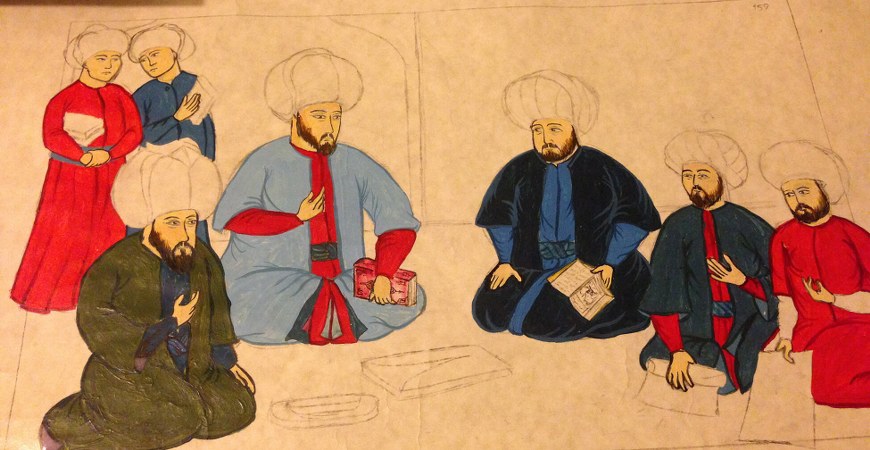
Everyone probably knows about the Turkish Ottoman Empire that existed for many centuries. But it was the empire of the Ottoman Turks. Here we will touch a little on the topic of their predecessors, the Seljuk Turks, who managed to capture vast territories by the 11th century.
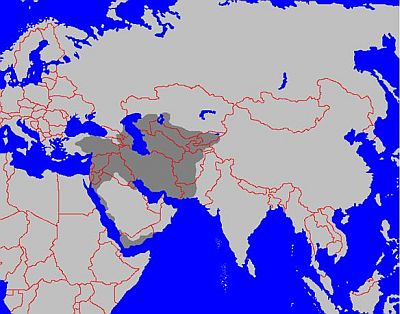
Possessions of the Seljuk Turks in the middle of the 19th century
Their original history is virtually unknown, historians can only speculate and speculate about who they were and where they came from. Judging by the names of the rulers, they were Turks who came from Central Asia. By the name of one of them, a Seljuk who allegedly lived for 107 years (this does not speak in favor of the truthfulness of this whole story), they began to be called Seljuk Turks. For several decades, the descendants of Seljuq managed to capture a significant part of the Baghdad caliphate, including Baghdad itself. But strangely enough, according to traditional history, caliphs from the Abbas family continued to rule in Baghdad. Historians explain this by the fact that the Seljuk sultans, having deprived the caliphs of secular power, left them the spiritual administration, and after a while gave them Baghdad and the surrounding lands. A beautiful but incongruous tale of traditional history.
In the middle of the 13th century, Baghdad was conquered by the Mongols, and the Abbasid caliphs immediately moved to Egypt, where they nominally led the country. The dynasty is not interrupted. What can be said here?
We see a clear chronological overlap: whereas in other cases the traditional chronology duplicated and scattered the same events over different centuries, here two different historical events appeared on the same historical segment and on a common territory. One is the rule of the Arab caliphs, the other is the rule of the Turkish sultans.
This can only be explained by the fact that the extant sources are fragmentary and largely far-fetched. The Abbasid dynasty, according to TV, stretches continuously from 750 to 1517. I suspect that most of the caliphs represented in it are simply fictional. We find exactly the same fictions when we consider the endless succession of popes, and this is precisely one of the main arguments of TV proponents: since there is a continuous chain of popes, the traditional chronology is correct. However, just like many Baghdad caliphs, a significant part of the Roman pontiffs is a medieval invention.
It is symptomatic, but the Seljuk Turks enter the historical scene immediately after the defeat of the Khazar Khaganate by Prince Svyatoslav. The number of Turks in Asia Minor has been increasing rapidly since the second half of the 11th century. In the same years, the Cumans, who were also Turks, appeared on the southern borders of Ancient Russia. The Turks are even seizing power in Egypt. TV’s explanations of such Turkic ubiquity are inconclusive, as a reasonable question arises: where and why did the activity of the Arabs disappear so suddenly? There is a feeling that the Arabs, if they do not disappear from the territory of the caliphate, then at least they become invisible.
The newcomers, the Turks, eventually assimilated the population of the territories of modern Azerbaijan, Turkey and part of Iran, although these lands have been inhabited since ancient times by peoples of high culture by those standards. However, the wild horde was somehow able to assimilate them. This is difficult to explain. However, if we assume that the population of these territories was sparse at the time of the arrival of the Turks, i.e. significant territories of Asia Minor were sparsely populated, then the process of assimilation by the Turks, of course, could well have been successful. The sparsely populated area of these lands, according to AB, can be explained by the consequences of the Semitic invasion of this region and their policy of extermination of the local population.
However, the success of assimilation, nevertheless, must imply the presence of a certain culture among the invading Turks. Traditional historians try to present the view that due to the spread of Islam among the Turkic tribes in the 9th and 10th centuries, they had the beginnings of a higher Arab culture, and the art of war also grew under Arab influence. Without denying this statement, however, I would like to note that these are only factors of a later period that made it possible to successfully continue assimilation. But they could not yet exist at the initial stage, when the Turks were just beginning their conquests.
The solution to this problem can be found in A. Koestler’s «The Thirteenth Generation». He writes that «the great Seljuk dynasty seems to have been closely related to the Khazars. This is reported by Bar Gebrey. Further along Koestler: «Bar Gebrey reports that Seljuk’s father Tukak was a commander in the army of the Khazar kagan and that after his death Seljuk himself, the founder of the dynasty, was brought up at the kagan’s court.… One of Seljuk’s four sons was given the Hebrew name Israel, and one of his grandchildren was named Dawud (David).»
The defeat of Khazaria by Svyatoslav allowed the Turkic tribes under the rule of the Khazars to gain independence and begin expansion into Transcaucasia. At the same time, the Seljuk Turks were no longer as wild as the TV portrays them to be. From contacts with the Khazars, they received the basics of culture and, most importantly, the basics of military art. The presence of Jewish names among members of the Seljuk clan can be explained by Judaism among some Turks. But in Transcaucasia, they encountered active Islam, which eventually led to the Seljuks’ conversion to the Muslim religion.
There is another explanation for the Turkic ubiquity in the pages of history. Yes, there were many of them, but not all historical Turks were such in reality. Thus, many Ugric tribes were declared Turks. The same Pechenegs, Huns, Khazars (more precisely, their Ugric components before contact with the Semites). And if the nations of Hungarians and Ossetians had not survived to this day, then the Hungarians and part of the Alans, too, would most likely have been declared Turks by historians.
The famous historian Professor A. G. Kuzmin in his work «The Khazar Sufferings» gave an example of deciphering the Saltovo-Mayak inscriptions (the area of the forest-steppe part of the Don region, where mostly Alans lived). «Without denying the Alan-Bulgarian identity of the settlements and burial grounds of the Don region, M. I. Artamonov began to think that these peoples had also been assimilated by the Turkic-speaking Khazars. This idea seemed to be verified and confirmed by the Turkologist A.M. Shcherbak, after reading a number of inscriptions of the Saltovo-Mayak culture as Turkic, and M. I. Artamonov immediately accepted this reading as a fact of great importance.» That was in 1954. And in 1971, it turned out that «Shcherbak not only translated incorrectly, but even reproduced all the inscriptions incorrectly, since he had not even seen them in the original. In fact, some of the inscriptions turned out to be Alano—Ossetian, while others were Circassian.»
But here’s what’s interesting: in 1976, that is, five years later, S. A. Pletneva’s book «The Khazars» was published. «The conclusion of M. I. Artamonov was also accepted by S. A. Pletneva, recognizing it as likely that by the middle of the 8th century a «common language» had spread on the territory of the khaganate, which «even the Iranian-speaking Alans» accepted» (A. G. Kuzmin). Turkism is still triumphant!
In Masudi’s work «Placers of Gold» we read: «Then follows the kingdom of Alan (al-Lan), whose king is called K. K. ndaj, which is a common name for all their kings.» In the notes to the work it is reported that K. rk. ndaj is probably a Turkish honorary title (kar—kun-dedj), and the element kar is found in many Turkish names and words. A little more and you see, historians recognize in some Alan tribes not Indo-Europeans at all, but Turks.
Meanwhile, the appearance of this title among the Alans is quite understandable from the point of view of AV. The same notes to Masudi’s work mention the names of the North Caucasian emirs.: These are Ishaq ben Kundaj and Ishaq ben Kundajik ben Urhur. And the names are Jewish! Ishaq, THE SON OF Kundaj. Ben is the Hebrew word for «son» (in Arabic, «son» is ibn). Therefore, we are immediately told that these emirs could be of Khazar origin. And here I agree with traditional historians. Indeed, these names are of Khazar, i.e. Jewish (by AV) origin. Kundaj is also, it turns out, the name of a Semitic root.
What were the names of the Alan kings? K. rk. ndaj. Otherwise: Kar Kundaj. But «ker» is a slightly corrupted Semitic «sar», i.e. «king, ruler»! Thus, we have that the Alan king was called «King Kundaj». Where did the Alans get their Semitic names from? It is quite possible that this king Kundaj was from the Khazars, i.e. Jews. The Semites practiced placing their tribesmen on the throne of their subordinate tribes.
A few centuries later, the Seljuks were replaced by their kindred Ottomans. At the very end of the 15th century, when the persecution of Jews began in Spain, it was the Ottomans who invited these refugees (Gentiles!) and even created conditions for their life and trade.