
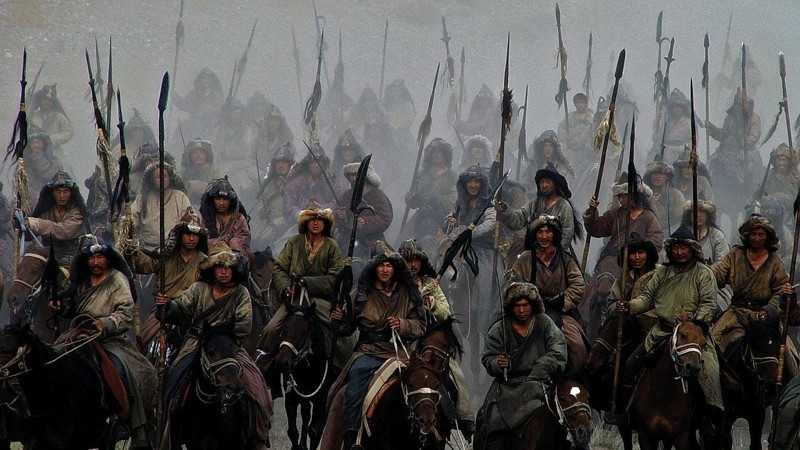
In the 3rd and 4th centuries, a great migration of peoples took place in East Asia north of China, reaching the borders of the Roman Empire in Europe. It began with the migration of the Southern Huns (Nan Xiongnu), Xianbei, Di, Jie, and other tribes, who gradually advanced from the north to the Central Chinese Plain, the cradle of the ancient Chinese ethnic community.
The nomadic tribes were the natural masters of the steppes of Inner Asia. Although the nomads differed in ethnicity and belonged to different language groups, they were all united by their native steppe. From generation to generation, its inhabitants adapted so well to local conditions that their culture, all their activities, and their very lives became so closely intertwined with the processes of nature that they became, in a sense, an integral part of the landscape they had mastered.
These young peoples easily read the natural book of their native steppe. Mobile and unpretentious, they easily covered huge distances, perfectly adapted to steppe life, and therefore it was not easy for sedentary peoples to resist their rapid advance. However, in times of severe weather, when the steppe could not feed their livestock and it died, the nomads left their homes in search of new pastures and penetrated deeper and deeper into northern China, where so-called barbarian states arose and fell, replacing one another.
With the collapse of the Hunnic alliance in the north, the southern groups of the Huns remained in the northern regions of Shanxi and Inner Mongolia. Their main occupation was cattle breeding. Representatives of the upper echelons of the five Hunnic tribes elected a supreme ruler, the shanyu, who gradually came to possess hereditary power. The shanyu had long been related to the Chinese imperial family, marrying Chinese princesses, and their eldest sons were often raised at the Han court. The camps of the shanyu and aristocrats accumulated considerable wealth. The Han emperors sought to establish relations with the nomads.
Chinese officials served at the court of the Shanyu and the heads of the five aimags. Chinese merchants traded and exported livestock. Hun troops often came to the aid of emperors or took on the task of guarding the borders. With the collapse of the Han Empire, the Shanyu began to actively intervene in Chinese civil strife. At the beginning of the 4th century, the Jin state, torn apart by turmoil, became easy prey for nomads. China experienced a tragedy of national proportions. The north of the country, the vast territories of the Central Plain in the Yellow River basin, was seized by steppe tribes. The troops of the Jin Empire were powerless against the powerful Hunnic cavalry that occupied the central provinces. In 311, Luoyang fell, and in 316, Chang’an fell. The emperor of the Jin dynasty was captured, humiliated, and executed. All those involved in the government fled south in fear. The courtiers, who gathered in Jiangye (Nanjing), proclaimed one of the descendants of the Sima family as emperor of the Eastern Jin dynasty (316-419).
Following the Huns, who had struck the Western Jin Empire, numerous other tribes that roamed along the land borders of the Chinese Empire were set in motion.
After the Huns, the largest group was the Xianbei tribes, who roamed the northeast and were engaged in hunting and cattle breeding. Their leaders and nobles had long traded with Chinese merchants, sent tribute and hostages to the court, and received titles and valuable gifts in exchange for promises to stop their raids.
Chinese politicians had long tried to use the Xianbei in the fight against the Huns. Since the 3rd century, the Xianbei tribes had been divided into several large alliances. The most numerous of these were the alliances of the Rouran, who ruled southern Manchuria, and the Toba tribes, who roamed Inner Mongolia and Ordos. The Rouran tribes occupied Hebei and waged long wars against the Huns. With the support of the Chinese, they established their own state, Yan.
The inhabitants of the western regions also sought to acquire the riches of the Middle Kingdom: tribes of the Tibetan group occupied the lands of Gansu, Shaanxi, and Ningxia. Their nobility established royal power and formed the state of Qin. These northwestern tribes possessed military power. Their conquering ambitions led to clashes with the Muyu, and then with the Chinese. A huge army, led by Fu Jian, the ruler of Qin, set out on a campaign, overcoming high mountain ranges and rushing rivers. Through Henan, the Qin army moved southeast, directing its attack against the Chinese who held the coastal areas of the Yangtze River. In 383, at the Feishui River in the Huaihe basin, they clashed with a small enemy force. The commanders of southern China, using cunning in the style of ancient military art, inflicted a crushing defeat on Fu Jian’s hordes. The nomads fled in panic. The Qin dynasty collapsed. The states created by the conquerors in northern China were politically unstable. Wars were accompanied by the enslavement of the indigenous population. Northern China, the oldest cultural center with the most developed and densely populated territories, turned into an arena of almost a century of war. Only a new grandiose invasion put an end to these incessant military clashes and campaigns: the Xianbei tribes of the Toba captured northern China. At the end of the 4th century, their leader Toba Gui was proclaimed emperor. Organizing the state apparatus, he turned to the Chinese system of government. Having broken the resistance of the small states of the tribal unions, the Toba invaded China in 367. Authorities based on the Chinese model were established in the conquered territory. Toba Gui’s grandson established the Northern Wei dynasty (386-534) in northern China.