
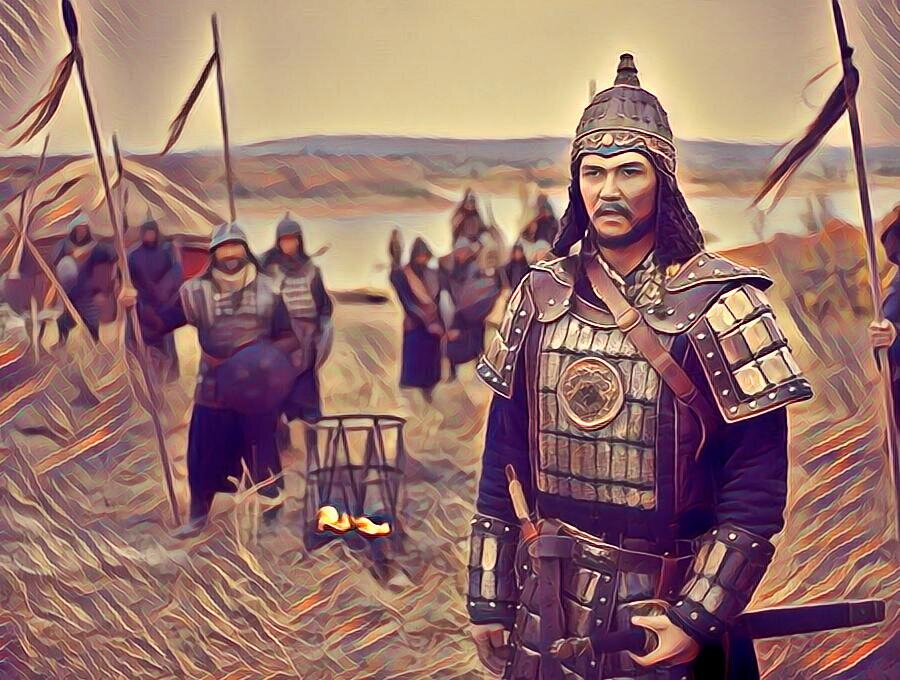
Is Kublai Khan the Mongol great Khan or the Chinese emperor? (Part One).
The fifth and last great Mongol Khan Kublai Khan was born in 1215. He became the founder of the famous Chinese Yuan Dynasty. His father was the youngest son of Genghis Khan, Tolui, and his mother was the Kerait princess Sorkhakhtani beki, who was the niece of Wang Khan and professed the Christian faith, although the Nestorian branch of it.
After the creation of the Yuan Empire, there were many natives of the Turkic tribes in China – Kipchaks and Kangly, who joined the Genghisid troops. Among the military leaders of the army that conquered China, Chinese sources name many Kipchaks and Kangly.
The promotion of Kipchaks and Kanglas to important posts in China during the era of Genghis Khanid rule occurred after the collapse of the Genghis Khan Empire into separate states, in the midst of internecine wars between Kublai Khan and his successor Timur Khan, on the one hand, and a coalition of Genghisid nobility led by Arigbuka and Haidu, on the other. During the feuds among the representatives of the aristocracy who contested the Great Khan throne, Kublai Khan found in the Kipchaks and Kangly an important military support for the policy of centralization. Since then, their military importance for the Yuan emperors, in particular for Kublai Khan, has been increasing. «Yuan-shi» writes that in 1287, by order of Kublai Khan, guard units from Kipchaks and Kangly were formed in the Yuan Empire. In 1291, the Kipchak guard was increased. «In the 23rd year of Zhi Yuan (1286), Emperor Kublai Khan established a personal Kipchak guard…»
One of the famous commanders of the Yuan army was Kipchak Tutukha, whose biography in «Yuan-shi» contains a number of information about the role of the Kipchaks that they played in the Yuan Empire. Tutukh’s father, named Banduchar, while at the head of his tribe, voluntarily submitted to the Mongols, took part and distinguished himself in the campaign against Russia. Then he commanded the Kipchak hundred in the troops of Kublai Khan. «Yuan-shi» testifies to this: «Under the leadership of Shizu (Kublai Khan), he conquered Dali (a state in southern China) and conquered the Song. They called him strong and valiant…Tutukha was the son of a Banduchar…Father and son, under the command of Shizu, went on a campaign to the north (i.e., to Mongolia against the Genghisids hostile to the Yuan throne), where both distinguished themselves and were awarded. Banduchar is dead.»
After the death of Banduchar Tutukha, he inherited his father’s position in the military, in particular, in the guard. «… When the supreme Wang Haidu prepared a rebellion, Shizu, since the best lands of the state were seized, ordered the heir to the throne Beipingwan (title) to lead all the wangs (khans – members of the Genghisid dynasty) and return these lands. But in the 14th year of Zhi-Yuan (1277), the Wangs (representatives of the nobility) That is, the Shilets rebelled and robbed their kindred tribes. They seized the large yurt of Xianzong (Mongke, the last great khan of the unified Mongol Empire) and were about to leave. Tutukha led the army and punished them. He defeated their commander Toerchian in the Nalanbulak area (in Mongolia) and called on all the tribes to return (under the rule of Kublai Khan). But a certain Zhiervatai prepared a rebellion and Totomu led troops to his aid. But during the campaign, the latter unexpectedly encountered Tutukh, who decided to join the battle. Before that, he had captured several enemy patrols. Totomu then retreated. Then Zhiervatai was destroyed, and Totoma (Tutukha) was pursued to the Tola River. Returning three nights later, [Tutukha] again attacked their trail and defeated them at the Orkhon River. He returned the large yurt they had captured, and the people of all the tribes returned to Beiping. under the rule of Kublai Khan).
In the 15th year (1278), a large army of [Kublai Khan] marched north (to Mongolia). Tutukha, at the head of a thousand Kipchak horsemen, pursued Shiletsi, seized Zhakhutai and others [enemies of the Yuan throne] to present them to the sovereign. Jinshan (Altai) has crossed. Defeated Kuanzhegen and other [enemies of Kublai Khan] again. Despite his wounds, he was bandaged, fought vigorously, and captured a large number of sheep, horses, and wagons. He returned to the emperor’s court. The emperor called to appear before the throne and personally caressed him with his attention. He presented [him] with gold and silver wine vessels, 100 liang (a measure of weight) in silver, and nine gold coins. During the year, for feasts, he [gave him] a set of clothes with a headdress, a white falcon from Haidun (for hunting), and also presented his yurt to [Tutukha], who had been returned from robbers. At the same time, the emperor said: «The yurt of my ancestors has not yet been given to anyone, but based on the fact that you were able to return it, I grant [it] to you…»
Yuan-shi reports on Kublai Khan’s decree to place all Kipchak military units under Tutukh’s command. He was instructed to select the most dedicated Kipchak warriors to guard the emperor’s personal headquarters, and the necessary financial resources were allocated for this purpose. As a result of his activities, the personal imperial Kipchak Security Guard was established. Subsequently, Tutukha was appointed commander of the guard. All the troops formed from the Kipchaks, who had previously been subordinate to other high-ranking officials and members of the imperial family, were under the command of Tutukh. His influence at the Yuan court was reinforced by his family ties with the ruling dynasty. He was married to a girl from the imperial family. Tutuha also became famous as a military commander in the wars against the Arigbuki and Haidu and their noble allies. During 1277-1278, at the head of thousands of mounted Kipchak warriors, he participated in two campaigns of Kublai Khan on the territory of Mongolia and crossed the Altai Mountains. He distinguished himself in these campaigns, for which he was awarded an award. In 1287, under the command of Kublai, he suppressed the uprising of the governor of Liaodong, Nayan, who defected to the side of Haidu.
«In the 24th year (1287), His Serene Highness Nayan rebelled,» writes Yuan–shi, «and secretly sent an ambassador to communicate with Yebugan, Shenlakh (enemies of Kublai Khan from among the nobility). Tutukha intercepted [the ambassador] and [Nayan’s] plans were revealed and brought to the attention of the emperor. Shenlaha hosted a feast and invited two famous military leaders [Kublai Khan] Doerdohuai and Tutukh. Doerdohuai went there, but Tutukha decided that this was a dark matter and did not come. Thus, Shenlaha was unable to carry out [his plan]. Soon, there was a decree from [the emperor] and Shenlaha was ordered to appear at the emperor’s court. [Shenlaha] took the east road. To which Tutukha replied: «The lands in the east are divided. What a surprise! It’s like letting a tiger into the mountains and forest.» Then [Shenlaha] was ordered to take the road from the west. And when it became known about Ebugan’s rebellion, everyone wanted to inform the emperor about it as soon as possible. Then the troops withdrew. Tutukha said: «It is very important that the troops act quickly, like a spirit. And if the enemy suddenly mutinied, our troops would suddenly approach, then victory was a foregone conclusion.» [Tutukha] raced for seven days on horseback, crossed the Tolu River and defeated the Fucker, who barely managed to escape. Shizu (Kublai Khan) then led a campaign against Nayan himself. The incident reached his highest ears and he sent a messenger to Tutukh with orders to capture the remnants of the gang.
In the lower reaches of the Tutukha River, he met with 18,000 horsemen of the rebellious Jiege, attacked them and put them to flight, capturing many horses. The rebellious van Haermu and others were captured.… At this time, Chenzong (Timur Khan, heir to the throne) and the emperor’s grandson called on the troops to follow the north, including Tutukha. The remnants of the gang caught up in the Halawen area. The rebellious Khan Udakhai was executed. And as a result, they forced their crowd (i.e., Nayan’s supporters) to obey. In the 25th year (1288), Zhuwang (Prince) Yezhili was attacked by the rebellious army of Kholuhesun. I sent a messenger to notify you as soon as possible. [Tutukha], under the command of the emperor’s grandson, moved with soldiers to his aid. Defeated Zhuuluhui and returned to the Halawen Mountains. At night, he crossed the Guilehe River, defeating the rebellious Wang Hedan (Kadan). As a result of [these victories], he took [control of] all the tribes on the right side of Liaohe. He established the directorate of temniks (commanders of 10,000 troops) of the eastern districts. Shizu often rewarded him. [Tutukha] married Dalun, Yezhili’s younger sister. In the year 26 (1289), under the command of the emperor’s grandson, he fought against Haidu. I arrived at the Hanai Ridge. The enemy was positioned at the precipice and all the attacks of the troops failed, and only Tutukha and his soldiers helped the emperor’s grandson with a fierce frontal attack. He ambushed the enemy with selected units.
In the spring, on the 7th moon (in July), Shizu deigned to inspect the northern borders. Tutukha was invited to appear before his eyes. The Emperor graciously told him: «In ancient times, Taizu (Genghis Khan), along with those of his servants with whom he drank water from Lake Banju, remembered this as their merit. (This refers to the time when Genghis Khan, in a difficult time for him after his defeat by the Kerait Van Khan, escaped to Lake Baljuna with those few comrades who were devoted to him). But the present deeds, how they are ashamed of the ancient people! (Figuratively speaking, «there were people in our time, not like the current tribe!»). The sovereign is making efforts to (i.e., to revive the mores of the era of his grandfather Genghis Khan). Returning to the capital, [Kublai Khan] invited his entourage to a big feast and turned to Tutuha again.: «People from Shofan (Mongolia) came and brought to our (i.e., Kublai Khan) ears the words of Haidu: «People and bosses like Tutuha are needed to protect Khanai. In 1291, Tutukha asked Kublai Khan to place several tens of thousands of soldiers under his command in order to keep them in constant combat readiness to ensure the security of the Yuan throne.
«…In the same year («Zhi-Yuan», year 28, I moon, Zhen-xu day, February 23, 1291), due to the fact that Tutukha commands troops in the places of [settlement] of the Vengu [Ongut], officials were ordered to meet their military needs. The decree of shangshusheng (local State Council body) was issued in Lu (district) Datong to give out enough rice to help the starving people of Vengu…»Earlier in 1287, «the people of Vengu were starving, 4 thousand shi of rice were given to help them…» As is obvious from the text, in the military efforts of the Yuan Empire in Central Asia, a certain place was given to the Turkic-speaking Onguts (who lived in modern Inner Mongolia), that it led to their plight. Consequently, there were Onguts under Tutukh’s command. In 1292, he led 10,000 soldiers on a successful campaign against Haidu. In 1293, Tutukh’s warriors conquered five Kyrgyz tribes living on the Yenisei and defeated Khaidu again. This was far from the first campaign against the rebellious Kyrgyz who entered the empire of Genghis Khan in 1206-1207. According to the information of the same Yuan-shi, the Mongolian military commander Jiatalahun, an artilleryman of stone throwers, distinguished himself in battles in the upper reaches of the Yenisei before marching on Jin in 1234. *** The consequence of these campaigns was a sharp deterioration in the life of the population in the lands engulfed by the fire of civil strife. «On the 28th year of Zhi-Yuan, the 4th moon, on [the day of] jisa (May 1, 1291), the people of Kolijisa (Kyrgyz) were helped with 3 thousand shi rice…» In this war, which was fought mainly on the territory of the Sayano-Khangai-Altai highlands, the opponents used all Turkic and The Mongol tribes of the Yenisei-Irtysh interfluve and the Altai-Khangai Highlands, the latter spread throughout this area during the war. Among them were the tribes of the Kipchaks, Kangly, Kyrgyz, and Mongolian tribes of the Yenisei-Sayan region. It is in this connection that it is of interest to study the circumstances of the movement of the Kipchaks led by Tutukh, who had Kyrgyz tribes as vassals. Together with the Kipchaks, Kangly and Kyrgyz, who were part of the army of Kublai Khan, moved along the Altai-Khangai highlands. Kublai Khan more often forcibly than voluntarily took them to his possessions, resettling them in Mongolia and China. Yuan-shi reports on the resettlement of part of the Kyrgyz to the Karakorum region (Helin) and to Shandong.