
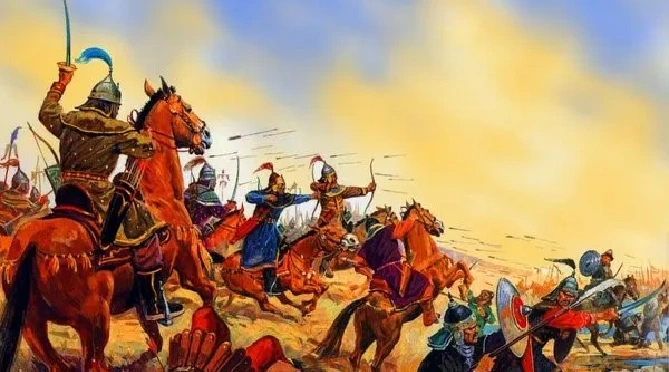
When, in 209 BCE, a young chieftain named Modu killed his own father and seized power over the scattered nomadic tribes of the Mongolian Plateau, no one could have imagined that he would create an empire that would reshape the history of Eurasia.
Chinese chroniclers called them “Xiongnu” (匈奴)—literally “fierce slaves.” For centuries, they were regarded simply as savage barbarians. But modern science and archaeology prove: this was the first true steppe empire in human history, with an army of 300,000 horsemen, sophisticated diplomacy, and technologies that changed the world forever.

The Bloody Path to Power: Modé’s Whistling Arrows
The story of the Xiongnu’s rise began with a family drama. Shanyu (ruler) Tumian decided to get rid of his eldest son, Mode, in order to pass the throne to his younger son by his favorite concubine. He sent Mode as a hostage to the hostile Yuezhi tribe, and then treacherously attacked them, hoping that in their anger they would execute the young man. But Mode stole a horse and miraculously survived.
Upon his return, he devised a way to create an utterly loyal army. Mode invented whistling arrows—tips that emitted a piercing sound as they flew. The order was simple: “Shoot where my arrow flies. Anyone who hesitates will lose their head.”
First, he shot an arrow at his beloved horse. He beheaded those who did not fire. Then—at his beloved wife. Again, he executed those who hesitated. And finally, while hunting, he shot a whistling arrow at his father. That day, Mode became the new Shanyu.
The Army That Forced China to Change Its Ways
The Xiongnu revolutionized warfare. Their primary weapon was a complex composite bow with bone limbs. It could be fired from horseback with incredible penetrating power. Each warrior took five horses on the campaign, switching them out as they went. Their speed seemed mystical to the Chinese infantry.
To somehow counter this lightning-fast cavalry, the Chinese had to resort to an unprecedented humiliation—giving up their traditional long robes. Even earlier, the ruler Wulingwang had issued a scandalous decree: to dress the army in “barbarian clothing,” that is, riding pants and short jackets. Conservatives were tearing their hair out, but military necessity triumphed over centuries-old traditions—the Xiongnu literally forced the world to wear pants.
The Great Wall and the Tragedy of the Chinese Princesses
It was precisely pressure from the Xiongnu that forced China to invest colossal resources in the construction of the Great Wall of China. But even it did not always save them.
In 200 BCE, Modu surrounded Emperor Han Gaozu with a massive army near Mount Baiden. To save itself, China adopted a policy of “heqin” (“peace through marriage”). Emperors began paying tribute in silk and wine and, most dreadfully, giving their daughters in marriage to the Xiongnu.
For refined Chinese women, this was a descent into hell. Instead of palaces—wind-swept felt yurts. But the greatest culture shock was caused by the custom of levirate marriage. When a Xiongnu chieftain died, the Chinese princess “passed by inheritance” to his son or younger brother. For the Chinese, with their ancestor worship, this was monstrous incest, while for the nomads, it was a common practice to protect women and preserve property within the family.
Mistresses of the Steppe and the “Smell of Raw Mutton”
While the men were away for months on raids, the Xiongnu women took full control of the nomadic camps into their own hands. Unlike Chinese women, who were confined to their homes, nomadic women enjoyed immense freedom. They managed the economy, tended the herds, and knew how to ride horses and shoot bows to defend the camp from enemies. The wives of the highest nobility even had a say in the councils of elders.
Chinese chroniclers often complained about the Xiongnu’s distinctive odor, calling it the “smell of raw mutton.” The fact is, the nomads’ diet consisted mainly of meat and sour milk (kumis). And to protect their skin from the harshest steppe frosts, the Xiongnu generously smeared their faces and hair with animal fat. Harsh? Yes. But it helped them survive where the pampered inhabitants of the south would perish within a week.
The Domino Effect: A Skull Cup and the Impact on India
The Xiongnu changed history even in places their horses never reached. After defeating their main rivals—the Yuezhi people—the Xiongnu ruler fashioned a wine cup from their leader’s skull.
Terrified, the Yuezhi fled their homes and migrated westward, setting off a great “domino effect.” They drove out the Saka (Scythians), who rolled into India (establishing Indo-Scythian kingdoms there), while the Yuezhi themselves settled in Bactria and founded the Kushan Empire. In other words, a single conflict in the Mongolian steppes led to a redrawing of the political and religious map from Central Asia to India.
Who Were They? Scientific Sensations of 2025
For many years, scientists debated: who were the Xiongnu, and where did they disappear to?
In 2025, geneticists and linguists put an end to many of these disputes:
1.A Linguistic Mystery: In the summer of 2025, a study by linguists was published proving that the ruling elite of the Xiongnu spoke an early form of the Arian language. It belongs to the Yeniseian language family and is related to the Ket language in Siberia and… the language of the Navajo people in North America!
2.The Path to Attila: In the 1st century CE, the Xiongnu Empire split, and part of the horde moved westward. They traveled across the steppes of modern-day Kazakhstan, Siberia, and the Volga region, intermingling with the local Sarmatians and the ancestors of the Slavs. A genetic study published in the prestigious journal PNAS (2025) found direct DNA links between the Xiongnu elite in Mongolia and the Hun elite in 5th-century Europe.
This means that the famous Hun leader Attila, who struck fear into the mighty Roman Empire, was a direct descendant of those very steppe rulers who, centuries earlier, had brought Ancient China to its knees.