
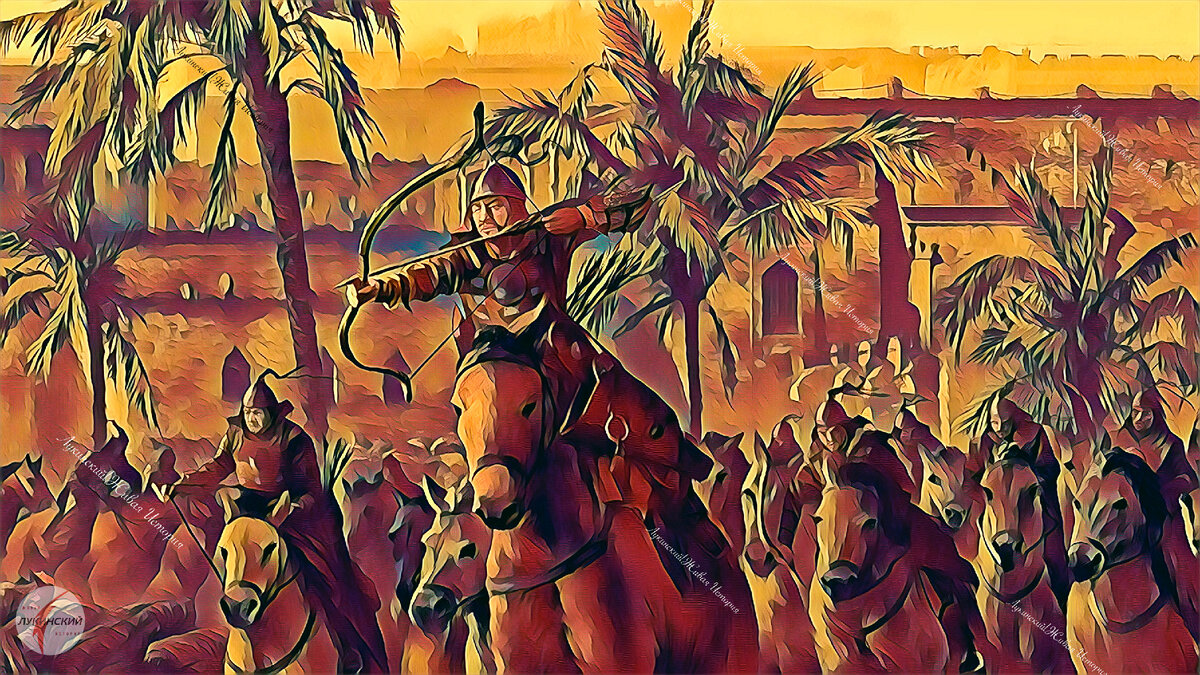
Mamluks: Slave Warriors Chapter 1 The Tulunid Kingdom and the New Army Recruitment System
Part 1 Mamluks: Slave Warriors
Chapter 1 The Tulunid Kingdom and the New Army Recruitment System
The energy of the Egyptians, who once created a great kingdom, dried up already in the XVIII century BC. The last ethnic impetus that created a New kingdom and raised the dynasty to greatness and glory, which gave Egypt pharaohs Ahmose, Thutmose III, Amenhotep II, Akhenaten, Pharaoh Hatshepsut, passed and the country that became an empire began to decline hopelessly to decline. The country has gone through its own development cycle. Although the Egyptians still retained their high knowledge in the fields of astronomy, agriculture, irrigation, medicine, and construction. But a fading ethnic group, according to Gumilev, loses its ability to defend itself at this stage of «old age.» And as a result, Libyans, Nubians, Assyrians, Persians, Macedonians, Romans, or those who knew how to hold weapons in their hands took over rich Egypt in turn. The Egyptians themselves practically no longer resisted the conquerors and let them fight each other.
The ethnic system of the Egyptians was simplified to the point that they lost even their name – Egyptians, and they began to be called Fellahs by their occupation, which means «farmers».
And this ethnic group has never dared to assert itself again. Other people came here, who became the heirs of the great power of the pharaohs. After all, while the Nile deposits fertile silt in the fields, Egypt was the richest country in the Mediterranean.
In the 7th century, the Arab ethnos confidently asserted itself. Few people had ever heard of slaves before, and none of them had expected such a violent surge of energy. And this is not surprising, until the sixth century, the Arabs were quiet and quietly grazed camels, or bred date palms in oases.
But the Prophet Muhammad came and gave them a new religion that managed to unite the fragmented and unfriendly tribes. The offensive of the Arab tribes was so strong that they crushed Iran and tore off the richest provinces of Syria and Egypt from the Byzantine Empire.
In 660 AD, Muawiyah ibn Abu Safyan founded the mighty Umayyad dynasty and moved his capital to the city of Damascus. The Umayyads directed the excess energy of their subjects to the conquest of Central Asia, Transcaucasia, North Africa, Spain, Aquitaine. And for almost a century they went from victory to victory.
Then the Umayyads lost the palm to the Abbasids, who created a new caliphate and moved the capital to Baghdad. And at the end of this dynasty of caliphs, Egypt was reborn as a powerful and independent state. The Tulunid dynasty came to power there, founded by Ahmad ibn Tulun, who was the son of Ghulam, in other words, a simple slave who served in the caliph’s guard. Subsequently, the Ghulam guard, or as they were later called the Mamluks, largely began to determine the policy of the country of Kemet.
Tulunids and the Gulyam Guard
The Tulunid dynasty was the first independent dynasty that ruled in Syria and Egypt without obeying the caliphs of Baghdad. The army recruitment system in Egypt under this dynasty was very remarkable. Subsequently, it will be returned to more than once in many sarans of the East. Many Muslim rulers then began to understand the unreliability of relying on local troops and began to look for an alternative.
The alternative was an army made up of slaves. At first glance, this may seem crazy. Who would entrust a slave with a weapon? Yes, the first thing he does is attack the owner, many will say. But this is not the case. The Greeks and Romans often trusted slaves with weapons, and in our case we are talking not about ordinary slaves, but about warrior slaves.
So, what is the advantage of such a guard? All the slaves bought in Egypt were strangers and no one needed them outside the barracks. And the barracks gave them relative comfort and the right to belong to the warrior class. And the soldiers were well fed and well clothed, too. Also, the prospects for career growth were not bad. It was possible to raise to a centurion, a thousandth, and even become a corps commander! And all this could be provided by personal bravery and talents.
Did these slaves have such an opportunity in their homeland when they were not slaves yet? Most of them don’t. Let’s say a Slavonic slave from Ryazan or Chernigov was sold into captivity by his own co-religionist prince. And where is the guarantee that when he returns home, for example, he will not be sold again? And where to go back to? His house was burned down in an internecine war, his property was destroyed and his family was massacred. And if you build a house in Southern Russia, accustomed to the raids of nomads, the problem was small, then no one will return the family. For a young man accustomed to peaceful work and brought up in piety, his whole world collapsed overnight! And you can’t replace it with a new home or a new family. In principle, such a poor guy has nothing more to do with his homeland. Therefore, he will not strive for freedom.
The same can be said about the slaves of the Cumans. A young nomad captured during an internecine war was also sold into slavery, and he also lost everything he had overnight and his world collapsed.
If their fellow tribesmen had sold them into slavery, what was there to believe? The entire value system was radically revised during this period of life.
All of them, the Ghali slaves, were outcasts, and life had battered them badly. But they were young and strong, and they got a second chance, and they took it. Therefore, the Ghulams were loyal and well-knit soldiers. Although gradually this «organism» began to be undermined from the inside. But I’ll talk about this a little later.
Under the Tulunids, slaves for the Ghulam guard were bought from Europe and from Sudan. Therefore, two guards were formed under the rulers of Egypt, a black (Sudanese) and a white one from different nations. And the commanders of these detachments have acquired enormous power.
Ahmad ibn Tulun (868-884)
The founder of the Tulunid dynasty was Ahmad ibn Tulun, who was a Turk by origin.
In 815, a slave named Tulun, among other slaves, was presented to Caliph Mamun by the ruler of Bukhara. And the caliph singled out a capable slave and raised him from the mud to high government positions.
And Tulun’s son Ahmad, who was born in Baghdad in 835, was already marked by a high destiny at birth.
Tulun died in 854, and shortly after his father’s death, Ahmad was appointed viceroy of the emir in Tarsus. And Ahmad’s stepfather Baikbakl received Egypt from the Caliph. And it was this same Baikbuckle who sent Ahmad to the country on the banks of the Nile as his attorney and gave him troops.
Ahmad entered Egypt and quickly took over the reins of government.
In 870, after the death of his stepfather, Ahmad was appointed Emir of Egypt. He quickly realized the benefits that could be derived from Egypt’s geographical location and continued the conquering policy of the pharaohs.
In 878, Ahmad, taking advantage of the death of the governor of Palestine, Jordan and Syria, moved his troops into these provinces, and quickly captured Jerusalem, Damascus, Hama, and Haleb. Then he invaded Asia Minor and started a war with the Byzantine Empire.
But the successful campaign of conquest had to be stopped and urgently returned to Egypt. Ahmad’s own son Abbas rebelled against his father there. While he was restoring order in Egypt, all the conquered provinces fell away from him.
And in 882, Ahmad had to start a new campaign in Syria. And he became successful again, and as a result of these conquests, a communal power arose that can be compared to Egypt during the Late Kingdom.
Ahmad maintained a large army and a strong navy, which became the basis of his power as a sovereign. He made up an army of slaves, among whom Turks, Greeks and Nubians predominated.
Ahmad’s capital was the city of Fustat. Intensive construction began throughout Egypt under Ahmad. New irrigation channels were dug, dams were built, and water meters were repaired.
In 884, this energetic and talented commander and ruler died.
Khumarawaih (884-896)
Ahmad was succeeded by his son Khumarawaih. And he began his reign by having to speak out against Syria again, which had fallen away from Egypt immediately after Ahmad’s death.
The new war in Syria lasted two years and ended in a complete victory for Khumarawaih. And his opponent in this struggle was the Caliph of Baghdad!
In 886, Khumarwaikh invaded Iraq and began to threaten the capital of the caliphate. The power of the ruler of Egypt forced the Abbasid caliphs to recognize the new ruler of Egypt and all his conquests.
In 887, Khumarawaih captured a significant part of Mesopotamia. And by 890, the Tulunid state had reached its maximum size. The borders of the Khumarawaiha state stretched from Sudan in the south to Adana in the north, from Tripoli in the west, to the banks of the Tigris in the east.
But it’s one thing to expand the borders of a state, but it’s quite another to keep the conquests in your hands. What is needed here is not the wisdom of a commander, but the wisdom of a ruler. But Khumarawaih led an idle life and spent a lot of time on pleasure. During his reign, luxurious palaces were built for the ruler, and numerous entertainments were held.
In 894, marrying his daughter to the Caliph Mu’tadid, the ruler of Egypt spent more than 1.5 million gold dinars on the wedding! By doing so, he emphasized his power and wealth.
Sources say that even the trees in the garden of the ruler of Egypt were covered with gold and silver. And after Khumarawaih’s death, there was nothing left for the state treasury. He spent everything on his pleasures! There were only debts and unpaid maintenance for the army.
Under Khumarawaih’s heirs, the dynasty began to decline, and on January 11, 905, the Tulunid state ceased to exist.