
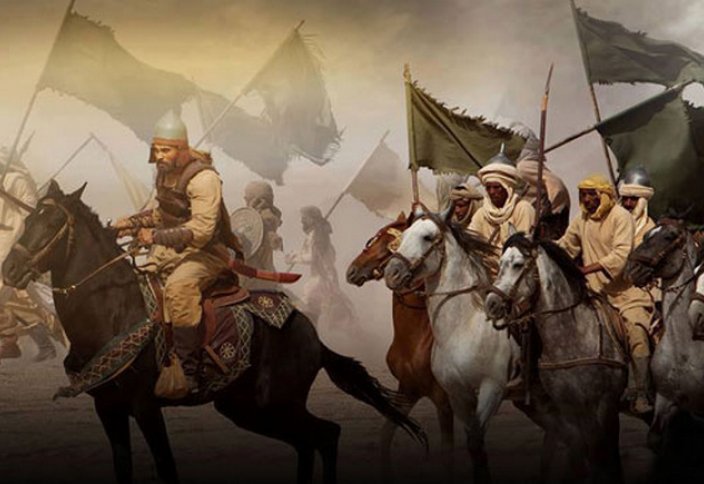
The Mamluks (translated as «belonging») were a military quasi–caste in medieval Islamic Egypt, recruited by the Ayyubid dynasty from young slaves of mainly Slavic, Georgian, Circassian and Turkic origin. The young men converted to Islam, then studied Arabic and trained in closed boarding schools for military service. Having no relatives and no connections in Egypt, on the one hand, they were devoted to the dynasty, but on the other hand, this allowed them to create a powerful conspiracy and take power, creating the empire of Dulat al-Atturk, literally the «Empire of the Turks», or, as it was also called, the «Empire of the Mamluks».
The Arab historian Ibn Khaldun wrote that their rise to power «was a boon from God, for it gave the Islamic world new strength and courage in a moment of weakness and decline and helped to cope with the great danger that threatened it.»
Even the Abbasid Caliph al-Mamun (813-833), creating a detachment of bodyguards and not trusting his fellow tribesmen after a long struggle with his brother, called on people who were not involved in local clan, social or interfaith conflicts. At first, he was guarded by Tarkans, blood relatives of his wife from the Turkic tribe, and then they began recruiting and training young slaves from slave markets. Soon, the caliph’s personal guard reached four thousand, with people from Slavic countries and Africans on foot, and the Turks made up the cavalry.
The Caliph’s personal guard was admired for its dedication and strength, and even scientific works were written about it, for example, the treatise «The Use of Turks» was widely known at that time, the authorship of which is attributed to the famous scientist and writer al-Jahiz (775-868).
In 831, popular unrest began in Egypt, and al-Ma’mun brutally suppressed it with the help of his personal guard. The next governor of the country was Abdullah ibn Tahir, who appointed Turks to many high posts, being sure of their unconditional loyalty. This was the beginning of the rule of the Turks in Egypt.
In 865, the Turkic Ghulams seized power in the Abbasid caliphate, subjugating the caliph.
Mahdi Abu Mohammed Ubaidallah, who came to power in Egypt in 909 and founded the Fatimid dynasty, realizing the precariousness of his position, began to strengthen his personal guard and recruit Slavic, Hungarian and Turkic slaves into it.
Later, Saladin began to recruit an army of slaves, when the war exhausted the human and financial resources of the Fatimid Caliphate, and some Turkic military leaders left his army. It was under him, according to some versions, that such warriors began to be called Mamluks. On one of the islands of the Nile River, Saladin set up barracks where young slaves from slave markets received special training under the guidance of experienced warriors. The first guard created from slaves got its name from Saladin – «salahia». When the Mamluks began to replenish the cavalry, they were called «Bahrits» by the name of the island where the training took place.
Gradually, the Mamluks began to predominate in the Egyptian army, and under Sultan as-Salah they made up a large part of it. The Baghdad Caliph al-Mustassim presented as a gift to the ruler of Egypt, as-Salah, a beautiful young woman named Shajar ad-Durr, who came from the noble but bankrupt Kipchak Durut family. The concubine not only won the sultan’s heart, but also became his faithful companion in military campaigns. After the death of as-Salah, his son, Turan Shah, took the throne. The Mamluks were not too happy with his rule, which caused constant conflicts. Turan Shah, instead of seeking compromises, resorted to intimidation, and also began to change military leaders and officials to people who obeyed him. Shajar al-Durr was a supporter of her husband’s policies, expressing the interests of the most powerful political group: the Mamluks. Unable to endure the oppression any longer, they rebelled.
On May 2, 1250, Turan Shah was assassinated by the Mamluk Emir Baybars. Next, a unique event occurred in the history of Islam: for the first time, a woman, Shajar al-Durr, was proclaimed sultan. The formal basis for the proclamation was that she was the mother of as-Salih’s children, who were rightfully heirs to the Egyptian throne. It is clear that the reason, to put it mildly, was «far-fetched.» Her reign lasted only a short time, only eighty days, but nevertheless, the beginning of the Mamluk era was laid: it was the birth of the Turkic Empire, which lasted for more than two and a half centuries and remained in history as the Mamluk Sultanate.
At the same time, two Mamluk dynasties were founded: the Bahri (mainly of Turkic origin, ruled in 1250-1390) and the Burji (mainly from the Caucasus, ruled from 1390 to 1517).
The high fighting qualities of the Mamluk army have repeatedly been admired by Muslims all over the world, and some chroniclers of that time argued that if it were not for the Mamluk Empire, Islam, as the state religion, could disappear from the world map. And indeed: on September 3, 1260, in the Battle of Ain Jalut (near modern Beisan), the Mamluk troops defeated the Mongols who invaded Palestine and Syria, and then expelled the remnants of the crusaders from these countries. And only the Mamluks were able to cope with the assassins in 1273. The Mamluks had vassalage in the eastern part of Libya (Barqa), Nubia, Hejaz, Cilicia since 1375, Cyprus since 1426.
Egypt’s economic and cultural flourishing began with the beginning of Mamluk rule, which lasted until 1516, when the troops of the Turkish Sultan Selim I conquered Syria, Egypt and Palestine, putting an end to the domination of the military caste.