
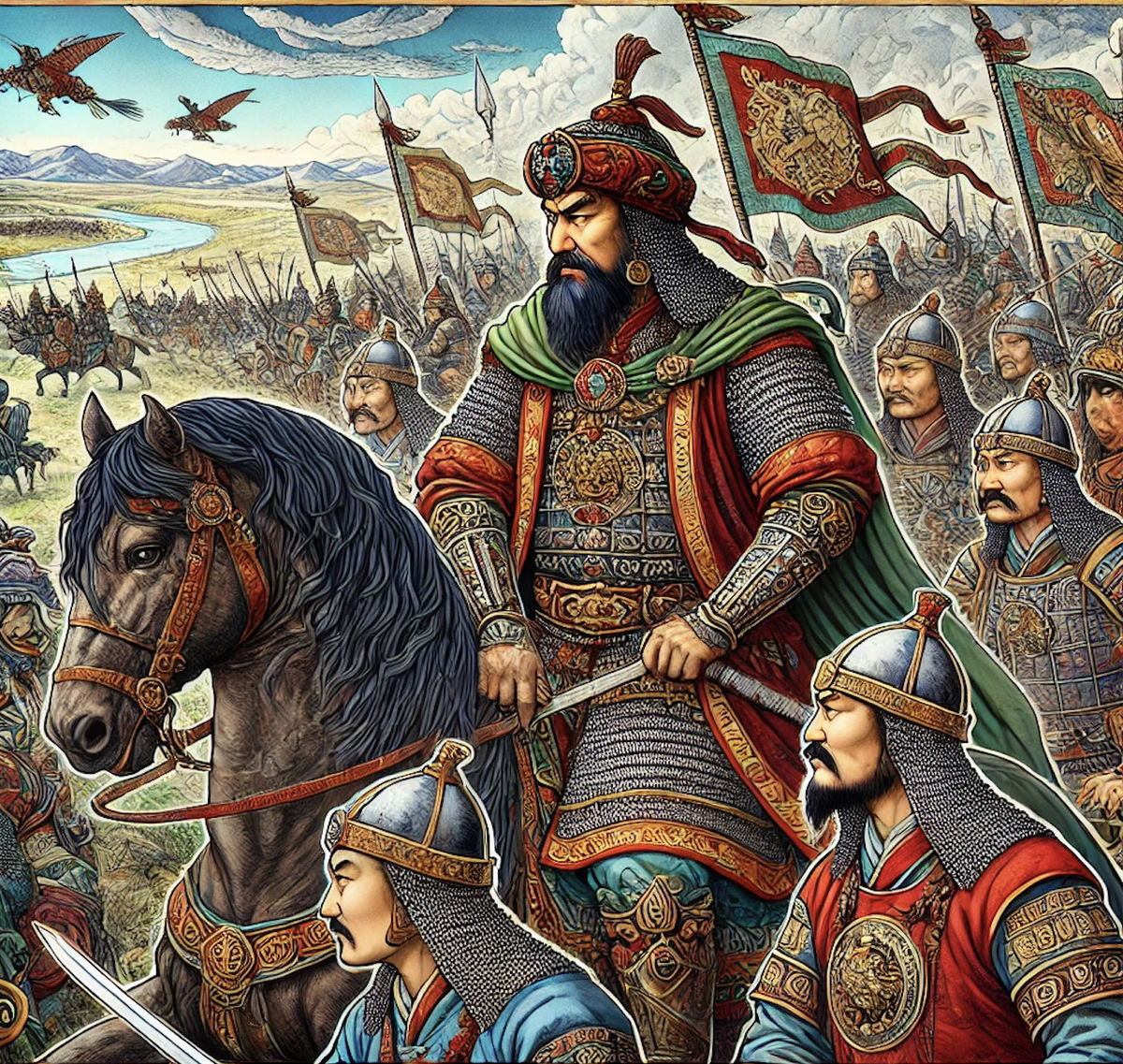
Berke, the third son of Jochi, was born in the lands of Desht-i-Kipchak (the territory of modern Kazakhstan) in the year when his father occupied Khorezm (1220). Upon learning about this, Jochi said, «I will make this son a Muslim.» Shortly after the establishment of strong Mongol power in Transoxiana (between the rivers of the Syr Darya and Amu Darya), Berke was sent to Khojand for upbringing and circumcised according to the Muslim rite. When he reached the age of majority, all the Muslims of the Jochi ulus joined his army.
Berke’s success in the struggle for power was greatly facilitated by the support of Muslim merchants and the clergy of Khorezm. Shortly after Berke’s accession to the throne, the mass conversion of the Golden Horde people to Islam began. Under Berk Khan, the Golden Horde had already fully developed as a large independent state. His name is associated not only with the construction of urban life in the Volga region, not only with the expansion and deepening of trade activities in southeastern Europe, but also with the severe war with the Hulagids (representatives of the Mongol authorities in Iran) and the diplomatic relations with Mamluk Egypt that it caused, as a result of which Berke Khan finally transferred the entire Jochi ulus to Islam.
The Arab writer al-Mufadzal, who described the embassy of the Egyptian Sultan Baybars to the Golden Horde, has preserved for us a peculiar portrait of Berke Khan.:
cite»Description of him: a thin beard; a large yellow face; hair combed behind both ears; a gold ring with a valuable stone in his ear; he is wearing a silk caftan; on his head is a cap and a gold belt with expensive stones on green Bulgarian leather; on his feet are shoes made of red shagreen leather. He was not girded with a sword, but on his sash were black horns, twisted, studded with gold.«

Attacking Mongol cavalry. A drawing from Rashid al-Din’s «World History»
It was under Berk Khan that Nogai first appeared on the historical scene, from the very first moments of the clash with the Hulagids, who proved himself to be a prominent military leader. Nogai (from Mong. «nohai» is a dog), whose name is still used by the numerous Nogai people, who at the end of his life strengthened so much that he founded his own domain, taking a position on a par with the Khans. He was the illegitimate offspring of Jochi’s seventh son, Tutar, and had a huge influence on the fate of not only the Golden Horde itself, but also on the fate of other Mongolian states.

The Mongol ruler and his retinue. A drawing from Rashid al-Din’s «World History»
Great organizational skills, firmness of character, and a tendency to resort to cruel and sometimes simply treacherous means opened up broad prospects for Nogai. Subsequently, many even mistook him for Khan, although he could not become such, with all his desire, because he was illegitimate. Therefore, he had the role of a temporary worker, and sometimes even the actual ruler of the Golden Horde. And if it were not for the Mongols’ deep conviction that only a direct and legitimate descendant of Genghis Khan could become khan, Nogai would certainly have taken this place.
In 1271, Nogai, following Berke’s example, converted to Islam, and in 1273 he married Euphrosyne Palaiologos (daughter of Mikhail Palaiologos). Nogai achieved his greatest power in the early years of Toktykhan’s reign, when the temporary ruler, having killed all the sons of Batu’s grandson Mengu-Timur (1266-1282), made him khan in 1291.
This caused an internecine war in the Jochi ulus, and in the end Nogai turned to the Hulagids for help, which finally ruined him. A number of prominent emirs of the Jochi ulus abandoned the temporary worker with a 30,000-strong army, because they considered him a traitor. Taking advantage of this split, Tokta Khan, crossing the Uzu (Dnieper) and Tarka (Dniester) with 60,000 troops, defeated Nogai’s army at Kukanlak in 1300 and killed him. However, Nogai’s feuds continued long after his death, until they led the Golden Horde to complete collapse.
Hulagu, born in 1214, became the creator of the Iranian Mongol state, which could have a significant impact on the fate of the Crusades. Despite the fact that the majority of Hulagu’s subjects were Muslims[18], the ruling elite maintained active relations with Europe for several decades, hoping to jointly defeat Mameluke Egypt. It was the wars with the Jochids that prevented the implementation of these plans – just at the moment when Hulagu had a strong and energetic army at hand. Hulagu died shortly before Berke Khan’s death in 1264.
As a commander, he was a typical Mongolian military leader who was able to combine decisiveness of action with the use of all means of Eastern diplomacy. In the war with the Jochids, his army had a clear advantage and was defeated due to elementary carelessness, which can be blamed on Hulagu himself and his prisoners.