
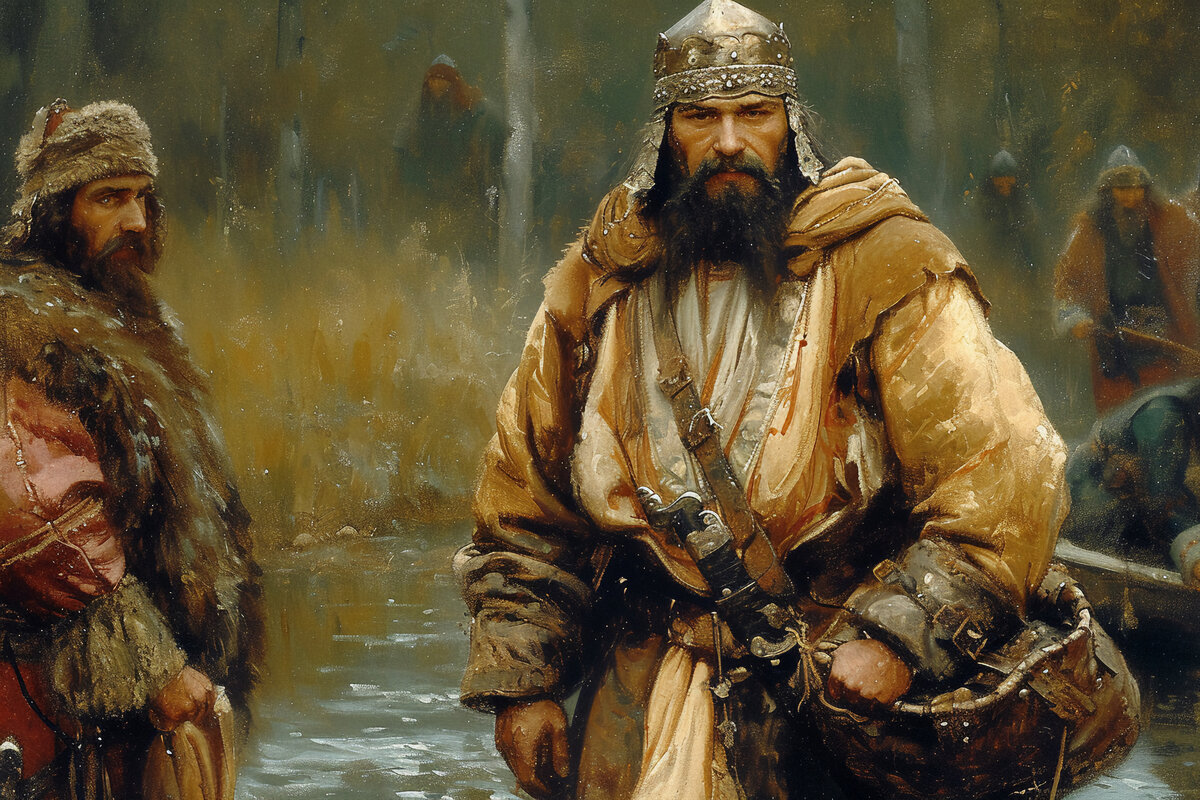
The Polovtsian horse hordes, which repeatedly shook the borders of Rus, Byzantium, and Hungary, disappeared from the historical scene after the Mongol invasion. They were partly exterminated and partly assimilated. And there were no more Polovtsians or their khans.
But this is just a bird’s-eye view. If we zoom in a little, we see that the last Polovtsian khan is mentioned in historical sources not in the 1240s, but much later, in the 1280s.
His name, by the way, was Uldamur. And there is every reason to believe that this was how the Russian name Vladimir was transmitted.
Russian name
The name Uldamur is not of Turkic origin and does not appear in Eastern sources. However, in Rashid al-Din’s “Collection of Chronicles,” the form Uladmur is used to refer to the Russian city of Vladimir. This suggests that Uldamur may have been baptized in Rus under the name Vladimir.
Such baptisms were not uncommon among the Polovtsian nobility. The son of the famous Konchak was baptized under the name Yuri, and the son of Khan Kobyak under the name Daniel. It is not known whose son Uldamur was, but his godfather was most likely some Russian prince — the Polovtsian khan received his name in his honor.
Uldamur’s fate is inextricably linked with Hungary, a country where thousands of Polovtsian refugees fled after the Mongol invasion of the 1230s. They were led there by Khan Kotyan.
Hungarian kings, especially Andrew II, actively recruited the Cumans into their service from the very beginning. They saw them not only as experienced warriors capable of strengthening the army, but also as a buffer against raids from the east. The Polovtsians received land in the Great Hungarian Plain, the right to preserve their customs, and even their own hierarchy.
In 1241, the Hungarian aristocracy killed Kotyan, and some of the Polovtsians left Hungary. However, not all of them left. Moreover, under László IV Kune, the son of King István V and a Polovtsian princess, the influence of the Polovtsians in Hungary grew stronger. László himself, who got the nickname Kún because of his background, was surrounded by Polovtsian guards since childhood and was raised in their traditions. He wore their clothes, spoke their language, and, according to chroniclers, preferred their company to Christian boyars.
This caused a deep split in the kingdom. The church and the nobility saw Laszlo as a traitor to the Christian faith, and the Polovtsians as barbarians threatening the very foundations of the state. In the 1270s, the king attempted to subdue the Polovtsian autonomy by demanding that they convert to Christianity and submit to Hungarian laws. The response was an uprising that broke out in 1280. It was led by Khan Aldamir, a name that is most likely a Latinized form of Uldamur.
The uprising was brutally suppressed in the Battle of Lake Khod in 1282. The Hungarian army, reinforced by knights from neighboring lands, defeated the Polovtsian troops. Many Polovtsians died, others fled. Among the fugitives, it seems, was Aldamir. Given the geopolitical situation, the most logical refuge for him was the Golden Horde, a power where other representatives of the Polovtsian nobility already served and where his origins would not hinder his career.
Place of burial
What do we know about his further fate? In fact, nothing. But perhaps we know the place of his burial — the so-called Tagancha burial mound.
In the Korolevino tract, near the village of Tagancha in modern-day Ukraine, a burial mound was excavated in the 19th century, which remained little studied for a long time. It was only in the 1970s and 1990s that archaeologists, primarily Orientalist and weapons historian Mikhail Gorelik, paid close attention to it—and for good reason.
The burial in the Tagancha burial mound turned out to be one of the richest and most mysterious Golden Horde burials in the southern Russian steppes. It belonged to a high-ranking person whose inventory combined elements of Polovtsian, Russian, Byzantine, Western European, and Mongolian cultures—a rare and almost unique phenomenon for the second half of the 13th century.
The buried man was dressed in ceremonial armor: next to him lay a saber with a silver scabbard, a scepter-mace with a long handle—a typical symbol of power in the Mongol tradition—a Mongol helmet with a tassel and traces of a ribbon on the top, as well as chain mail and a sling.
There were also copper bars with an embossed image of Christ, characteristic of the Russian aristocracy, and a church vessel from Lorraine. The vessel was clearly captured by its last owner in some Catholic church, after which a new embossing was applied to it — the Cyrillic letter “B”. The initial of the captor? Vladimir?
Researchers believe that it is probably Uldamur who rests in the Taganchinsky burial mound. His disappearance from written sources after 1280 coincides perfectly with the date of burial — the second half of the 13th century.