
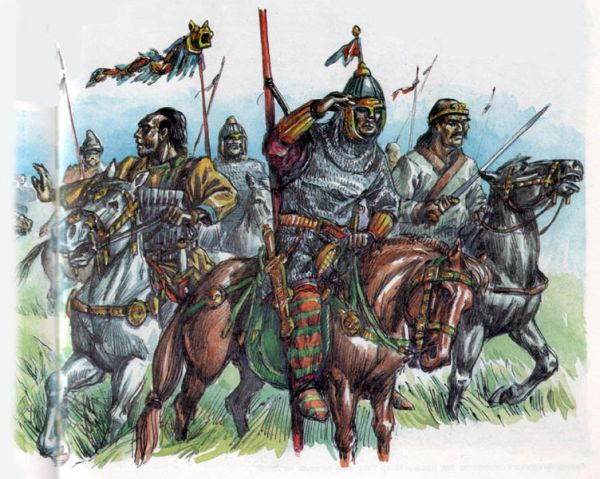
In 1099, the Polovtsian army stood shoulder to shoulder with the Russian druzhina against a common enemy. And this enemy had come from Central Europe. Hungarian King Coloman I the Scholar, having just annexed Croatia and tasted victory, decided that the Russian lands in the Carpathian region would be his next conquest. He miscalculated badly.
Blind Vasilek
To understand how the Polovtsians came to be allies, we must go back two years, to 1097. Prince Svyatopolk Izyaslavich of Kyiv gathered all the princes of Rus’ in Lyubech. They agreed on the main point: each would hold his own patrimony and not encroach on others’ lands. They kissed the cross. But as soon as the congress ended, Prince David Igorevich of Vladimir-Volynsk, a man without many moral scruples, came to Svyatopolk with a denunciation. He claimed that Prince Vasilko Rostislavich of Terebovlia was conspiring with Vladimir Monomakh to seize Kyiv. Svyatopolk, a suspicious man, believed him.

Vasilko was lured to Kyiv under false pretenses, captured, and taken to Zvenigorod. There, the prince—a descendant of Yaroslav the Wise and the great-grandson of Vladimir the Baptist himself—had his eyes gouged out. According to the beliefs of the time, a blinded man could not claim the throne (a tradition originating from Byzantium). Davyd Igorevich expected that Vasilko’s brother, Volodar Rostislavich, Prince of Peremyshl, would lay down his arms. He was mistaken.
In the spring of 1099, Volodar and the blinded Vasilko marched against Svyatopolk. The Prince of Kyiv advanced against them with a large army. In the heat of the fierce battle, as the dead fell on both sides, Svyatopolk could not hold out. He fled. His two sons, two nephews, and the son of Davyd Svyatoslavich fled with him.
The Hungarians are marching on Peremyshl
Svyatopolk, humiliated and defeated, devised a new plan. If he couldn’t succeed on his own, he would have to call in outsiders. He sent his son Yaroslav to Hungary for help. King Coloman I, who had just celebrated the annexation of Croatia in 1097, saw this as an excellent opportunity to expand his territories eastward. He assembled a massive army. The chronicle speaks of a hundred thousand warriors—of course, this is a chronicle figure and an exaggeration, but there is no doubt that there were a great many Hungarians. The king himself and two bishops took part in the campaign. They approached Peremyshl and laid siege to Volodar, who had barricaded himself inside the city.
The situation was becoming desperate. The Hungarians outnumbered the Russians. And then a most unexpected savior appeared on the scene.
David Igorevich, the very same man who had slandered Vasilko, was in Poland at the time. Upon learning of the Hungarian invasion, he rode off to the Polovtsian steppe. He needed an ally. And he found one. Khan Bonyak, one of the most experienced and ruthless Polovtsian leaders, agreed to march against the Hungarians. Together they set out for Peremyshl.
Why did Davyd Igorevich side with Volodar, Vasilko’s brother? Because the Hungarians in those parts were far more dangerous to him. The prince himself laid claim to the Volyn lands, and seeing them fall into the hands of King Koloman was the last thing Davyd Igorevich wanted.
The chronicler recorded an episode that resembles a scene from a horror movie more than a real military council. During the night encampment, Bonyak rode away from the camp, raised his head toward the moon, and began to howl like a wolf. A wolf’s howl answered him from the thicket. Then more wolves howled. Bonyak returned to Davyd and said, “Tomorrow we will be victorious.”

This scene was not madness. The Polovtsians believed that wolves were sacred animals, harbingers of good fortune. Bonyak had performed a shamanic divination ritual, and the gods had answered him with their consent.
Like a falcon striking jackdaws
In the morning, Bonyak mustered his troops. The khan himself had three hundred horsemen, and Davyd Igorevich had a hundred. A total of four hundred men against the Hungarian army of many thousands, which was stationed in a narrow mountain valley by the Vagra River. The balance of power was monstrous. But the steppe warriors knew something the Hungarians did not.
Bonyak divided his detachment into three parts. He sent fifty men under the command of Khan Altunopa ahead. He positioned the rest in ambush. Altunopa rode up to the front ranks of the Hungarians, unleashed a cloud of arrows, and galloped away, feigning panic. The Hungarians rushed to pursue him, thinking they would easily crush the pitiful band of nomads.
They raced past the ambush, and then Bonyak struck them from the rear. Altunopa turned around and struck them head-on. From both sides, the Polovtsians cut down the Hungarians, giving them no chance to recover. In the narrow valley, the Hungarian army, deprived of any room to maneuver, turned into a helpless herd. “And they beat the Hungarians into a ball, as a falcon beats down jackdaws,” the chronicler recorded.
The Hungarians fled. Many drowned in the Váh and Sána rivers. Others, fleeing to the mountains, pushed each other into the abyss. The pursuit lasted two days. Bishop Kupan, who commanded one of the regiments, perished in that massacre. The chronicle speaks of forty thousand Hungarians killed.
Let us emphasize once again that, of course, one should not believe the specific figures. Exaggerating the enemy’s numbers and casualties was a favorite pastime of medieval chroniclers. But even if we divide the strength of the Hungarians by ten and multiply the combined strength of the Rus’ and Polovtsians by ten, the result is still impressive.

The Battle of Váh decided the fate of the Carpathian region. The Hungarians withdrew and forgot the way to Przemyśl for a long time. King Coloman I, who had just conquered Croatia, suffered the most crushing defeat of his career. The Rostislavichs defended their lands and laid the foundations for the future Principality of Galicia, which would become one of the strongest in Rus.
And the Polovtsians? A few years later, Bonyak would attack the Posulye, and Vladimir Monomakh would rout him. Altunopa would perish in battle against the Russian druzhinas on the Suteni River in 1103. In medieval politics, alliances were short-lived.