
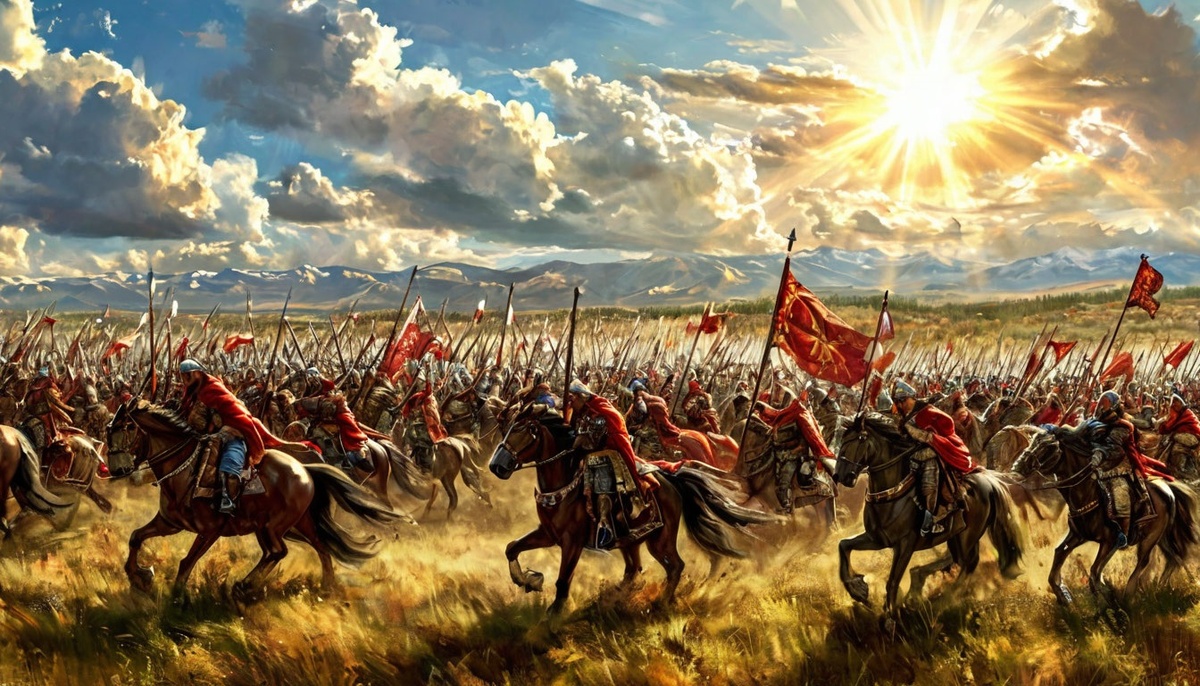
The unification of China and the nomadic peoples occurred at the same time, and these processes were likely interconnected. When the Chinese were at the height of their power, they carried out successful raids into the steppe. And the local peoples decided that it was far better to submit to a single khagan than to a foreign emperor.
Ultimately, they themselves became a serious threat to the Middle Kingdom, which responded by sending scholars and diplomats north. As a result, the Middle Kingdom had a fairly good understanding of the balance of power that had emerged beyond the Great Wall. In particular, in 201 BCE, the Yenisei Kyrgyz people were first mentioned in southern Siberia. They were tall, fair-skinned people with light hair and green or blue eyes. At that time, they were vassals of the Xiongnu Empire.
After the Xiongnu were driven westward, much happened in the steppes, and the inhabitants of the upper Yenisei disappeared from Chinese chronicles for a long time. But they reappeared in them during the early Middle Ages, when the powerful Tang Dynasty ruled the Middle Kingdom. Its court chroniclers believed that this ruling family, like the Yenisei Kyrgyz themselves, descended from a single progenitor—General Li Yuan. In official diplomatic missives, the Chinese wrote: “You are not like other barbarians.”
This led to a strategic alliance, and after a series of powerful blows dealt by China to the Turkic Khaganate, the Kyrgyz were among the first to recover, marking the beginning of their own era of great power. In the mid-9th century, they founded a vast state that occupied most of Mongolia and Southern Siberia. But this did not last long, and the new hegemons of the steppe eventually became mired in internal strife.
For the following centuries, the Yeniseians were just one of many nomadic confederations. When the creation of Genghis Khan’s empire began, its founder sent his eldest son, Jochi, north to subjugate the so-called “forest peoples.” The Kyrgyz submitted peacefully, but rebelled repeatedly in the following decades. During the era of Mongol internecine strife, local chieftains supported various princes who granted them greater autonomy.

Ultimately, a decision was made to resettle the rebellious subjects far to the west, leaving only a pitiful remnant behind. The descendants of those Kyrgyz are the modern Khakass and Altai peoples. The main body of the people, settled in the Tian Shan, faced a far more interesting fate.
Since ancient times, this region belonged to Iranian nomads—at various times, it was home to the Usuns, and later to the Kangyu states. After the founding of the Turkic Khaganate, the region was ruled by the Karluk and Karakhanid tribes—Turkic tribes distinct from the Kyrgyz. But the Chingizids settled both old enemies and new allies in this area, resulting in the emergence of a unique people.
Among modern representatives of this ethnic group, the European haplogroup R1a1 predominates, reaching an average of 63%—higher than among the Eastern Slavs. This indicates a strong Scythian substratum, especially since there are clans of this origin among the Kyrgyz. There are also Kipchak, Oghuz, Karluk, and Uyghur clans, the presence of which attests to a very complex origin.
Nevertheless, the Kyrgyz language is Kipchak, like all the languages of the inhabitants of the former Golden Horde. But the fact is that the territory of modern Kyrgyzstan became part of the neighboring Mongol state—the Chagatai Khanate—where the Old Uzbek Karluk dialect was widespread. Therefore, their dialect, which belongs to a different group, must have been adopted from their Kipchak ancestors. At the same time, it was the ancient Yenisei Kyrgyz who formed their ethnic core.