
The Oirat conquests of the 17th century can be considered the third largest in scale after the Mongol conquests and the Turkic expansion of the 1st millennium.
In the west, they reached the Black Sea, and if we count the Kalmyks’ participation in the Russian army’s campaign in Europe in 1812, then they reached Paris. In the east, they reached Tibet and Southeast Mongolia.
At the same time, the Oirat conquests were not classic land seizures like those of the Mongols and Turks. Rather, it was similar to the Great Migration of the early Middle Ages, which was caused by the collapse of the Oirat union “Durbén Oirat.”

The Durben Oirats (Mongolian: Дөрвөн Ойрад) were a union (confederation) of Oirat nomadic ethno-political associations that founded the Oirat Khanate.
The most powerful formation among the Oirat associations of the 17th century was the Dzungar Khanate. This polytonym is incorrect, since the rulers of Dzungaria were Khuntaiji (princes), not Chingizid khans. But it so happened that this union is called the Dzungar Khanate.
During this period, the Dzungars (and the Oirats in general) played a leading role among all Mongols.
All this was supported by the powerful Dzungarian army, which is still considered a model of a balanced nomadic army.
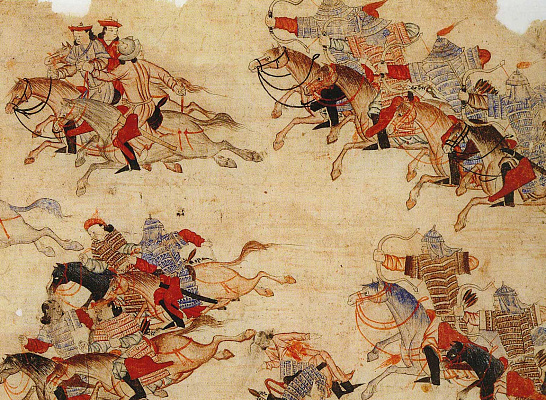
The Dzungarian army was mainly made up of mounted soldiers in armor.

The development of armored cavalry was encouraged by Dzungarian laws, according to which two out of every 40 yurts paid taxes in armor (kuyaki). With an average of 200,000 yurts in the Dzungar Khanate per year, this yielded about 10,000 suits of armor. This was quite sufficient to maintain a large number of armored horsemen and replace their protective equipment.
Cold weapons and iron were supplied to the Dzungars by the ancestors of the modern Shorts, the so-called “Kuznetsk Tatars.” They paid the Dzungars alman (tribute) with these very products.
Armored cavalry formed the backbone of the Dzungar army. At the same time, its most numerous component was light cavalry, additionally armed with pikes.
It was the Dzungars who introduced the use of pikes by light cavalry into military practice. This greatly increased the combat power of each horseman and cavalry unit. After that, this idea was taken up by all the steppe peoples, including the Cossacks.

It was thanks to pikes that the Kalmyks mostly won battles against the Crimean Tatars, who had nothing to counter pikes with except sabers. Only the Bashkirs, who also retained their spear-fighting skills, fought on equal terms with the Kalmyks in mounted hand-to-hand combat.
Therefore, from the 1660s, Crimean warriors also began to arm themselves with pikes, which were made for them by the Circassians and the Perekop Bey (border commander).
And from the Crimean Tatars, pikes spread to Europe, where the Uhlan cavalry was formed in the 18th century.

The presence of armored soldiers and a large number of pikemen allowed the Oirats to deliver powerful blows to the enemy’s formation. It was practically impossible to repel this attack.
Indeed, it is psychologically difficult to withstand when a whole forest of pikes is rushing at you!
Another feature of the Dzungar army was the use of two types of bows. One, the standard Mongolian bow, was used for point-blank shooting from horseback, while the other (num) was used for long-range shooting.

All these innovations and features allowed the Oirats to emerge victorious from battles with the Nogais, Crimean Tatars, Kazakhs, Mongols, and Manchus. The Bukharans and Bashkirs were worthy opponents of the Oirats, matching them in weaponry and military skill. It was from them that the Oirats suffered their greatest defeats in the 17th century.