
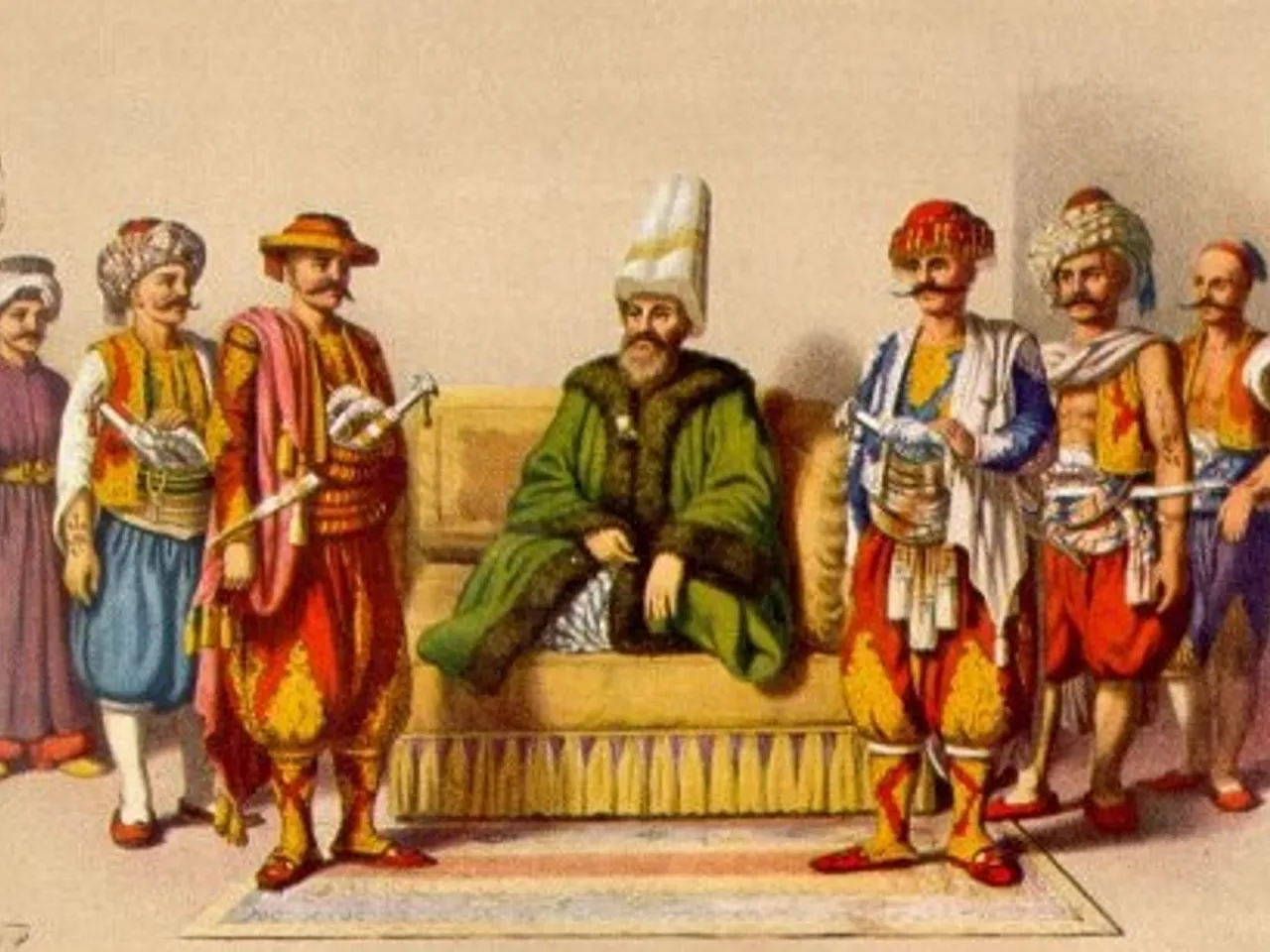
The state of the Oguz jabgu (or Oguz El) arose after 766 and existed until the middle of the 11th century, before it was conquered by its neighbors, and the bulk of its population dispersed to all corners of the world. It occupied the steppes from the Aral Sea to the Caspian Sea and played an important role in the politics of its time. Turks, Turkmens, and Azerbaijanis, as well as a number of smaller ethnic groups, trace their history back to the Oghuz people.

The meaning of the word «oguzy» is not entirely clear. But, apparently, this name means «tribe» or «tribes». In the early Middle Ages, many Turkic confederations had this name with the addition of a numeral: uch-Oguz – «three tribes», Tokuz-Oguz – «nine tribes» and so on.
But the Uch-Oguzes (ancestors of the Karluks) and Tokuz-Oguzes (ancestors of the Uighurs) were not close relatives of our Oguzes. According to Chinese sources, a group of nomads called Gusu occupied the Semirechye region at the junction of present-day Kyrgyzstan and Kazakhstan in the 7th and 8th centuries. Their capital there was the city of Guzia. It is assumed that their union originally consisted of 24 tribes, but two Khalaj clans left it very early.
In 766, the Karluks seized power in the Turgesh khaganate, of which the Oghuz were subjects. After the latter lost in the struggle for leadership, they were forced to leave for the west. The Arab historian Ibn ul-Asir reports that these nomads settled in the steppes north of Transoxiana and Khorezm during the reign of the third caliph of the Abbasid dynasty, Muhammad ibn Mansur al-Mahdi, i.e., in the 775-785-ies.
This was how the Oguz Jabgu state was founded, which originally stretched from Issyk-Kul in the south to Sairam (south of Kazakhstan, near Shymkent) in the west, from the mouth of the Syr Darya and to Karakum. Their capital was Jankent («new city»). At the beginning of the 9th century, a temporary alliance of the Oghuz, Karluks and Kimaks defeated and ousted the Pechenegs and Kangars.
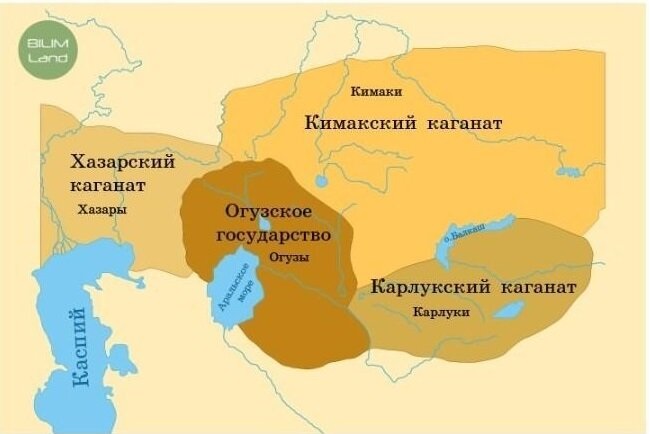
Some of them joined the winners, while the rest migrated to the Northern Black Sea region. After that, the Oguzes began to own the steppes in the area of the Aral Sea and the eastern coast of the Caspian Sea. At this time, one of the chiefs began to use the title yabgu. Initially, in the nomadic hierarchy, he stood below the titles of khan and kagan, but gradually became equal to them.
In fact, the Oguz El was a classic confederation of loosely connected steppe tribes, which included some subordinate nomadic groups. Also, the power of the Yabgu extended to residents of several cities and small settled rural communities.
Nevertheless, there were some elements of centralization: yabgu had a deputy, kül–erkin, syubashi commanded the army, and taxes were collected. Power was inherited within the ruling family. However, a particular sovereign was appointed through elections in which the highest aristocracy participated. The basis of her power was the private ownership of cattle and the command of the militia of her tribe.
As the interests of the hostile Karluk tribes eventually shifted to the settled part of Central Asia, the powerful Khazar Khaganate became the main foreign policy opponent of the Oghuz. Having concluded an alliance with the Russian Prince Svyatoslav Igorevich, the Yabgu crushed his main forces in the 960s. A couple of decades later, they took part in Vladimir Svyatoslavich’s campaigns against the Volga Bulgars.

Then the territory they controlled reached its historical limits. But after centuries of prosperity, the population has grown significantly. And there wasn’t enough pasture for all the nomads. This led to an increase in taxes, and later to civil strife and the collapse of the Oghuz confederation.
Around 985, one of the princes named Seljuk settled in the city of Jend and converted to Islam. On this basis, he refused to pay taxes to yabgu, because «a Muslim cannot pay tribute to a non-Muslim.» His descendants and the part of the Oghuz tribes under their control became known as the Seljuks, and founded a magnificent empire in Western Asia, named after themselves.
And although the Yabgu and their people converted only a couple of decades later, this did not lead to reconciliation between the Seljuks and the main line of the Oghuz Turks. The latter were also seriously weakened by the attacks of the Ghaznavid empire and the invasions of the Kipchaks from the Kimak Khaganate.
However, during the reign of the last Yabgu Shah Malik, the Oghuz state recovered somewhat. This ruler managed to recapture Khorezm from the Ghaznavids, but only to fall under the blows of the Seljuk Empire two years later. In the end, the Oghuz leader was captured, after which he was sent to heaven. His wife became the wife of Sultan Toghrul beg, and his son and heir was raised as a simple soldier at the Seljuk court.
The Oghuz possessions were divided between the Kipchaks, Karakhanids, and Seljuks. From that moment on, this nation became Islamized, and became known as Turkmen in Muslim countries. Moreover, this name also applied to the related Seljuks.

Thus, in the middle of the 11th century, the Oguz Ale disintegrated forever. The population either migrated west with the Seljuks, or disappeared into the abyss of Desht-i-Kipchak Turks. However, some of them survived as an ethnic group and in the following centuries were again at the peak of their glory. Thus, the great power of the Khorezmshahs was founded and ruled by Turkmen tribes. Some of them went west again, fleeing the Mongol invasion, but many remained anyway and became the basis for the emergence of modern Turkmens.