
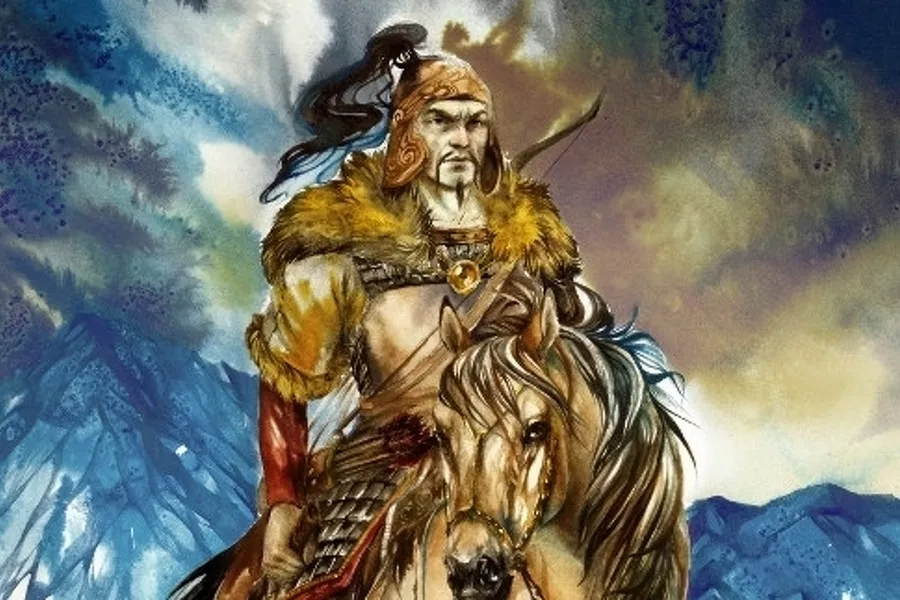
According to the Turkic-Mongolian tradition of the High and Late Middle Ages, power over the state was not inherited by the eldest son of the previous monarch, but by the eldest member of the clan. However, during the time of the Turkic Khaganate, this rule was either unknown or not always applied. The heir to the founder of this empire, Bumyn-Khan, was his firstborn son, Kara Issyk Khan, and not his younger brother, Istemi.
Thus, Istemi ceded the title of sovereign to his nephew. But in return, he effectively became the sole ruler of the western lands. His descendants followed this policy for half a century, but in 603 they seceded and founded the independent Western Turkic Khaganate.
What happened to him after the collapse of the unified empire of the ancient Turks?
While the Mongolian Plateau became the center of the Eastern Turks, the western branch of this people settled in Central Asia. Until the arrival of the Huns, the steppe part of the region was almost entirely under the control of the Scythians. But now Iranian, Turkic, Ugric, and Mongol tribes lived here.
Istemi fought his way to the Volga, which became the western border of his possessions. This military leader’s headquarters were located in the city of Karashar (Yanqi) in the very center of the modern Chinese region of Xinjiang. But already in 576, his heir went on a campaign against the nomads of Eastern Europe, including invading Crimea.
It is unknown how tightly these lands were controlled. But the center of power of the Western Turks was located in Semirechye, and the capital was in the Chu River valley. Their summer and winter residences were located in the now defunct cities of Nevaket and Suyab, both in modern-day Kyrgyzstan. Thus, the Western Khaganate was primarily located in Central Asia, with the Northern Black Sea region playing a lesser role.

Although the power of the khagans was recognized by the Chigil, Yagma, Karluks, Uisuni, Kangls, Turgesh, Bulgars, and Khazars, the political core of the empire was an alliance of ten tribes. Five Dulu clans lived east of the Chu River and the same number of Nushibi clans lived to the west. They were close relatives and fought together in war and were called “on ok,” which means “ten arrows.” All the others were subordinate to a certain extent but were forced to pay tribute.
The majority of the population were nomads, although the Karluks and their relatives had already begun to settle in the Central Asian oases. The inhabitants of the steppe formed the basis of the army, while the state received its income from control over the caravan trade.
The Sogdians, who controlled the Great Silk Road route, had significant economic influence at that time. A 6th-century Chinese general claimed that «…the Turks themselves are simple-minded and short-sighted, and it is easy to stir up discord among them. Unfortunately, there are many Sogdians among them who are cunning and deceitful; they teach and instruct the Turks…» Although the Orkhon runic script was still used for ceremonial inscriptions, the Sogdian alphabet, a local version of the Phoenician alphabet, was gaining increasing influence.
The border with the sedentary peoples ran along the Amu Darya, but they were ruled by nomads – the Hephthalites. Tun Yabgu Khan, who sat on the throne in 618-630, sent an army against them, founding the Turkic principality of Tokharistan (southern Tajikistan and Uzbekistan, northern Afghanistan). Subsequently, the descendants of these warriors advanced as far as India—until the beginning of the 11th century, Kabul was ruled by Turkic shahs, who were either Buddhists or Hindus. At the same time, the western Turks went to Persia via the Caucasus, where they fought against the Sassanid Empire.
However, in the year of Tun Yabgu’s death, the Chinese Tang dynasty defeated the Eastern Turks and established its suzerainty over them. Dark clouds began to gather over their western brethren. Things became particularly bad after the 630s, when civil strife broke out between the Dulu and Nushibi, who were equal members of the “Ten-Arrow Turks” alliance.
Already in the 650s, the Western Turks, Tibetans, Chinese, and Arabs began a series of wars for the division of Central Asia. Moreover, while the political influence of the former was declining, that of the latter was growing. In 658, the khaganate became a vassal of the Celestial Empire, and its possessions in Central Asia were transformed within the framework of the imperial administrative system. Chinese governors with strong garrisons settled in large cities.
The Bulgars, Khazars, Kangls, and Uisuns suddenly gained independence and began their own journey into eternity. But the khaganate still survived and continued to be ruled by the Ashina clan, descendants of Istemi. However, as part of its “divide and rule” policy, the Tang Empire placed either princes from among the leaders of the Dulu tribes or their rivals from the Nushibi on the throne.
In the end, the Turgesh got tired of this circus with horses. In 699, they proclaimed their own state in Semirechye with its center in the same Suyab and declared war on their Chinese allies, the princes of Ashina. Over the next few years, the Western Turkic Khaganate ceased to exist as a given, and the Turgesh even briefly drove the Chinese out of Central Asia.
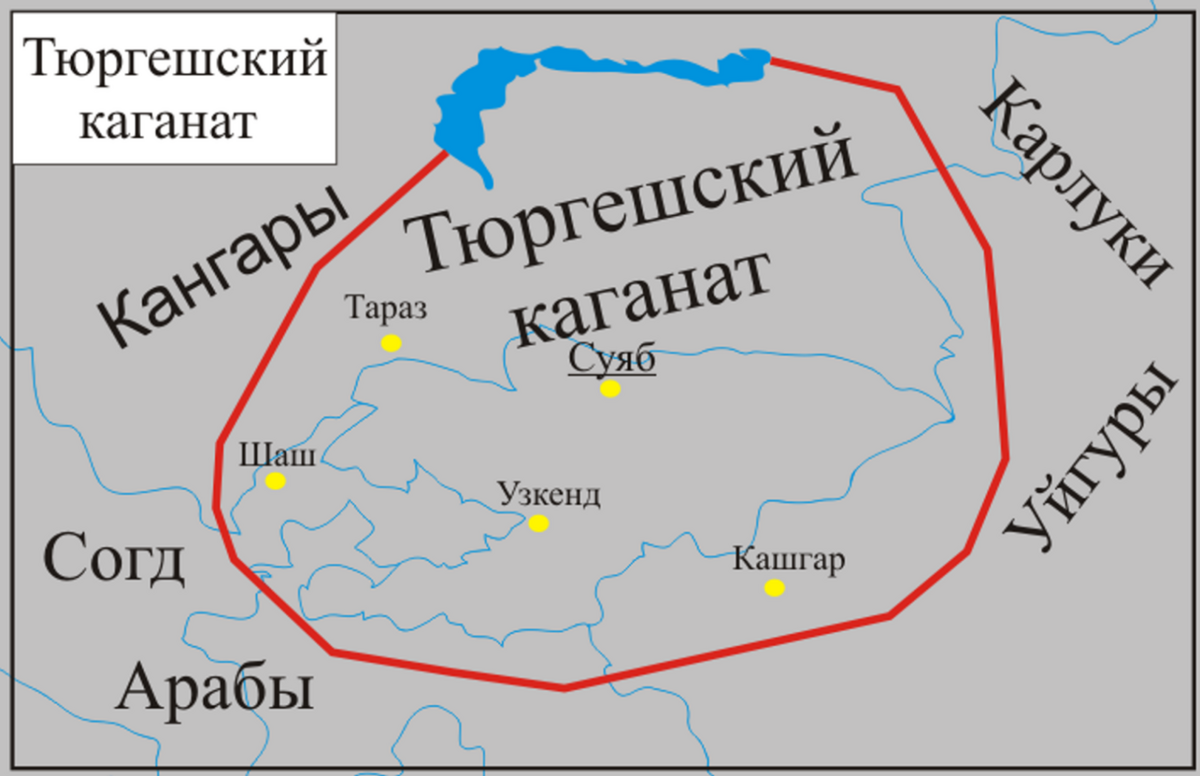
Only in the Tarim Basin did rulers from the Ashina clan remain, but they were completely subordinate to the Celestial Empire. In 704, in Chang’an, the capital of the Tang Empire, the last khagan of the Ashina clan, Khusheloshad, passed away—since then, the Western Turkic state has ceased to exist. However, its historical role is significant: in less than a century of its existence in Central Asia, Iranian nomads were replaced by Turkic ones, and this situation continues to this day.