
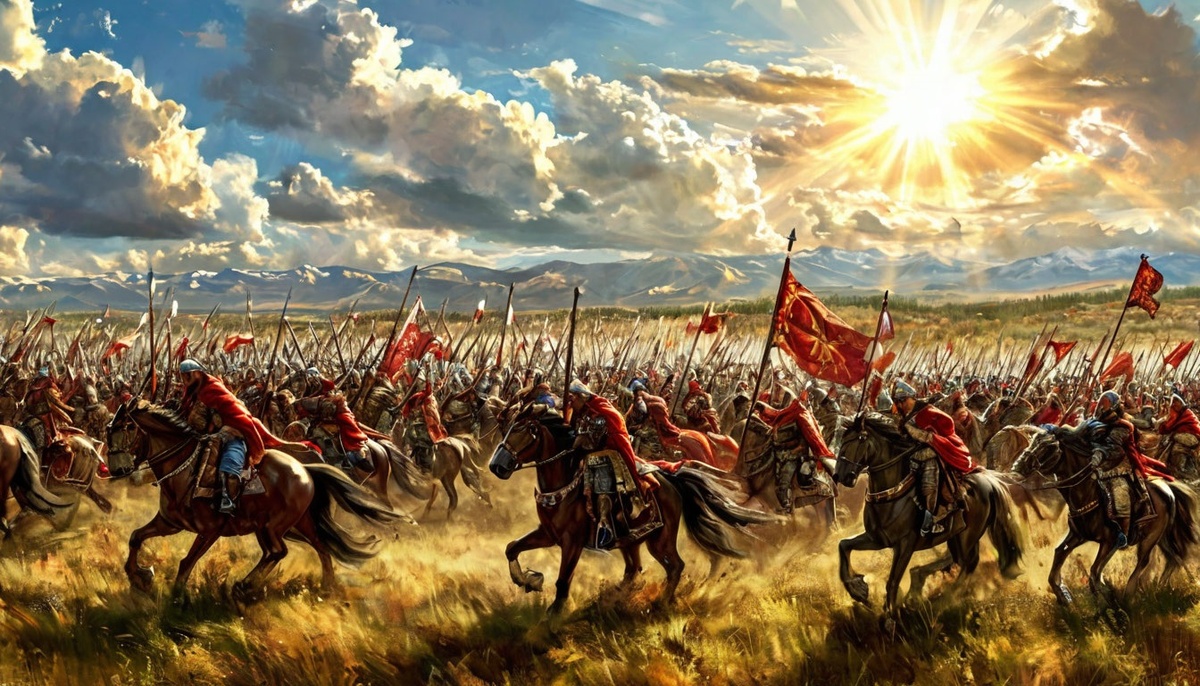
Some people had concerns about the new ruler. For example, the Keraite king Vankhan, who understood that his yesterday’s vassal was becoming his equal.
According to the official Genghisid history, the alliance of Genghis Khan and Wankhan was more beneficial to the latter. In any case, if at first the support of Wang Khan allowed Genghis Khan to escape from his enemies, then soon the Mongol hero was able to render a similar service to his overlord. One day, the exact date is unknown, Vankhan was overthrown by his own brother Erke–kara with the support of the Naiman king Inanch Khan. He fled to the southwest, to the Chu River, to the Karakitai, from whom he never received help. Having quarreled with the king of the Karakitai, he wandered for some time in the Gobi. Desperate, Wang Khan decided to turn to Genghis Khan. He gave him a small army and helped him regain the Keraite kingdom. He later reminded Wang Khan of this with these words: «You came hungry, exhausted, like a dying campfire. I gave you sheep, horses, clothes. You were thin, and in fifteen days I fattened you up again.» Wang Khan’s other brother, Jagambu, decided to seek refuge with the Jin emperor, but Genghis Khan offered Jagambu help and sent troops to protect him from the Merkits. Later, Genghis Khan told Wang Khan, «This is the second favor I’ve done you.»
However, Vankhan, apparently, neglected Genghis Khan’s services and violated the military alliance agreement: without warning Genghis Khan, he launched a campaign against the Merkits, forced their leader Toktoa to flee through the mouth of the Selenga to the southeastern shore of Lake Baikal (to the country of Bargu, mentioned in the «Secret Legend»), killed one of the sons of Toktoa, He took another prisoner, took many captive soldiers, a large number of livestock, and valuable loot, while violating the treaty and not sharing it with Genghis Khan.
Nevertheless, Genghis Khan, according to the official Genghisid chronicle, continued to trust Wang Khan. When the Naimans intervened in the Keraite country and put Jagamba’s brother and Vankhan’s son to flight, the latter turned to Genghis Khan for help, who immediately sent him his «four glorious warriors» who saved Vankhan’s son, drove the Naimans out of the Keraite country and returned with rich booty. Kazar, Genghis Khan’s brother, ended the campaign with a major victory over the Naimans.
After this war, the troops of Genghis Khan and Wang Khan marched against the Taichiut, who were sworn enemies of Genghis Khan, as a result of which the Taichiut ruler Tarkutai-Kiriltug, who had been persecuting him since childhood, was killed.
The Yuan-Shi mentions a coalition of various clans, embittered by the defeat of the Naimans and Taichiut and vowed to take revenge on Genghis Khan and Wang Khan. But Genghis Khan, warned in time by his father-in-law, Daisechen, defeated the coalition forces at Lake Buyur. It was this battle that Genghis Khan hinted at later in his famous poetic message to Vankhan: «Like a falcon, I soared over the mountains and flew across Lake Buyur; I captured cranes with blue paws and ash-gray feathers for you–Dorbens and Tatars.»; Then, flying over Lake Kele, I captured blue–capped cranes for you — katakins, Saljiuts and congirats.»
Although Wang Khan was officially considered the most powerful ruler in Mongolia at that time, in fact, his power did not have a strong foothold. Even Wanhan’s own family had traitors. He had to wrest the Keraite throne from his uncle’s hands, then fight with his brother. «Yuan-Shi» testifies that after defeating the coalition, Wang Khan was again almost deprived of the throne by his brother, Jagamba, who fled to the Naimans after discovering the conspiracy.
Mongolia was experiencing turmoil. Against the hegemony that Wankhan and Genghis Khan were trying to create, Jamukha formed a new coalition. He gathered an impressive number of vassals and kinsmen and submitted his demands to the tribal leadership. The unification of the forces of all Mongol tribes under a single leadership was not the personal desire of the contenders for hegemony, but the desire of some of the tribal elites to regulate the chaos of intertribal and inter–tribal relations. The most far-sighted understood that the unification of forces would not only give stability to social ties in the future (for example, in the proper inheritance and protection of the rights of the hereditary steppe nobility that was in the process of formation), but also in the present would allow a single ulus that had gathered all the forces of the tribes to enrich itself through the robberies of its neighbors.
The beginning of the final phase of the struggle for hegemony in the Mongolian steppe should be attributed to 1201, when 16 tribal leaders gathered in the Alkui-Bulak tract for a kurultai and proclaimed Jamukha Gurkhan, i.e. «universal khan», thereby effectively declaring war on Genghis Khan and Wankhan. It was in such an environment that the Mongol Empire began to take shape. It remained to find out which of the two rivals would be her ruler – Genghis Khan or Jamukha. In this duel, Genghis Khan had political calculation, perseverance, the ability to prove himself right, and, at the very beginning, Wang Khan’s indecisive but supportive side.
As for Jamukha, he possessed violent, sometimes overly violent, energy, a rebellious disposition, a talent for intrigue and, according to Genghisid sources, was an unreliable ally and did not even shy away from plundering the tribes of his supporters. On the contrary, Genghis Khan always remained faithful to those who entrusted their fate to him.
The decisive figure on the scale was Wang Khan, and he supported Genghis Khan. Together they defeated Jamukha’s troops in Koiten, despite the storm caused by Oirat and Naiman sorcerers, after which Jamukha withdrew to the lower reaches of the Arguni.
Realizing his own strength, Genghis Khan decided to act on his own. First, he punished the Taichiut for their previous betrayal. He exterminated part of their army, forced the rest to submit, thus restoring the unity of the Borjiga clan. The young Taichiut warrior who shot Genghis Khan’s horse with an arrow was to be executed, but Genghis Khan pardoned him. Under the name Jebe («arrow») This brave archer later became one of the best Genghisid generals. With his glorious colleague Subotei, he was the most talented strategist of the Mongol epic.
Genghis Khan then turned to the remnants of the Tatars, whom he eventually subdued. Two Tatar beauties, Yesui and Yesugen, became his wives. Then, in 1202, Genghis Khan settled accounts with his old enemies, the murderers of his father. The defeated Tatars were subjected to mass extermination, the survivors joined the Mongol tribes.
Meanwhile, Altan (a representative of the noble branch of the old royal Mongol family, the son of the former Mongol Khan Kutula), Khuchar and Daaritai (Genghis Khan’s paternal uncles) engaged in independent robbery, thus violating Genghis Khan’s decree. He ordered them to take away all the loot from them, and they gradually began to move away from Genghis Khan and soon joined his enemies.
After the defeat of the Tatars, according to Yuan-Shi, Toktoa, the king of the Merkits, returning from Transbaikalia, where he had gone under pressure from Wang Khan, attacked Genghis Khan and was defeated. Then Toktoa joined Naiman Buyuruk Khan, under whose banner the surviving remnants of the armies of various clans gathered. The new coalition waged war with the combined forces of Wankhan and Genghis Khan, who attacked the Naiman Buyuruk Khan. He fled without accepting the battle, but was overtaken in the lower reaches of the Urungu River and killed.
Vankhan began to have doubts about the sincerity of Genghis Khan’s intentions. And he invited Genghis Khan to join the upcoming campaign against the Mongol Naiman tribe in the far west, to which Genghis Khan agreed. When the campaign began, Wang Khan changed his plan of action, turned back without notifying his ally, and Genghis Khan barely managed to lead his army out of the trap.
As compensation for the betrayal on the part of the Kerait king, Genghis Khan asked for the hand of Princess Kaur-Baki for his son Jochi. But Wang Khan refused him, and the two sovereigns severed diplomatic relations.
Of course, the Kerait king failed to recognize a rival in his vassal in time and did not deal with him when he was proclaimed khan in 1182. When Vankhan began to see the light, it was too late. Perhaps he wanted to end his days in peace, but he was pushed to break up by his own son, Prince Sangum. Sangum advised his father, Wankhan, to support Jamukha in the fight against Genghis Khan. The fact is that he had a close relationship with Jamukha, who, at his insistence, took refuge at the Keraite court after the collapse of his hopes for the kingdom. Having reached an agreement with Sangum, Jamukha incited Wang Khan’s distrust of Genghis Khan, accusing the latter of betrayal towards the Keraite leader. At the same time, Altan, the legitimate heir of the ancient Mongol khans, who did not want the royal power to fall into the hands of an upstart, also came to Wang Khan and began to persuade him to go to war against his former ally.
There was a final break between Genghis Khan and the Keraites. It was a turning point in the life of the Mongol leader. Until now, he had played the second role under Wang Khan, although he had performed it brilliantly, and now he began to fight with him, claiming the main role.
At Sangum’s instigation, the Keraites tried to deal with Genghis Khan, deciding to invite him to a meeting ostensibly for reconciliation, then they would organize a surprise attack to take him by surprise. Two officers overheard a Keraite general telling his household about the plot and warned Genghis Khan. (He subsequently appointed them «tarkhans» with the right to have bodyguards.) Genghis Khan immediately took the necessary measures. First, he retreated to the area of Maoundur, where he left a small patrol post, and the next day he went further into the mountains, closer to the source of Khalagun-olAt Sangum’s instigation, the Keraites tried to deal with Genghis Khan, deciding to invite him to a meeting ostensibly for reconciliationer.
The battle was tough. Genghis Khan’s colleague, old Khuildara, the leader of the Urud clan, showed wonders of bravery, and he was not the only one. Nevertheless, due to the numerical superiority of the Keraites, Genghis Khan left the battlefield at night. His third son, Ogodai, and two of his most loyal officers, Boorchu and Borokul, did not have time to leave. When they reunited, Borokul, on horseback, was holding Ogodai, who had been shot in the stomach by an arrow. As the «Secret Legend» says, upon seeing this painting, the «iron lord» began to cry.
So, Genghis Khan retreated closer to the mouth of Khalagun-ola, where the Ungirats lived, the tribe from which Genghis Khan’s wife came. He reached out to them and got them to support him.
Genghis Khan sent Wang Khan a message in which he tried to touch the heart of his former overlord, recalling the years of friendship and his devotion. According to him, he wanted only one thing – to earn his grace again (and Sangum commented on it this way: to lull Wan Khan’s vigilance). He called Wang Khan his father, «khan-ichige,» and emphasized that he always fulfilled the duties of a vassal. He also reminded Altan that if he, Genghis Khan, had agreed to the khanate, it was only because Altan and the other heirs of the elder branch had refused it. The lyric-epic form concealed a legal argument confirming the author’s honesty as a person and as an ally and his loyalty to the old overlord. From a political point of view, Wang Khan, who saw a strong personality in the former vassal too late, made the mistake of supporting Genghis Khan’s first steps. But by breaking their alliance and treacherously attacking Genghis Khan, he gave him every right to act the same way. And in this game, the old Kerait king, who was influenced by his entourage, as well as threatened by the rebellion of his own son Sangum (if he did not go with him to the end), could not compete with Genghis Khan.
It was a difficult period for Genghis Khan. In the face of the enemy’s numerical superiority, he was forced to retreat far north, to the border of Mongolia, to Transbaikalia. He went with a handful of supporters to the source of the Tura River south of Chita, and they had to drink dirty water from a small lake called Baljuna. He spent the summer of 1203 there. The people who shared the hardships of exile with him, the Baljunians, were subsequently generously rewarded.
Meanwhile, the coalition formed against Genghis Khan collapsed again, because the nomads who composed it considered themselves bound only by «seasonal» military pacts. According to Rashid al-Din, some of the Mongol leaders who joined Vankhan out of hatred for Genghis Khan — Daaritai, Khuchar, Altan, Jamukha – conspired to destroy the Kerait king. Wang Khan was warned in time, and he took harsh measures, and the conspirators escaped. Jamukha, Khuchar and Altan went to the Naimans, and Daaritai went to bow to Genghis Khan.
In this regard, Genghis Khan’s position improved significantly when, in the autumn of 1203, he moved in the direction of Onon in order to seize the initiative. He instructed Kazar, whose family was in the hands of the Keraites, to lull Vankhan’s vigilance with false promises. As a result, Wang Khan entered into peace negotiations and sent Genghis Khan a bull horn filled with blood as a sign of trust. At the same time, Genghis Khan, after a covert march, attacked the Keraite army and dispersed it. This battle, which, according to the «Secret Legend», took place near Mount Dzhedzheer, between the sources of the Tola and Kerulen, marked the final triumph of Genghis Khan. Wanhan and his son Sangum fled to the west. Arriving in the country of the Naimans, Vankhan was killed, apparently by mistake.
Sangum crossed the Gobi, for some time plundering on the borders of the kingdom of Si-Hya. In the Khotan region, the leader of the Kalach tribe captured and killed Sangum.
The path to hegemony in the Mongolian steppe was now open for Genghis Khan. The significance of this event cannot be overestimated – the henchman of the khan of one of the largest proto-states in the Mongolian steppes dramatically changed the entire political situation there in just a year or two. Having annexed Vankhan’s possessions, Genghis Khan now became on a par with all the groups of Mongol tribes that remained outside his power – the Naimans and their allies. It is not surprising that the events of the defeat of the Keraites shocked their contemporaries. The descendants of the Mongol conquerors of Siberia preserved epic legends about them until the 17th century.
This is how the most powerful and ancient Christian khanate of Central Asia ended its existence, falling victim to pagans. Based on the sources, it can be concluded that the Mongols themselves did not attach importance to the difference in faith. And from this point of view, it is very important that the Keraites themselves held the same opinion.
The Keraites submitted to Genghis Khan and have served him faithfully ever since. However, the cautious Genghis Khan distributed the «Keraite elements» among the various Mongol clans.
The drastic change in the political situation did not go unnoticed by the head of the Naymans, Tayan Khan, who clearly expressed the essence of the matter.: «They say that a new sovereign has appeared within these limits. We firmly know that the sun and moon are destined to be together, but what about two sovereigns on earth in the same domain?» In this, Jamukha agreed with him, who made the last bet in his game by joining the Naiman coalition against Genghis Khan.
The Keraites and Mongols had common traditions, unlike the Naimans, so the war between them should be considered as an intertribal one.
At the end of 1203, when Genghis Khan became ruler of Eastern Mongolia, the Naiman king Tayan Khan ruled Western Mongolia. Following instinct, all those defeated in previous wars, all the irreconcilable enemies of Genghis Khan grouped around Tayan Khan: Jamukha, the leader of the Zhadarans, Toktoa-Baki, the leader of the Merkits, Kutuka-Baki, the leader of the Oirats, not to mention the remnants of the defeated tribes — Dorbens, Katakins, Tatars, Saljiuts – and even the clan of rebellious Keraites. All of them, and mostly Jamukha’s troops, were preparing for war against Genghis Khan. To attack him from the rear, Tayankhan sought help from the Onguts, Turks who lived around Dokdo, north of Shanxi province: they served as border guards for the Jin emperor and, by the way, were Nestorians. But the Ongut leader Alakuch-Tegin hastened to warn the Mongol conqueror and from that moment became his ally.
Genghis Khan was preparing for a campaign against the Naimans. In the spring of 1204, he carried out measures to reorganize his army.
To prevent future enemies from taking him by surprise, as he had captured Wang Khan, Genghis Khan created a special unit to guard his camp day and night. It consisted of 8 night and 70 day guards. In addition, a regiment of 1,000 Baaturs was organized under the command of the leader of the Jelairs, one of the clans that joined Temujin immediately after his break with Jamukha. The entire army was divided into units of thousands, hundreds, and dozens. Thus, the decimal system was adopted as the basis of the army, and its configuration was carried out not only according to generic units (as was the case in the systems of other nomads, starting with the Huns), but according to the principle of expediency and by decision of the commander-in-chief. Genghis Khan turns his close people into a personal guard, which is allocated to a special unit of 150 people, which has become, in Vladimirtsov’s words, «an embryo army and an embryo guard … a kind of military school.» Over time, this «guard» became one of the main supporting elements of the state of Genghis Khan. In the meantime, all this has significantly cemented the Genghis Khan ulus of the 1189-1203 model.
When the reorganization of his headquarters and troops was completed, Genghis Khan was ready to fight the Naimans, not only as one of the most powerful Mongol tribes, but also as one of the most civilized. The neighbors of the Uighurs, as we noted earlier, used their alphabet, which was based on the Sogdian alphabet, and that, in turn, on the Syriac alphabet. The Naiman Khan had a secretary and a state seal.
In order to prevent the Naiman attack, Genghis Khan convened a kurultai in the spring of 1204 on the banks of the river Tie-Mai-Kai (in «Yuan-Shi»), or Temeyen-Ker (in the «Secret Legend»). Most of the military leaders believed that the horses were too thin and it was better to postpone the campaign until the autumn. Genghis Khan’s young half-brother Belgutei and his uncle Ochigin-Noyan insisted on an immediate offensive to take the enemy by surprise. Genghis Khan agreed with them and sent troops to the border of the Naiman country. Before ordering the soldiers to march on the Naimans, Genghis Khan put up his ancestral banner and consecrated it by libation.
Some sources indicate that he immediately began military operations, while others indicate that he attacked the Naimans only in the fall.
The Taiankhan troops with all the allied forces moved towards the Mongols – from Altai to Khangai. Halfway there, they met with the Mongol vanguard; according to Abul-Gazi, the battle took place near the Altai River (Altai-Su).
In the «Secret Legend» it is reported that the Mongols lit a large number of campfires on the eve of the battle in order to deceive the enemy. Tayan Khan, falling for this trick, hesitated and was about to withdraw his troops. His son, Kuchluk, was outraged by such cowardice. In the very first skirmish, his advanced detachments suffered greatly, and, not daring to strike a decisive blow, Tayan Khan restrained his cavalry units rushing to attack.
The battle was fierce. In this battle, Kazar, Genghis Khan’s brother, who commanded the center of the Mongol army, proved himself to be a talented commander. By evening, the Mongols had won. Tayan Khan, who was seriously wounded, was carried away by the soldiers to a hill.
Vladimirtsov believes that Jamukha, fearing the might of the Mongol army, abandoned Tayan Khan and fled with his Chadarans even before the start of the battle. The Mongol legend says that the last loyal companions asked Tayan Khan in vain what to do, as the king was already dying. Trying in vain to bring him to his senses, Korisu-Bachi shouted to him that his wives and his mother were waiting for him in the tent. Weak from blood loss, Thayan Khan lay motionless on the ground. Then his last companions, led by Korisu-Bachi, rushed back into battle to die. Genghis Khan admired their bravery, and he wanted to spare their lives, but they refused to surrender and died in battle. Kuchluk, the son of Tayan Khan, fled with some of his men to the Irtysh, however, not feeling safe there, later moved to the country of the Karakitai. It was a branch of those Khitans who, after the overthrow of the Khitan Empire in northern China by the Jurchen (Jin) in 1125, headed west and succeeded in establishing a kingdom in Transoxiana and the Khotan region of Chinese Turkestan (Xinjiang). Meanwhile, the Naimans, left without a leader, submitted to the power of Genghis Khan. It was 1204. Genghis Khan also received assurances of submission from the Oirat leader Kutuk-Baki. Genghis Khan then attacked and defeated his old enemies, the Merkits. The Merkit beauty Kulan became his fourth wife.
In 1205, Genghis Khan’s rival Jamukh, who managed to escape from captivity during the defeat of the Naimans, was captured by his own vassal and brought to Genghis Khan. The latter sentenced him to death, but, remembering his former friendship, allowed him to die «without shedding blood.» According to the Mongols, a person’s soul is in his blood; killing him without shedding blood was considered good for his soul. This grace was usually bestowed on members of royal families guilty of treason, and in exceptional cases on other high–ranking criminals. According to Genghis Khan’s order, Jamukha’s remains were placed in a special coffin with due honors.
If the authors of the chronicle embellish Genghis Khan’s generosity and, in order to exalt him, emphasize Jamukha’s treachery, it is striking that Khan actually offered his former friend to reconcile. He promises to forget all the betrayals of a man who has deceived, persecuted, and betrayed him many times. In response, Jamukha asks for death for all his betrayals. The story of these people and its tragic ending could have inspired Sophocles.
The last Merkit gangs were destroyed in Uighuria by the Mongolian general Subetei, along with Tokuchar, Genghis Khan’s son-in-law. And even earlier, in 1207, the Kyrgyz of the Upper Yenisei (Tannu-ola and the Minusinsk region) submitted to Genghis Khan without a fight.
Thus, the conquest of the Merkits ended the war for hegemony in the steppe, which was won by Genghis Khan. Ironically, he began his journey to it with the defeat of the Merkits and ended with the defeat of the latter. The steppe was united again, as in the days of the Turkic and Uighur khans.
Now the whole of Mongolia was under the rule of Genghis Khan. His standard– a white flag with nine tails, became the banner of all Turkic-Mongols.
It should be noted that during the defeat of the Naimans in 1204, the keeper of the golden seal of Tayan Khan, Ta-Ta-Tonga, transferred to the service of Genghis Khan, whom Genghis Khan ordered to teach tsarevichs and princes to write in their language in Uighur letters. It was through a Naiman official that the Uighur letter was accepted by the Mongols. After the transition of this venerable Uighur to the retinue of Genghis Khan, in all cases when imperial decrees were issued, the seal began to be used. Thus, the foundation of the Mongolian statehood was formed at the court of the conqueror. The task of «bringing the whole of Mongolia together» set by Genghis Khan was successfully accomplished. Now Genghis Khan could focus entirely on nation-building and begin the first steps towards external expansion.
So, in order to understand the key problems of the history not only of Central Asia, but also of the whole world, it is necessary to specify the reasons.: 1) how and why the Mongol Empire was formed and 2) why its nomadic neighbors lost the war with it: Naimans and Keraits, Merkits and Tatars.
First of all, we note that the role of Jamukha in this is no less than the role of Genghis Khan. The point is to break off the twinning relationship, i.e. the andes.
In 1182 Jamukha, having received the news of Temujin’s election and his conversion to Genghis Khan, gathered a large number of vassals and after some time demanded his election to the tribal leadership.: 16 tribal leaders at the kurultai elected Jamukha as a gurkhan.
At that time, the Mongol tribe was going through a stage of disintegration: an extreme aggravation of relations between the tribal aristocracy and recalcitrant people seeking to leave the orbit of the tribe. This process has set the task of uniting people who have separated from the tribes – the so–called «people of long will» — but not on the basis of the tribal principle. The tribal elders wanted to create a confederation of tribes with an elected khan, whose post was suitable for Jamukha, an experienced warrior and a resourceful politician. However, in this scenario, «people of long will» had no place left. Therefore, the latter grouped around Temujin, who was essentially one of them.
In the context of the aggravation of relations between the «people of long will» and the tribal elite, the resolution could only be military. And it didn’t take long: the conflict occurred because of the murder of Jamukha’s brother, who decided to recapture the herd from the Genghisites. The battle of Dalan-Baljut took place, where Jamukha marched with 30 thousand horsemen against 13 thousand Genghis Khan’s. Jamukha defeated Genghis Khan’s army, executed the prisoners and withdrew his troops without completing the destruction of Genghis Khan’s coalition.
Of course, Jamukha’s entourage was very interested in the campaign, but this campaign was only a means. The goal was to destroy the coalition of Genghis Khan and himself. Why did Jamukha not want to put this final point in his campaign, which, one might say, was decisive in the further course of world history? In fact, there is no answer to this question, since all historians limit themselves to only retelling the sources. Our analysis of a large number of chronicles, which relate specifically to Jamukha’s personal characteristics, allows us to draw the following conclusion: Jamukha’s interests were not the interests of his entourage, they coincided only in their orientation towards Genghis Khan, but no more. The goals of the tribal aristocracy were to be achieved by victoriously completing the campaign, while Jamukha’s goals were achieved by the very process of the campaign, defeating Genghis Khan’s army and thereby destroying him as a commander and personality and demonstrating his own superiority. After all, being on the verge of defeating Genghis Khan, he suddenly leaves the battlefield, saying only: «Well, we firmly locked him in the Onon Tseren!»
Perhaps the fact that Jamukha did not complete his campaign with the complete defeat of Genghis Khan was also due to the factor of their fraternization with blood. Anyway, Genghis Khan survived. Nevertheless, the war has become objectively necessary, and for everyone.: for the opponents of Genghis Khan, for the surrounding tribes – the Tatars, who poisoned Genghis Khan’s father; the Merkits, who dishonored his wife; for the Vankhan of Kerait, who sought to raise his prestige with victories; for the Naiman Khan, who assessed the political situation as impossible for the people to have two sovereigns.
Jamukha did not live up to their hopes. After that, even the most warlike tribes of Jamukha joined the service of Genghis Khan, as they sought to win, it became clear overnight that it was impossible to win with Jamukha.
A political struggle ensued, and as a result, various tribes sided with Genghis Khan. The antagonism of the social forces was growing. The camp of the «people of long will» was homogeneous in its composition and its aspirations; the aristocratic camp was divided into two layers: the tribal aristocracy, which clashed with the «people of long will», and the ordinary members of the tribes, who were potentially the same «people of long will» and differed only in their obedience to the nobility. This situation created instability in the camp of the tribal aristocracy and the possibility of tribes moving to the camp of Genghis Khan, despite the social contradictions. And in the camp of the «people of long will,» the rise of the military elite, led by Genghis Khan, transformed the struggle for freedom and independence into a struggle for supremacy. Genghis Khan turned from an ataman into a sovereign.
In the 13th century, the traditions of steppe unity, laid down by the Huns and developed by the Turks, did not disappear. The time had come to crown the building of nomadic culture, and it was clear that this would be done by the united Turkic-Mongols under the leadership of Genghis Khan. The generals and clan leaders who supported Genghis Khan knew that their newly created nation and already experienced army were ready for further conquests.