
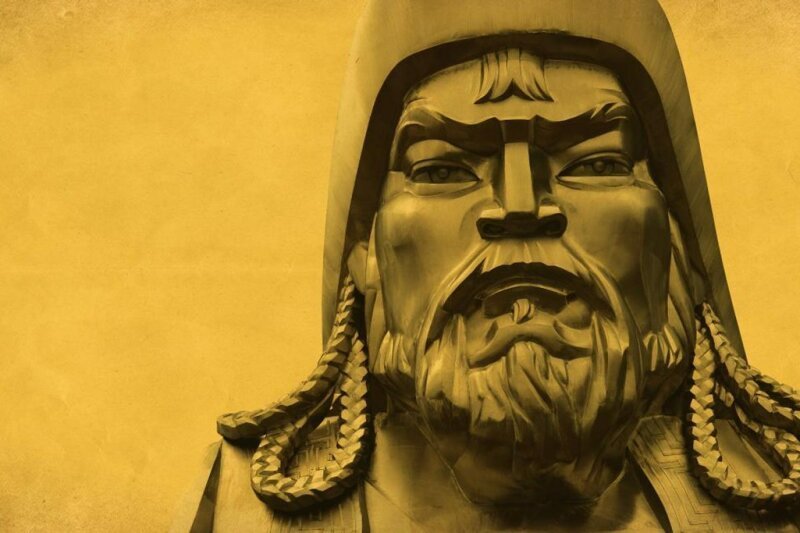
They placed a wooden shackle on him—a mark of a slave and a criminal. The boy from a noble family, the son of a chieftain, stood helpless before his enemies. No one around him imagined that this young man would one day rule from the Pacific Ocean to the shores of the Caspian Sea.
But it was precisely this humiliation that made him who he became.
The historical era of the 12th century in the Mongolian steppes was not the romanticism of nomads under the starry sky. It was an endless war of all against all, where yesterday’s ally would steal your livestock tomorrow, and a relative would betray you at a feast. It was in this cauldron that the story of Temüjin began—the man we know as Genghis Khan.
He was born around 1162 on the banks of the Onon River. The Secret History of the Mongols—the principal epic chronicle of that era—describes his birth with almost mystical detail: the infant clutched a congealed clot of blood in his right hand. The shamans immediately declared this a sign of a great destiny.

His birth coincided with his father’s return from a campaign against the Tatars. In honor of the captured Tatar leader, the boy was named Temujin.
His father, Yesugai-Bagatur, was a typical representative of the steppe nobility: bold, ruthless, and not averse to raids. His mother, Oelun, he had once simply kidnapped from her fiancé of the Merkit tribe—right from the wedding procession, in full view of the entire entourage. The Merkits remembered this insult. For a very long time.
When Temujin turned nine, his father took him to seek a bride—the ten-year-old Borte from the Ungirat tribe. According to steppe custom, the boy was left for a year with his future wife’s family. Yesugai set off for home alone.
He never made it home.
On the way back, Yesugai stopped at a Tatar encampment. The laws of hospitality forbade openly offending a guest—even a sworn enemy. They fed him and gave him drink. And poisoned him. Upon reaching the encampment, he managed to order that his son be returned. And he died.
The death of a chieftain is a signal. It had always been that way on the steppe.
The chiefs of the neighboring Taichut tribe, which was part of Esugai’s ulus, did not wait. They simply moved on, taking their people, livestock, and supplies with them. The deceased’s family—two wives, seven children—was left on the steppe to certain death. Without food, without protection, without a future.
But Oelun did not die. She hunted, dug up roots, and survived with a stubbornness that could hardly be called anything other than fury. And she raised her children, instilling in them everything she had: hatred for traitors and the will not to break.
It was during these years that Temujin befriended Jamukha—a boy from the noble Jadaran clan, his peer and distant relative. Their friendship was so strong that they performed a blood-swearing ceremony, mixed their blood, and became andas—brothers for life. An unbreakable oath. Or so they thought.
When the Esugai brothers had grown a little older, the Taiyuts realized they had left avengers alive. They organized a manhunt. Temujin was caught, fitted with a kanga—a heavy wooden shackle worn by slaves—and paraded in disgrace before the entire tribe.

He fled at night. He hid in the river, breathing through the reeds until his pursuers had passed. One of his guards took pity on him, removed the shackle, and gave him a horse.
Humiliated, but alive.
The time had come to claim his bride. Borte had been waiting for him all this time—and her father kept his word. The wedding took place. But family happiness did not last long: the Merkits, who had not forgotten the abduction of Oelun, came at night and took the young wife in retaliation. Temujin had neither an army nor allies. But he had the memory of his father’s connections.
He set out for Togril—the khan of the Kereits, a powerful Christian (Nestorian) tribe in central Mongolia. Togril was his father’s andai. He took in his brother’s son, helped him, and recognized him as his adopted son. The news spread across the steppe.
Warriors began to flock to Temujin. Those who had served his father. Those seeking protection. Shepherds, commoners, even former slaves.
And then he turned to Jamuka. A blood brother. An old friend. The three united: the powerful Toghril, the popular Jamukha, and the ambitious Temujin. They struck against the Merkits. They routed them. They freed Borte.
After the victory, Temujin and Jamukha roamed together. But this alliance fell apart after just a year and a half.
The two sworn brothers were too different. Jamukha was an aristocrat; he valued lineage, traditions, and birthright. Temujin had endured poverty and hardship—and had long understood that noble birth was worth nothing without personal loyalty and courage. Ordinary people were drawn to him, and this irritated Jamukha more and more.
Legend has it that the final straw was a trivial argument: one warrior said they should stop here—it was good for the horses; another suggested they go further—it was better for the sheep. Behind this spat between a shepherd and a horseman lay a far deeper conflict. Jamuka took it as an insult. He rode off that night.
In the morning, he discovered that many of his own warriors had remained with Temujin.
Friendship turned into enmity. A deadly one.
Around 1189, the nobility of the Borjigin clan proclaimed Temüjin as khan. At the kurultai, he was lifted onto a white felt rug and given a new title—Genghis Khan. The exact meaning is still debated by scholars, but the most widely accepted translation is “great” or “all-encompassing” khan. Jamuka could not bear this.
He gathered the tribes loyal to him and struck first.
In the decisive battle, he routed Genghis Khan. Genghis Khan fled and went into hiding. For many years.
Jamuqa, meanwhile, demonstrating his power, dealt with the captured leaders so brutally that the entire steppe trembled. He violated the unwritten laws of honor. By doing so, he permanently alienated those who might still have become his allies.
The turning point came in 1196. The Chinese Jin Empire decided to punish its own allies—the Tatars—who had ceased to be useful. Toghril called on Genghis Khan to join this campaign. The Tatars were routed. Genghis Khan proved himself a talented commander. His authority was restored. His army grew.
Then there was another betrayal. Jamuka convinced Toghril that Genghis Khan had become too powerful. That night, both allies secretly left the camp, leaving him alone to face the Naimans.
But they miscalculated. The Naimans struck at the strongest part—Toghril’s Kereits—and routed them. In desperation, the old khan sent messengers to the very man he had just betrayed.
Genghis Khan came to the rescue. He defeated the Naimans. He freed Toghril’s son.
This was not a sign of weakness. It was a precise political calculation.
In 1201, Jamukha proclaimed himself “Gurkhan”—King of Kings—and rallied everyone he could against Genghis Khan. But his time was already running out. Genghis Khan routed the Taiyichuts—the family traitors. In 1202, he almost completely exterminated the Tatars who had killed his father, sparing only the children. Toghril’s own Kereits were defeated three days after a surprise attack. The mighty tribe vanished from the map of the steppe.
In 1204, it was the Naimans’ turn. Jamukha fled to them as a last resort. In the decisive battle, he betrayed them as well—at the most critical moment, he withdrew his men. The Naimans were defeated.
At the end of 1205, Jamukha’s own servants, weary of wandering, seized him and handed him over to Genghis Khan. The man who despised betrayal more than anything else in the world ordered them to be executed before their former master’s eyes.
He spoke with Jamukha at length. According to one account, he offered forgiveness and friendship. According to another, he interrogated him.
But Jamukha asked for a dignified end. He understood: there can be no two masters on the same steppe.
His request was granted. He departed without bloodshed—as befits a leader.
In the spring of 1206, a great kurultai was held at the headwaters of the Onon River. The nobility of all the conquered tribes gathered there. Temujin of the Borjigin clan was proclaimed the Great Khan of all Mongolia. A nine-tailed white banner rose above the steppe.
He was about 44 years old. Behind him lay a poisoned father, betrayed comrades, a slave’s shackles around his neck, a stolen wife, and years of wandering.
The era of conquest had not yet begun. But the man who would start it was already standing on the white felt.
And here is where history takes an interesting turn.
Most people think that Genghis Khan won because he was a great commander. Because the Mongols were cruel. Because he had the best cavalry.
But if we’re honest—he won because he understood one thing before anyone else: people don’t follow blood or titles. They follow someone who knows firsthand what it means to lose everything.
A man in chains knows this. An aristocrat on a white horse does not.