
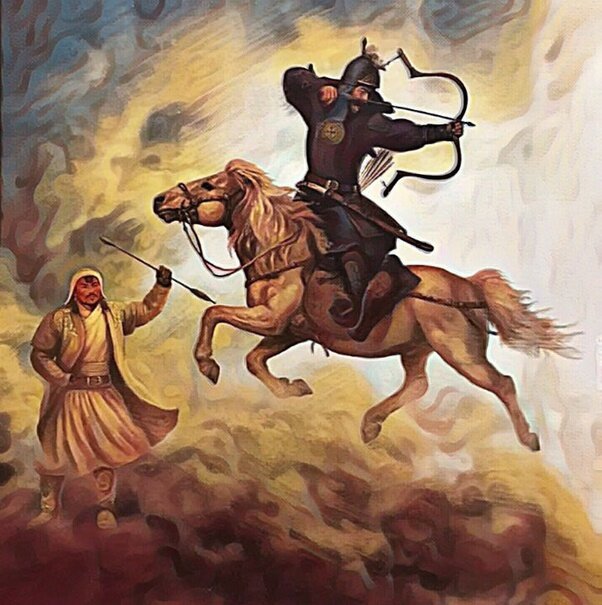
When we picture a Mongol horseman, the image is always the same: a horse galloping across the grass, the archer turning back at full speed and showering the enemy with arrows. It’s beautiful. But a blunt practical question immediately arises: where, exactly, did these arrows come from?
All around is bare steppe. No forests, no workshops. A campaign could last for years. At the Battle of Legnica (1241) or at Kalk (1223), a single archer would sometimes fire up to 30–40 arrows per battle. Multiply that by tens of thousands of horsemen.

The main rule: don’t look for them in the steppe—bring them with you

To modern people, it seems that nomads improvise on the go. No. The Mongols hated improvisation when it came to supplies.
Every warrior (and on major campaigns, they mustered as many as 100,000–150,000) set out not with just one horse, but with 3–5. He rode one, while the others walked alongside—packs of arrows, spare bowstrings, and food were strapped to them. This wasn’t “a couple of horses for speed”; it was a mobile warehouse.
Example. During the campaign against Khwarezm (1219–1221), Genghis Khan’s army crossed the Kyzyl Kum Desert. There are neither trees nor water there. But every tumen (10,000 horsemen) had a supply train of thousands of pack horses. Arrows were stored in leather quivers called saadaks, which were attached to the saddles of spare horses.
The Mongols solved the problem of “where to get them” simply: don’t wait until the arrows run out, but carry enough to last for 3–4 major battles without resupply.

The steppe offers no trees, but it offers freedom
The “open steppe” means no forests, but it’s also the perfect highway for mounted logistics. The Mongols took full advantage of this.
Imagine: a European knightly army dragging heavy carts along broken roads. A Mongol supply train, on the other hand, consists of pack horses that move at the same speed as the combat units. No traffic jams. The steppe allows the supply train to stretch for kilometers without losing control.
Subedei (1175–1248), the chief strategist of Genghis and Batu, in the famous campaign of 1220–1223, circumnavigated the Caspian Sea from the north, passed through the Caucasus, and defeated the Russians at the Battle of the Kalka. His army covered 8,000 kilometers in 3 years. And not once did they run out of arrows. Why? Because Subedei divided the army into three corps, and each carried its own supply. When one corps used up its arrows, it swapped horses with another and received replenishment from the supply wagons.
Arrows were not only transported but also carefully preserved
In movies, heroes shoot until the very end and throw away empty quivers. The Mongols did not do that. An arrow was expensive: the shaft was made of birch or maple (the raw materials were brought from the forest-steppes of Southern Siberia), the tip was made of iron (the Mongols had almost no iron of their own; they took it as spoils of war or bought it from the Uyghurs), and the fletching was made of eagle or goose feathers.
Therefore, after a battle, if the enemy retreated or was defeated, the Mongols would always collect the arrows from the field. Even the broken ones: the iron was reforged, and the feathers were replaced. This was not greed; it was the norm of steppe warfare.
An important fact. In The Secret History of the Mongols (1240), there is an episode where Genghis Khan orders, after the victory over the Tatars (1196), that all weapons and arrows be collected from the battlefield. Those who left a single arrow behind were punished.
In addition, the Mongols used arrows wisely. They had:
— light whistling arrows (for signaling and to scare the enemy’s horses);
— heavy armor-piercing arrows with forged tips (for armored soldiers);
— incendiary arrows (for sieges).
Different types meant different rates of consumption. In battle, the squad leader would shout which type to fire. No one wasted arrows.
Organization beats miracles
People often say, “The Mongols won thanks to their bows and horses.” That’s like saying a soccer player won the championship because of his cleats. Their true strength lay in their ironclad organization.
In 1206, Genghis Khan divided the entire army into tens, hundreds, thousands, and tumens. Each unit was responsible for its own supplies. In every ten-man unit, a man was appointed to oversee the arrows: he ensured that every warrior had at least 30–40 arrows in his quiver before battle. If anyone lost or broke arrows during the march, not only was he to blame, but so was his squad leader.
A figure. According to the Arab historian Rashid al-Din (1247–1318), each Mongol horseman on a major campaign carried an average of 60–70 arrows in three quivers: one on his belt, two on spare horses. This was a supply for 2–3 days of intense combat. And then—replenishment from the supply train, which followed 10–15 km behind.
Which is more important: tactics or logistics?
Beautiful archery on the gallop is just the tip of the iceberg. Beneath the surface lie thousands of pack horses, strict arrow accounting, iron discipline, and calculations that would do credit to any general staff.
Take the Battle of Mohi (1241, Hungary). Hungarian chroniclers wrote that the Mongols “shot without ceasing, like rain.” But where did the arrows come from? A month before the battle, Batu and Subedei established an intermediate depot in the Carpathians. Arrows captured from the Russian principalities and purchased from the Volga Bulgars were transported there. When the main army reached the Sajó River, supply units delivered 20 additional arrows per archer within a day.
Conclusion. A great army is distinguished not by its ability to shoot, but by its ability to ensure it never runs out of arrows on foreign steppes.