
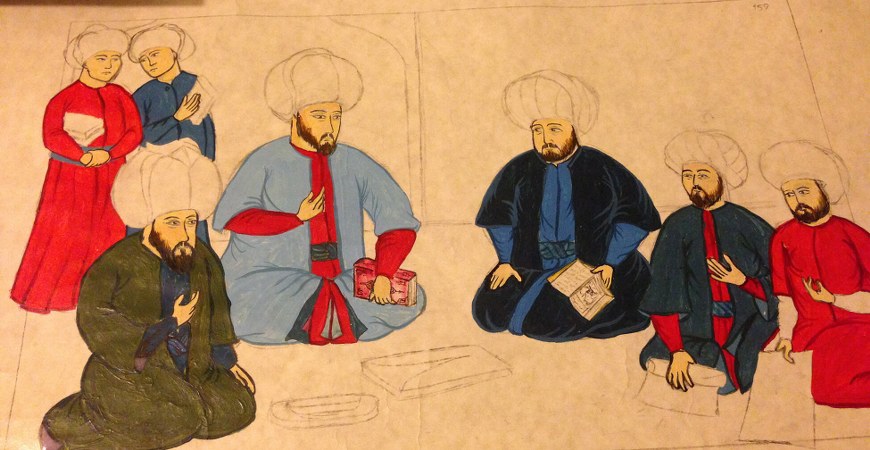
After the death of Sultan Suleiman I, Selim—the padishah’s only surviving son—inherited the Ottoman throne. At that time, he was 42 years old. And of all the sultan’s sons, excluding Cihangir, who had been ill since birth, it was Selim who had the least chance of becoming the ruler of the empire. But things turned out differently. Let’s find out what kind of man Selim, Suleiman’s third son, was and how he proved himself as a sultan.
Appearance, Personality, and Character
It is generally believed that, in appearance, Selim resembled his mother—Hürrem Sultan, or Roksolana—more than his other brothers. He had red hair and a beard of the same shade. That is why one of his nicknames was Sarı, meaning “fair-haired.”

Engin Öztürk as Prince Selim
The Padishah was known for his generous patronage of poets; he loved literature deeply and wrote poetry himself under the pseudonym Selimi. Even when he was governor in Kütahya, he already spent a great deal of time with poets, including the famous Ottoman historian and poet Gelibolu Mustafa Ali.
Selim Khan was also renowned for his generosity and love of entertainment, and he enjoyed the company of scholars and musicians. He did not particularly like to appear in public. Even when his father Suleiman went to the Friday prayer at the mosque, the young prince preferred to remain in the palace.
But Selim is especially known by another nickname: Selim the Drunkard. Indeed, even from the time when he was a prince, Selim developed a taste for strong drinks. But in essence, he did not suffer from alcoholism in the literal sense of the word. He was dubbed a drunkard because he generally allowed himself to drink alcohol, which is strictly forbidden in Islam.
Early Years
Selim was born in 1524 and was the third child of Suleiman by his concubine, and later wife, Hurrem (Roxolana). By that time, they already had a son, Mehmed, and a daughter, Mihrimah. Selim also had another older brother—Mustafa, Suleiman’s son by his former favorite, Mahidevran.
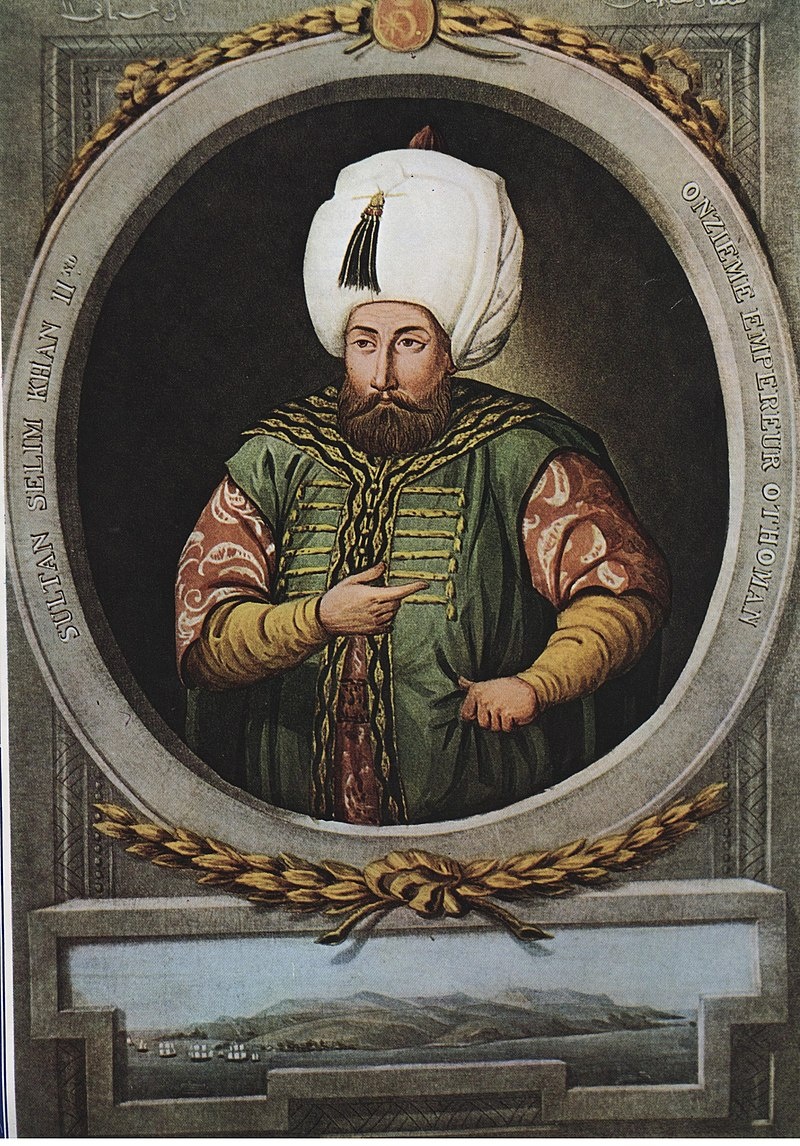
Sultan Selim II
In 1537, the 13-year-old Selim accompanied his father on a military campaign for the first time. His older brother Mehmed was also with him. The presence of his sons in Suleiman’s army was intended to emphasize the continuity of the dynastic line in the eyes of the people.
In 1541, Selim again accompanied his father on a military campaign—to Buda. The following year, his father appointed him governor of the province of Karaman, and later of Konya. In 1553, Suleiman and Selim set out on a campaign against the Persian Safavid dynasty. During this campaign, by order of the padishah, Suleiman’s eldest son, Mustafa, was strangled. At the same time, the young shehzade Jahangir, the sultan’s youngest son, died of illness and grief. And shehzade Mehmed had died several years earlier of smallpox.
The Struggle for Power
Thus, Selim became the eldest heir—just a step away from the throne. The only other surviving son of Suleiman was Shehzade Bayezid, who was a year younger than Selim. Rivalry had been brewing between the brothers since childhood. And so fate decreed that they would have to engage in a merciless struggle for power.
But Suleiman was still alive, as was his wife Hurrem. Historians disagree on whom they wanted to see on the throne after the padishah’s death. After Mustafa’s execution, Suleiman officially declared Selim the heir. At the same time, American historian Harold Lamb noted that the sultan wanted to see Bayezid at the head of the empire, since he was stronger than his brother and more beloved by the people.

Sultan Selim II
As for Hürrem, she supported first one son, then the other. She was likely trying to maintain a balance to protect each of them. And as long as she was alive, she managed to sustain a precarious equilibrium and keep both brothers from engaging in open struggle for power. But with her death in 1558, the last thread connecting Selim and Bayezid was severed. Now the issue was acute: one of them was destined to die, and the other to ascend the throne.
It should be noted that both heirs to the throne were fighting not only for power, but also for their own lives. For if one shehzade ascended the throne, the other brother was to be executed along with all his sons, regardless of their age. This cruel rule was known as the Law of Fatih. In theory, this law was intended to prevent internecine strife. But in essence, it only intensified the dynastic struggle.
After Hürrem’s death, a separate faction of allies formed around each of the brothers. On Bayezid’s side was his sister Mihrimah. Selim, meanwhile, was supported by experienced statesmen—Sokollu Mehmed Pasha and Lala Mustafa Pasha.
Seeking to ease the tension between the brothers, Sultan Suleiman sent each to distant provinces of the empire. This did not help. In 1559, Bayezid and Selim engaged in a bloody battle near Konya. Selim was supported by the padishah himself, and he managed to secure victory.
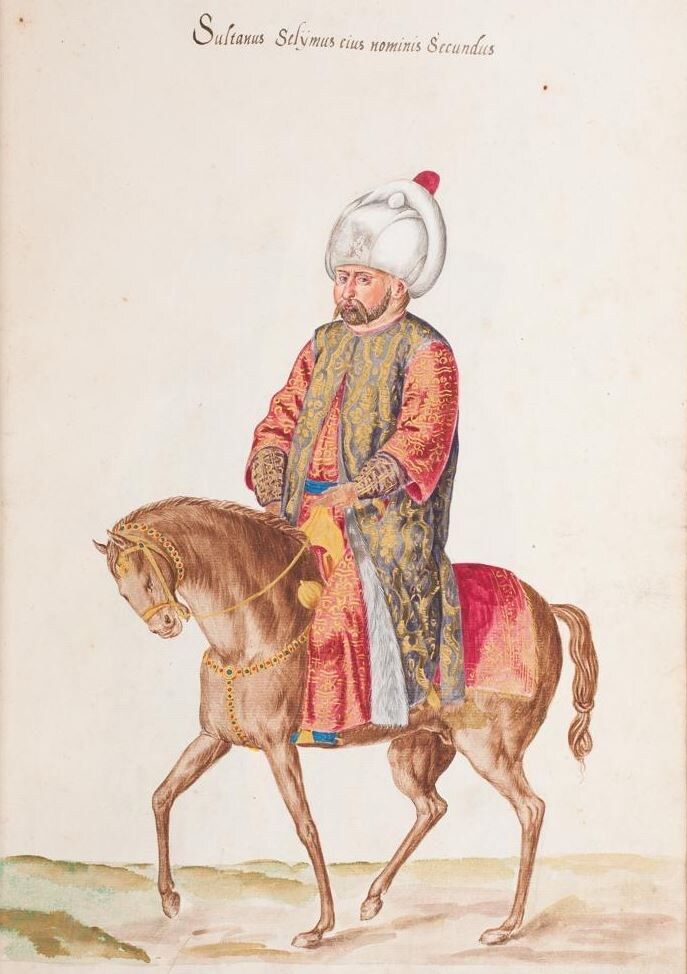
Sultan Selim on horseback
Bayezid fled to Persia, seeking the protection of Shah Tahmasp. But the Shah began secretly negotiating with Suleiman regarding Bayezid. In 1561, Tahmasp handed Bayezid over to the Sultan. And by order of the Padishah, the Shehzade and all five of his young sons were executed. There is no information as to whether the prince Selim was involved in this cruel decision.
The Reign of Selim II
In 1566, Suleiman died, and the prince Selim ascended the throne. His reign had both strengths and weaknesses. Selim’s Grand Vizier and son-in-law, Sokollu Mehmed Pasha, gained immense influence during his reign. He was an experienced and cunning politician who skillfully used his position to appoint people he trusted to key posts. The Jew Joseph Nasi also wielded great influence under Selim, having aligned himself with him even when Selim was still a prince.
Unlike his father, Selim did not go on military campaigns very often, preferring to spend more time in his palace. He was generally quite peace-loving by nature; there is a view that not a single person was executed during his reign. But we cannot say how true this is.
During Selim II’s reign, the Janissaries’ power grew. They used their influence to obtain more money for personal needs. In addition, they acquired the right to marry and send their sons into the Janissary corps.
In 1569, Selim launched a campaign against Astrakhan. His plans included connecting the Volga and Don rivers via a canal. However, the Astrakhan garrison successfully repelled the siege of the fortress of Azov, and the remnants of Selim’s fleet were destroyed by a storm. The following year, the sultan and Ivan the Terrible concluded a peace treaty.
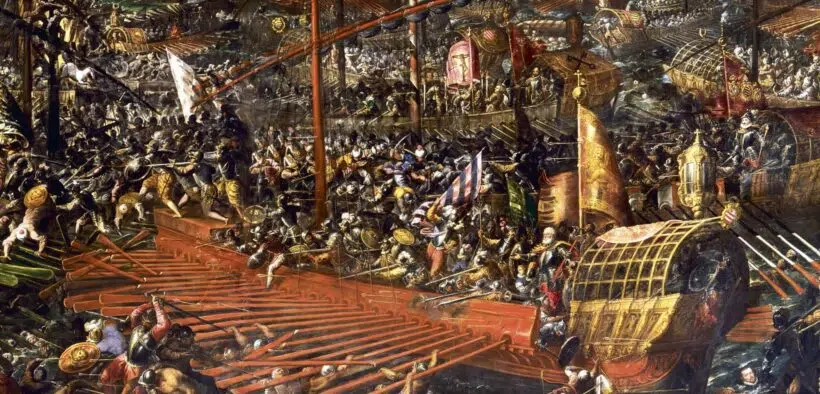
The Battle of Lepanto
Selim II also conducted a series of campaigns in the Mediterranean Sea. In 1571, he seized Cyprus from the Venetians and made it an Ottoman province. But that same year, the Ottoman fleet suffered a crushing defeat at the Battle of Lepanto. It took a whole year to recover from the losses. In 1574, Selim managed to capture Tunis, which became one of his greatest victories.
Like his father, Selim was actively involved in construction. Since he preferred Edirne to Istanbul, it was in Edirne that he built the Selimiye—a massive mosque, one of the greatest achievements of Islamic culture. The work was overseen by the outstanding court architect Mimar Sinan. Under his guidance, Selim also organized the restoration of the Hagia Sophia and expanded the Süleymaniye complex built by his father.
As for his family, Selim’s principal wife was Nurbanu Sultan. She bore the sultan a son, Murad (the future Sultan Murad III), and four daughters. It is known that he had several other sons by various concubines. All of them were subsequently executed by Murad in accordance with the same law of Fatih.

Selimiye Mosque
Selim himself died in 1574 at the age of 50, having reigned for eight years. A possible cause of death was a severe blow to the head against the marble floor of a bathhouse: the sultan likely slipped and fell while intoxicated. According to another account, Selim had suffered from dizziness for many years; he did indeed fall, but was completely sober. After his death, his son Murad ascended the throne.