
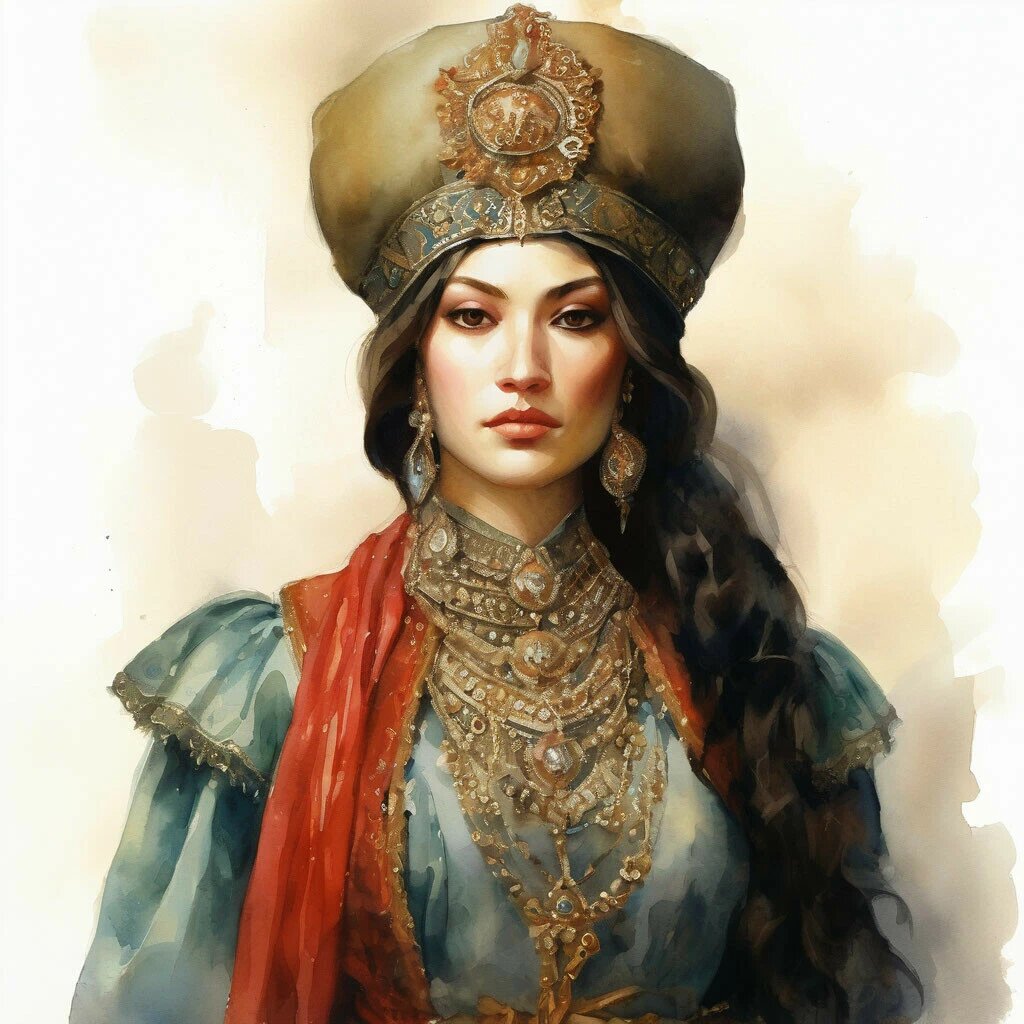
The “Princess of Ukok” is a well-preserved female mummy discovered in 1993 on the Ukok Plateau in Altai, inside a burial mound dating to the Pazyryk period (approximately 5th–3rd centuries BCE). Her attire and personal effects are truly striking in their richness and complexity: a long woolen skirt; a thin silk shirt; fur elements of clothing; a tall, elaborate headdress; jewelry and ritual objects. It is particularly significant that silk was a very expensive material at that time and was associated with long-distance trade routes. This indicates the Pazyryk people’s extensive contacts with ancient China, Central Asia, and other regions of the steppe world.
Excavations of the Pazyryk kurgans have generally revealed a high level of culture: magnificent carpets; intricate wood and leatherwork; the art of tattooing; advanced horse breeding; rich animal symbolism; and ritual burials with horses and valuable objects. The famous Pazyryk carpet is considered one of the oldest surviving carpets in the world and demonstrates a very high level of craftsmanship. Therefore, archaeologists view the Pazyryk culture as a complex and wealthy society of nomadic aristocracy, rather than simply scattered tribes.
The discovery of the “Princess of Ukok” demonstrates that members of the Pazyryk culture were indeed highly advanced and far from “primitive,” as nomadic peoples were sometimes previously portrayed. As it turns out, the mitochondrial DNA of the “Princess of Ukok” is not linked to the “earliest Indo-Europeans,” as had long been suggested. Genetic studies show that her mitochondrial lineage U4a is of ancient Central Asian origin. It is believed that this genetic lineage—the U4 branch and its sub-branches (including U4a)—
formed in Central Asia and dates back approximately 20–30 thousand years.
The mtDNA of the Ukok Princess—U4a with marker 16356—is still found today among the population of the Northern Altai. Of the 110 samples from Northern Altai women studied, the U4a lineage was found in 6, and in 4 of them, the same HVR1 haplotype 16356 was found as in the Ukok Princess. Northern Altai women, Tuvans, Todzhin, and Buryats may claim genetic kinship with her. The Northern Altai people include the following sub-ethnic groups: the Tubalars, Chelkans, Kumandins, Shors, Khakass, Teleuts, and the descendants of the ancient Yenisei Kyrgyz. This also calls into question older reconstructions of the “princess’s” appearance, which depicted her with a distinctly European phenotype.
Pozdnyakov’s reconstruction shows the Ukok Princess with pronounced East Eurasian (Mongoloid) features. And many residents of Altai actually consider it more realistic than the earlier “Europeanized” depictions.
Source of the study: M.V. Derenko et al. “Molecular Genetic Differentiation of the Ethnic Populations of South and East Siberia Based on Mitochondrial DNA Polymorphism.” Russian Journal of Genetics, 2002.
(Molecular Genetic Differentiation of the Ethnic Populations of South and East Siberia Based on Mitochondrial DNA Polymorphism M.V. Derenko et al. Russian Journal of Genetics, Vol. 38, No. 10, 2002, pp. 1196–1202).
Molecular Genetic Differentiation of Ethnic Populations of South and East Siberia Based on Mitochondrial DNA Polymorphism M.V. Derenko et al. Russian Journal of Genetics, Vol. 38, No. 10, 2002, pp. 1196–1202.
U4 Southern Urals mutations, and a large temporal gap