
BERKE KHAN OF THE GOLDEN HORDE AND HIS REFORMS IN DOMESTIC AND FOREIGN POLICY (1254-1266)
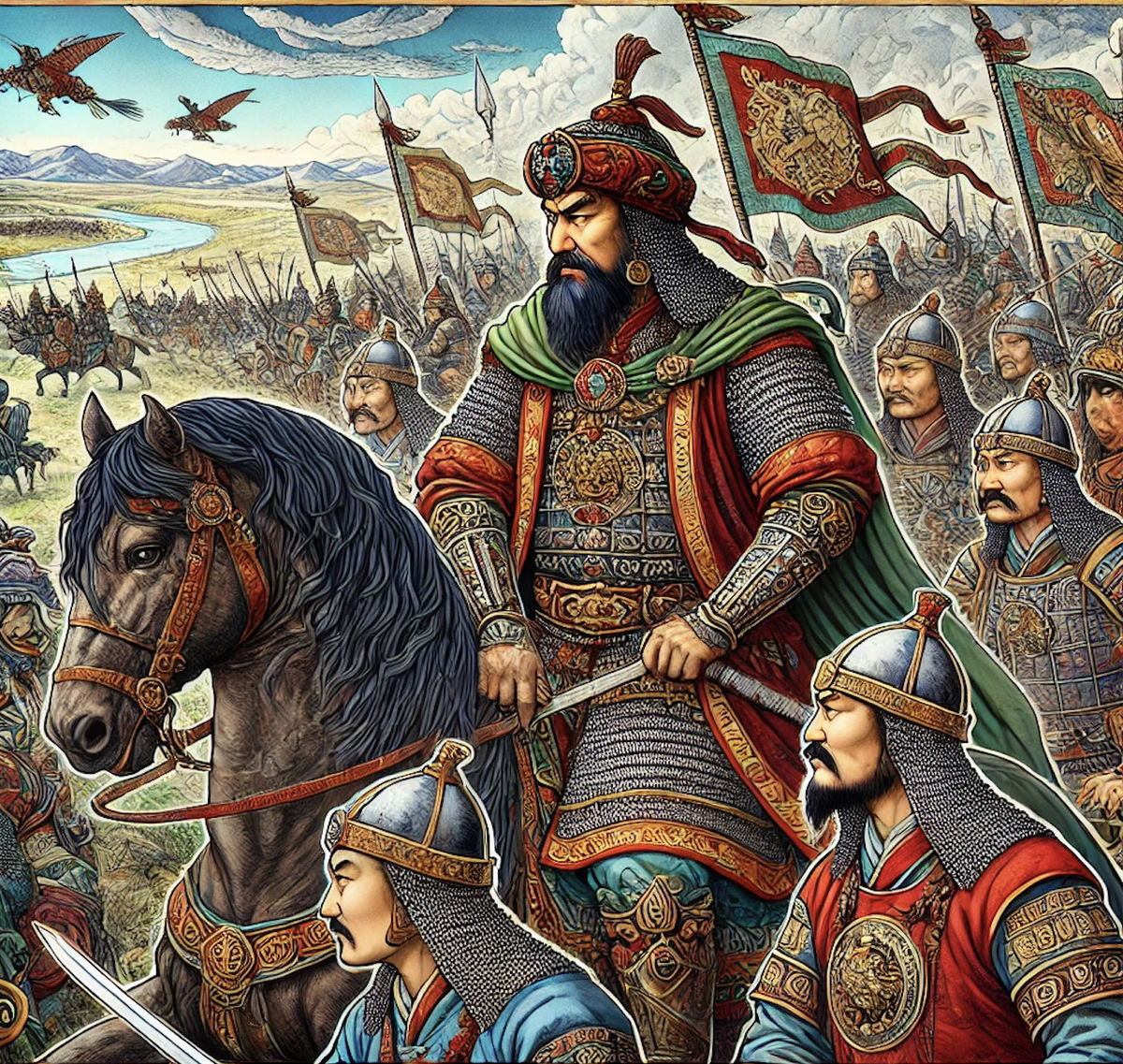
Khan Berke, according to contemporaries, was of a violent nature, although, apparently, he was not a big exception among his relatives, the Asian lords. He poisoned his nephew and his infant son, brutally executed Batu’s beloved wife, putting her in a bag filled with cats and ordered her to be thrown into the sea. It is possible that Batu’s death was the result of his activities. Having seized power in the Golden Horde, Berke began to carry out reforms in the internal life of the Golden Horde, and changed relations with his neighbors in foreign policy. He left the capital, Sarai, and built a new Sarai, 60 versts above the former one, along the Akhtuba River. Batu’s Barn remained the capital of the Horde, but Berke rarely visited it and lived in the Barn he had newly built.
The Mongols did not have well-established religious beliefs, did not have an alphabet and a literary language. Therefore, in order to create a common cultural base for the diverse composition of his possessions, Berke converted to Islam. The language of the Turkic people, the Kipchaks, became the written and literary language, and the Mongolian language began to be used only in official relations. After the adoption of the official religion of Islam, foreign policy began to change, both with the neighboring Mongol uluses and with the entire Muslim world.
The Central Asian ulus was created on the site of the former Muslim state of Khorezm. In the struggle of the khan of this ulus with the Supreme Khan, Berke could use the latter for his own purposes and began to pull towards an alliance with Muslim peoples. Berke sought to establish friendly and commercial relations with European nations as well. Batu’s barn was turning into a major trading city between east and west. The cities of the sea coast of the Sea of Azov in Tavria were also important. Having suffered greatly during the Mongol invasion, they began to recover and establish trade relations with the Caucasus, Persia and Italian cities. Relations were established with the Genoese and Venetian commercial industrialists and they were given the rights to free trade. Trading posts were allowed to be opened in Surozh and Tanais. The struggle of the khan of the Central Asian ulus with the Supreme Khan Menke in 1256 ended with the victory of the latter. Representatives of the family of Khan Ogedei were liquidated, and Menke’s brother, Hulagu, was appointed Khan of the Central Asian ulus, and the second brother, Kubilai, was appointed khan of the ulus of northern China. The relations of these khans towards Berke, who illegally seized the power of the Golden Horde, could not be friendly. In the planned conquests towards Southern China, and even more so against the Muslim peoples, Berke not only could not take part, but also had to take a hostile position. The cities of Baghdad and Damascus were the centers of the Muslim world, where the caliphates of the eastern and western part of the Muslims were located. Egypt was one of the most important states of Islam, with Jerusalem under the Sultan’s rule. Berke aspired to the Muslim peoples and sought to establish friendly relations with them. By this time, favorable events had occurred in Egypt for the Golden Horde. In 1250, the Egyptian sultan was overthrown and replaced by the «Scythian dynasty», set up by the Mamelukes. The origin of the Mamelukes was directly connected with the Black Sea steppes, with the tribes that occupied them, the Kipchaks. After the Mongols defeated the Polovtsians in the Black Sea steppes, most of them fled to the west and temporarily roamed south of the mouth of the Danube, on the Black Sea coast. Ambassadors were sent from Egypt to them with the sultan’s proposal to cross over to Egypt and enter the sultan’s service. The Cumans accepted the offer and were transported to Egypt, where they were organized to protect the sultan under the name of Mamelukes. Then the sultan was overthrown and Bayborsa, from the Kipchak tribe, was put in his place. The Kipchaks of Egypt were irreconcilable enemies of the Mongols and, in view of the threat looming for them from the Central Asian ulus, they sought opportunities to restore friendly relations with Berke who converted to Islam, under whose rule was a large part of the nomadic tribes, including their Kipchak relatives.
Khan Hulagu, appointed khan of the Central Asian ulus, began to expand his possessions, and quickly conquered the lands of Asia Minor to India and west to Damascus. Baghdad was taken by his troops, the Caliph was killed, the city was destroyed and the Muslim population was beaten. The same thing happened in Damascus. By destroying Muslims, the Mongols protected Christians. Hulagu’s wife was a Christian, Wang Khan’s granddaughter, Dokuz Khatun, his commander, Kitbok was also a Christian, and Hulagu himself was strongly inclined towards Christianity. At his headquarters, there was always a marching church for his wife. The defeat of the centers of Islam and the murder of the caliphs put Berke in a hostile position to his relatives, the Mongols, and he resolutely embarked on a military alliance with Egypt. Berke wrote to the Egyptian sultan: «Know that I am a friend of orthodoxy, and that this enemy is Hulagu, an infidel who brutally beat Muslims and seized their lands. I figured you’d move on him from one side, and I’d move on the other. We will attack him from two sides at once and drive him out of his edge. I am giving you the Muslim lands that are in his hands.»
Due to the impending war, Berke decided to increase the number of armed forces and began recruiting the population in the Russian principalities. In 1257, Pshenenich appeared in Novgorod from the «lower land» and told the Novgorodians: «If you do not give tagmas, then the regiments are ready and will come from the lower land»… The Novgorodians gave a tenth of the property and tagma, i.e. the tenth person. After that, the Tatars moved to Lithuania, conquered the whole land and beat the people. The campaign to Lithuania was undertaken at the request of Prince Alexander Nevsky, since he was always waging wars against Lithuania with the «Tatar» troops. In 1258, Berke decided to carry out the plan of Khan Menke, to make a census of the Russian population and its property. Baskaks with scribes and armed detachments were sent to all the cities. Centurions, thousandth guards, and prison guards were stationed all over the country. The Mongols had to make a census of men starting at the age of 16. Murmurs and indignation against the Mongols rose throughout the country. Mongols with scribes also appeared in Novgorod and demanded tribute and a «tagma», i.e. the tenth person. The Novgorodians refused to comply with the demands of the Mongols, Prince Vasily, the son of Alexander Nevsky, was sent to Pskov, and the Tatars were expelled. Prince Alexander Nevsky, having learned about what had happened in Novgorod, arrived with an armed detachment, ordered his son to return to Novgorod, and dealt with the perpetrators: who had their noses cut, who was blinded. The Novgorodians gave the Tatars large gifts, a tenth of their property and a tenth man. A census of the Tatar population was carried out throughout Russia, including in the Galician Principality.
After the census carried out in the Russian principalities, accompanied by the indignation of the people, Berke, in order to facilitate the receipt of tribute and tagma for himself, transferred the right to collect to the Khiva farmers. Under Prince Alexander Nevsky, the Khiva chief baskak, Amragu, was appointed, who was constantly with the prince. Baskaks with armed detachments were deployed in all cities of the Russian principalities. The tax collectors were given unlimited power in collecting tribute, and the Russian people were placed in even more severe economic dependence not on the conquerors, but on the greed of the tax collectors.
In 1257, the Supreme Khan Menke died, and in the same year the Mongols moved on to conquer Southern China, Syria and Egypt. Kublai Khan conquered all the regions of China located south of the Yellow River, Tibet, and the Song River to the borders of India. According to Marco Polo, during the conquest of China, there were 30,000 Greek Christians in the troops of Khan Kubilai, and 1,000 selected Russians among the Khan’s guards. These were the troops sent to the headquarters of the Supreme Khan by Batu.
In the same year, Khan Hulagu launched an offensive against Egypt. The Mongols’ successes in Asia Minor raised the spirits of the Christian population, and they saw the Mongol movement as the «yellow crusaders» waging war against the Muslim infidels. Ambassadors from the Tsar of Armenia, the Prince of Antioch and the King of France, Louis IX, were at Hulagu’s headquarters.
The Mongols promised Christians to give the Holy Land to Christians after they occupied it. By the time the Hulagu movement against Egypt began, the Crusaders had been driven out of Palestine, and only one of the orders they founded, St. John of Jerusalem, occupied the Arka fortress. This order entered into an agreement with the Egyptian sultan, and began to assist him against Hulagu. They opened a free path for the Egyptians in Syria, provided food for the troops with local funds. The troops of Hulagu, under the command of Kitbok, met with the troops of the Egyptian Sultan at En–Jelug on September 3, 1260. After a fierce battle, Kitbok’s troops were defeated, and he himself was captured and beheaded. The whole of Syria up to western Mesopotamia passed into the possession of the Egyptian sultan. The battle of En–Dzheluga put an end to the Mongols’ conquering movement. Hulagu withdrew his troops and established the center of the Iranian ulus in the city of Tevriz.
The adoption of Islam as the official religion did not affect attitudes towards Christians and, on the contrary, the church hierarchy of Christians was given a more correct organization. In 1261, a diocese was opened in the Headquarters of the Khan of the Golden Horde, headed by a bishop.
The Metropolitan of All Russia enjoyed a certain freedom under the rule of the Mongols. After transferring the metropolitanate to Kiev, Metropolitan Kirill traveled to Constantinople and attended the opening of the Diocese in Sarai. Some historians attribute the founding of the diocese solely to his concerns. Undoubtedly, this event did not happen without his participation. But the church organization was also part of the plans of the khans of the Golden Horde. In governing a Christian country, the Mongols clearly preferred ecclesiastical rather than princely authority. Metropolitan Kirill was present at the opening of the Sarai Diocese, Mitrofan was appointed its bishop and the Diocese was named Sarai and Podon.
The Christian Diocese in the Crimea and the Azov region has existed since the first centuries of Christianity and its centers were the cities of Surozh and Tanais. Now the center of these Dioceses was moved to Sarai, and the entire population located within the steppe zone, the Azov region and the North Caucasus came under the authority of its Bishop. The founding of the Diocese in Sarai was important for the Russian population, settled among nomadic peoples. Firstly, the Bishop’s authority united the people and connected them with the general church organization of all Russia, since the Bishop was subordinate to the Metropolitan of all Russia. In addition, the church organization awakened the consciousness of unity among the people, they were no longer an impersonal mass scattered among nomadic tribes, but a socially organized people with their own territory and the church authority uniting them. Under Mongol rule, the church organization had a rather complex hierarchy: in addition to the Metropolitan and bishops, there were: a spiritual judge, a scribe, a lawyer, a mentor, a rector, a hermit, a metricator and a dean. After the opening of the Diocese, temples and monasteries began to be built everywhere, clergy were installed, and Church life was improved.
In the restored Tanais, the temples of St. Nicholas and St. John the Baptist rose from the ruins. A temple and monastery were built in the newly formed town of Sirotinsk; cathedrals were also built in all Other places of settlement of the Christian population: on the Ridge, Yaik and mainly within the limits of the Chervlen Yar, along the Khopr, the Bear and the Crow. The role of the bishop installed in the Barn was important not only for the people under his control, but also for the Metropolitan and the Moscow princes. While at the Khan’s Headquarters, the Bishop was in constant contact with the local authorities and could serve as an adviser and mediator between the Mongolian authorities, the Metropolitan and the Russian princes who came to the Headquarters on their own business. Russian Russian princes began to use troops from the Russian population, which were given to the princes by the Mongols to fight their opponents, in controversial princely matters, the Bishop of Sarai began to acquire even greater importance. The Russian princes could not have their own armed forces, but they could use the troops of the Mongols. The Russian princes in the general state organization could not distinguish themselves from the Golden Horde, and therefore only those who were under the rule of the khans could be considered armed forces for them. Russian Russian troops, most of whom were recruited by the Russian population, were called «grassroots troops» among the Russian people. The records of the Russian chroniclers after the Mongol invasion continued, albeit very briefly, in Novgorod. Russian Russians have been using Russian regiments against the Russian people since the early days of their rule, and the record shows that in 1257 Pashenenich arrived in Novgorod with an order from the Tatars, threatening: «If you do not give tagmas, then the «grassroots regiments» are already ready.»