
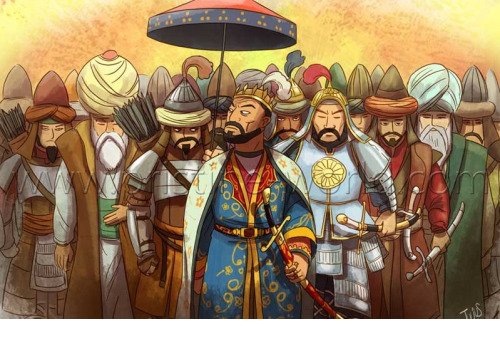
Mongol rule in Russian history is described under the name of the Golden Horde, while to the Mohammedans our distant deeds were known as the Jochi Ulus or the Desht Kipchak Khanate. Our further story is about this khanate.
One day, a medieval manuscript was found in Spain, the work of Ibn Battuta, a subject of the Moroccan sultan, who then owned Spain. This work was titled as «A gift to those interested in the curiosities of distant lands and wonderful journeys.» In the preface, Battutta reports that he circumnavigated not only the region of Timbuktu on the Niger River beyond the Sahara (which is quite possible for a Moroccan), but also remote and unintelligible southern Russia, India and China between 1325 and 1346.
At that time, there were no geographical maps, and any writer could shuffle all the cities and peoples among themselves, attributing any miracles to them, sometimes alternating them with correct messages gleaned from the notes of people who actually visited there. And in order for the reader not to ask from whom the author learned all this, the best way was to present his information as if he had seen everything himself. Undoubtedly, this is exactly what the authors of books about the Mongols and the Chinese, Plano Carpini, Marco Polo, Rubruk, did.; This was done by Ibn Battuta and the authors of all other Arab and non-Arab «Voyages» to distant lands up to the 19th century AD. Are you in doubt? Let’s get this straight.
We are quoting Ibn Battuta’s book here, translated by N. A. Morozov.:
«The area where we stayed is known as Desht-Kipchak. Desht in the Turkic language means steppe. It is green and blooming, but there is no mountain, hill, or rise on it. There is no firewood on it, and they burn only dry manure, which is called a tezek. You see how even their elders pick it up and put it in the hem of their clothes. People travel through this steppe only on carts, and it stretches for six months of travel; three of them travel through the lands of Sultan Muhammad Uz-beg, and three through other possessions.»
«On the next day of our arrival, one of our comrades’ merchants set off across this steppe to those belonging to the people known as the Kipchaks. They are of the Christian faith.»
«We arrived in the city of Kafu (Feodosia). It is inhabited by Christians, most of whom are Genoese. They have a prince named El-Demedir.»
The Genoese El Demedir! We suggest that the reader himself restore this Italian name in Arabic pronunciation and judge by it the other names given in Ibn Battuta’s book.
«I have seen wonders in this region regarding the great honor in which women are held. They are more respected than men. As for the wives of the princes, the first time I saw them was when I left the Crimea: I saw Prince Salty’s wife then, in her arba. The whole arba was covered with expensive blue cloth; the windows and doors of the caravan were open; in front of the prince’s wife were four girls who accompanied her. As she approached the prince’s campsite, she got off the cart, and about 30 girls got off with her, who lifted the hem of her clothes (that is, the train). They had loops on them; each girl took hold of a loop, lifting the floors from the ground on all sides, and she walked, thus swaying importantly (it was a long train if it was carried on strings by 30 girls!). When she reached the Emir, he stood in front of her, bowed to her and sat her down next to him, and the girls surrounded her.… As for the wives of merchants and common people, I’ve seen them too. One of them was in a cart driven by a horse, and in front of her were three or four girls lifting the skirts of her dress. On her head is a cap decorated with precious stones, with peacock feathers on top. The windows of the caravan were open; her face is open, because Turkish women don’t cover themselves (really?! And this is written by a Muslim about another Muslim country he visited himself!)».
The story of the extraordinary gallantry of the «Sarai» tsars and all the cultured inhabitants of the Sarai kingdom towards the ladies could only arise from the transfer of the chivalrous mores that prevailed in Europe across the Volga. At that time, in the Mohammedan East, as in Russia, they were kept in the position of prisoners in harems (chambers), sold into marriage by their fathers and were not shown to outsiders except in veils. This story is an obvious absurdity.
«I pitched my tent there on a hill, and the royal headquarters, which they call Urdu, came up to it, and we saw a large (nomadic) city moving with its inhabitants. It has nomadic mosques and bazaars, and smoke from kitchens billowing through the air. They cook food during their very ride, and the horses carry the carts with them.»
And where does the food for such a nomadic city come from, we ask, and where does the cattle find grass in such a tight place, because it will be devoured in an instant! Our traveler is silent about this.
«The tsar rode up and settled down in his headquarters separately. His name is the glorious Uz-bek, and the word khan means sultan.…
When one of the favorites arrives, the king stands in front of her and holds her hand while she ascends the throne. As for the main one, he goes to meet her at the door of the tent, greets her and takes her by the hand, and when she ascends the throne and sits down, only then does the king himself sit down, and all this happens in front of people without cover.…
This sultan is the owner of a vast kingdom, he is strong in might, great in dignity, high in dignity, the destroyer of the enemies of Allah, the inhabitants of Constantinople the Great and a zealous fighter for faith in the war against them. His possessions are vast and his cities are large, and his capital is Sarai. He is one of those seven kings who are the greatest and most powerful kings of the world.»
What kind of enemies of Allah did this Volga Khan crush in Orthodox Constantinople between 1325 and 1346?! It’s completely unclear. The Crusades have already ended, the Turks are still a hundred years away from conquering Constantinople, and Khan Uz-bek is not a Turk at all, as you will see now. Ibn Battuta lists the 7 greatest kings of the world:
«1. Our Lord (the Moroccan Sultan), the ruler of the faithful, the shadow of Allah on his land, the representative of a victorious army that will not cease to stand up for the truth until the hour comes. May Allah strengthen his cause and magnify his victory!
- The King of Egypt and Syria.
- The King of both Iraqis.
- This king Uz-bek.
- The king of the lands of Turkestan and Transoxiana.
- The King of India.
- The King of China.»
Let’s reflect on what we’ve read. The «seven[50] great kingdoms of the earth» are listed here. The five on the list require no further explanation.: These are the kings of China, India, both Iraqis (Persia and Mesopotamia, now Iran and Iraq), Egypt and Syria, and «our lord» – the Sultan of Morocco, in which country the author wrote his work.
The sixth great king, the «king of the lands of Turkestan and Transoxiana», can be identified with Osman I (died 1326), Sultan of Turkey, since Turkestan literally means the Land of the Turks in Arabic.
And where does the seventh king, the elder of the Bonds, rule, with such gallant cavaliers and such exquisite ladies? He is the owner of a huge northeastern kingdom, the kingdom of Desht and Kipchak, which included Siberia and the Trans-Volga region, and the then Genoese colonies in the Crimea, and in general all settlements on the northern shores of the Black Sea. This is the opinion of traditional history. Let us refer, for brevity, to the Soviet Encyclopedic Dictionary (ed. 1989):
DESHT-I-Kipchak (Kipchak steppe), the name in Arabic and Persian texts of the 11th-15th centuries. steppes from the Irtysh River to the Danube River, from Crimea to Bolgar the Great, where the Kipchaks (Cumans) roamed. In the 13th century it was captured by the Mongol-Tatars. In the 16th and 18th centuries, the name of only the eastern part (the territory of modern Kazakhstan)». We should add that his capital, Sarai, was located, according to historians, on the Lower Volga.
Now take a geographical map of Europe and Asia in your hands. The author of the 14th century, a knowledgeable and educated man who has personally traveled half the world, names the states of North Africa, the Middle East, South Asia, the Far East and … the steppes from the Danube to the Irtysh among the greatest kingdoms of the planet.
If he had personally traveled from Morocco (northwest Africa) through Egypt, Palestine, Syria, «Turkestan», Iraq and Iran, he could not have ignored the stories that only thirty or forty years ago the Crusades ended, which had been raging here since 1096. For a quarter of a millennium, European knights of Germanic origin, first of all, wave after wave, armies of hundreds of thousands, or even up to a million people at a time rolled into Muslim lands … but look at the map! The traveler knows nothing about the existence of Europe! Among the great kingdoms listed by Ibn Battuta, there is no huge German kingdom. He noticed the Deutsche in the east, but not the Deutsche in the west.
How is it that Ibn Battuta, a native of Tangier on the southern shore of the Strait of Gibraltar, whose entire culture was associated with the then Moorish Andalusia, Spain and Europe in general, enumerating the seven greatest states of the «earthly circle» and knowing about such remote ones as China or India, did not know anything about the existence of Germany, the closest to him, the strongest and the most cultured of the states of that time? How did some geographically impossible nomadic steppe kingdom with a nomadic king Uz-bek at its head appear instead?

Ibn Battuta’s World map
Let’s leave aside the speculations of Ibn Battuta and his commentators. It was not the mythical steppe kingdom with a nomadic capital on the Lower Volga that owned the lands of the northern Black Sea region (Kipchakia) and the entire northern spur of the Great Silk Road, which ran through the steppes of present-day Russia and Ukraine, but Germany. Deutsch-Kipchakia!
The Kipchaks, Cumans, and Cumans are three different names for the same people. We are told that the Cumans who now inhabit Great and Little Cumania throughout the middle of Hungary are descendants of the Cumans who migrated here during the 4th Crusade, fleeing from Genoese colonization. Yes, the Cumans are descendants of the Cumans, but they did not run away from the Genoese to Hungary, but on the contrary, their whole plan was to come from Hungary with the Genoese to the Black Sea and Far Eastern countries as merchants.
The name of the country located north of the Black and Azov Seas «German Merchant» is confirmed by many German words of administrative meaning that have entered the Ukrainian and Russian languages. This is a «basurman», or, as it is written in the chronicles, Besserman, the German «Besteuermann» is a collector of taxes, a label is a document for the reign, a one–year vassal obligation to pay a certain tribute to the overlord, and other words.
The original Cossacks were not «serf fugitives» at all, but reborn crusaders who mixed with the local population and eventually «went wild», if it is appropriate to say so. Therefore, in the Zaporozhian Sich they called themselves knights (lytsari) from the German word Riter, and their modern name Cossacks most likely comes from the Latin-Italian casa, house (hence the word barracks, army house), so a Cossack means a farmer. The title of their chief hetman comes from the German word Hauptmann (leader). The title of the senior chief subordinate to him, ataman, comes from the German Autmann. And the word yesaul, introduced, as you know, only in 1567 by the Semigrad prince, and then by the Polish king Stefan Batory, can be called «Tatar» by the Ukrainian Cossacks only if we harass the Tatars from the Tatras, since Semigrad (Siebenburgen or Transylvania) is the southeastern part of Hungary.. But it turns out that all the authorities there were originally German, although not without the influence of the Genoese-Venetians, since the second Muslim name of this region, Ulus Jochi, is consonant with the Italian word duce – duke; Russian duchy.
Similarly, the old word terem is the German Turm, tower, which became the name of the prison in Russian, which also indicates the former German administrative initiative in Russia.
But if we define Battuta’s Desht-Kipchak as the conquests of the Germans in the East, then who is Tsar Mohammed Uz-bek, who appeared in Russian chronicles under the names of Ozbyak and Uzbek, the patron saint of Moscow, the father-in-law of Moscow Prince Yuri Danilovich? If he is the king of the Deutsch-Kipchak, that is, the German-Austrian Empire, then he must coincide with its ruler. And the Habsburgs ruled there. Well, it’s more than likely a coincidence! The name of Habsburg[51] is so unpronounceable for non-Germans that it could easily be reworked by them into Guzbek, Ozbyak, Uzbek.
There is a misconception that Ivan III, declaring Russia the «Third Rome», adopted for the country the coat of arms of Byzantium, a double-headed eagle. But the Byzantine (Romaic) Empire did not have a coat of arms! The double-headed eagle was the ancestral coat of arms of the Habsburgs, even when they were Rhenish landgraves, but they really got it after the representatives of the family fought in the lands of Byzantium. When the Habsburg dynasty established itself in the Holy Roman Empire of the German nation in the 13th century, they turned their family coat of arms into an imperial one. Ivan III could have appropriated this coat of arms for Russia only if Russia had been associated with the Catholic West, led by the Habsburgs, during the entire time of the Crusades. This is another confirmation of the Uzbek–Habsburg parallel.
And as for the name Mohammed, which Ibn Battuta awarded him, it is not a name at all, but a nickname meaning Glorious.