
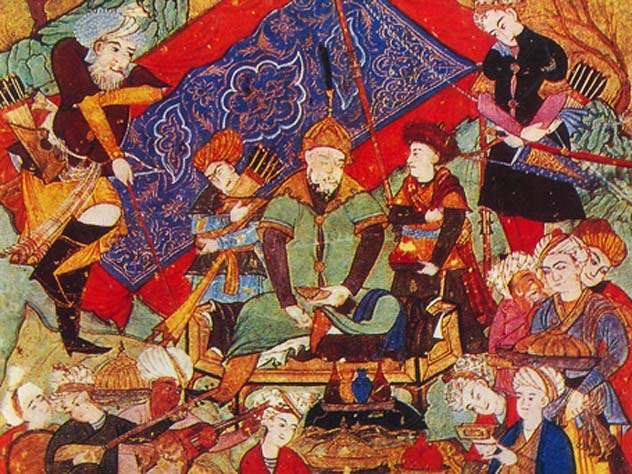
By the middle of the 14th century, as the Genghisids faded into the shadows in Iran, China, Transoxiana and Southern Russia, representatives of the Jochi family branch came to replace them and claimed their share in historical empires. We are talking about the Sheibanids, a dynasty of Uzbek khans. But first, let’s fill in what lands these heirs of the Genghis Khan family owned.
The eldest son of Genghis Khan is Jochi (? – c. 1227) – received lands from his father with the tribes that inhabited them, stretching from the Irtysh to the western borders of the Mongol Empire. The son of Jochi Batu (1208-1255) expanded the boundaries of the ulus far to the west with his conquests in Eastern Europe, thereby securing the possession of the Turkic tribes of the Polovtsian steppes. The rest of the Jochi ulus was divided between the Batu brothers, Horde and Sheiban.
The Horde received lands on the right bank of the Syr Darya, from the city of Sygnak, near the Kara-Tau mountains, to the river delta on the bank of the Aral Sea, including a strip on the left bank of the delta that stretched to the Amu Darya, i.e. almost the entire eastern coast of the Aral Sea, as well as the Sary-Su basin and the Ulu-Tau massif, which it separates this pool from Turgai. Later, the khanate of the Horde went down in history as the White Horde (Ak-Horde).
During the division of the territory to the east and southeast of the Southern Urals, Sheiban received a significant part of the Aktobe region and Turgai. He ruled the steppes north of the Syr Darya, known as Desht-i-Kipchak (Kipchak Steppes). As for his military exploits, Shayban distinguished himself in 1241 during the Turko-Mongol campaign in Hungary. According to Rashid al-Din, if the Turko-Mongols had held this country in their hands, Shayban would have become its ruler.
There were Turkic and Mongol tribes and clans in the possessions of Sheiban, who came with the sons and grandsons of Genghis Khan to the West, and then assimilated with the local nomads of Turkic origin. Sheiban roamed between the Ural Mountains and the Ilek and Irgiz rivers, and in winter he went to the areas irrigated by the Syr Darya, Chu and Sary-Su. The borders of Sheiban’s domain have remained exactly like this for quite a long time, although with the extreme mobility of the nomads, the stability of any borders is unthinkable at all. The Sheyban ulus did not remain unchanged in its ethical composition either: for a long period of its existence, nomadic migrations took place in it with the ebb of some and the ebb of others from different places, especially since the troubles in the Golden Horde, which began in the second half of the 13th century. and in the east of the Kipchak steppes, in the White Horde, often forced subjects of Turkic-Mongol origin should leave the borders of their nomadic state and migrate in whole tribes to the southwest or east of Sarai and to the north and northeast of the White Horde. An example of this is the story of the Golden Horde Khan Nogai from the non-ruling branch of the house of Jochi.
Nogai took an active part in the struggle of the Golden Horde Khan Berke with his cousin, the Persian Ilkhan Hulagu, as commander of the Golden Horde troops. After Berke’s death, Nogai becomes an all-powerful temporary worker in the Golden Horde (as mentioned above). Due to the vastness of his political influence, which extended from the Danube to the Urals, and with his unlimited power in this territory, Russian chronicles and some Eastern authors call Nogai the tsar. His authoritarian rule in the Golden Horde eventually began to weigh on Khan Tokhta, and he entered into a struggle with Nogai, which ended with Nogai being defeated and killed in battle (1300) in Desht-i-Kipchak. The victors took many prisoners, who were sold to almost all parts of the world, especially many of them were sold to Egypt. The Nogai Mangkity tribe and some allied Turkic-Mongol clans, collectively known as the Nogai, eventually became scattered across the plains of Southeastern Europe and the steppes north and northeast of the Syr Darya due to their almost incessant movements after their leader to the Danube, Crimea, and Desht-i-Kipchak. Fischer, a researcher of the history of Siberia, mentioning Nogai, who «founded his own state,» notes that although he «disappeared with his son Jikoy, but the name of the Nogais named after him was kept after him for several more years, and it is very likely that this people spread from the Volga to Yaik, and from there to the Irtysh.» In the Russian chronicles of the XVI century. these lands were called Shiban.
In 1360, when the ruler of the White Horde, Khan Tokhtamysh, conquered the Golden Horde, most of the White Horde went to Europe, and the old part of the Horde, north of the lower reaches of the Syr Darya, was gradually occupied by the Sheibans.
The entire region of Sary-su and Ulu-Tau, as well as Turgai, were inhabited by representatives of the Sheybana clan. However, the hordes or tribes subordinate to the Shaybans took the name «Ozbeks» or «Uzbeks» in the middle of the 14th century, and it was under this name that they entered history. There is still no single point of view on the origin of the very name «Uzbeks».
The Uzbeks, as a people in general, were not uniform in their composition, no matter how they tried to explain the name of this people from the name of the Golden Horde Khan Uzbek or as a self-sufficient name taken by itself. In any case, an interesting circumstance is that neither the Arab authors contemporary with Uzbek Khan and subsequent ones, up to the 15th century, nor the Persian sources closest to us ever mention the Uzbeks as part of the tribes of the Golden Horde.
The regular relations of the Golden Horde with Egypt naturally provided Arab historians of that time with rich material on the life and ethnographic composition of Uzbek Khan’s possessions, which they drew not only from Egyptian ambassadors who visited the Golden Horde, but also from the Turkic-Mongol ones, with whom Muslim scholars came. The works of these historians, together with the description of the Golden Horde by the famous Arab traveler Ibn Battuta, who lived for a relatively long time in the kingdom of Uzbek Khan, personally communicated with the latter and his court and left us a lot of interesting information of a domestic and economic nature about the Golden Horde, give us a sufficient idea of the main nationalities of Uzbek Khan’s domain. The Arab information of the 14th century does not name any other Golden Horde peoples, except the Mongols and Turks, less often the Kipchaks. Even in the preliminaries of the messages addressed by Sultan Uzbek Khan, written in gold and ink on a large sheet of Baghdad paper, Uzbek Khan was referred to as «the Sultan of the Mongols, Kipchaks and Turks.»
In addition, we do not find any instructions from modern Arab chroniclers of Uzbek Khan that «tribes disposed towards him, as a just monarch and enlightened by the light of the true faith,» would begin to call themselves «Uzbeks» in his honor. The authors, of course, should have mentioned the Uzbeks as the dominant tribe, say, or, if this corresponded to factual data, that Uzbek Khan’s name began to be given to, say, a tribe closest to his headquarters or Sarai, because of his merits in the cause of Islam and his actions as The emperor’s views in the spirit of an ideal Muslim ruler were indisputable. Apparently, during Uzbek Khan’s lifetime, not a single «noble tribe» of his ulus called itself by his name.
One thing is certain, that under Uzbek Khan there was a rapid process of Turkification of the Mongols who lived in his ulus. Al-Omari wrote about this quite definitely: «In ancient times, this state (i.e. Khan Uzbek) was the country of the Kipchaks, but when the Mongols took possession of it, the Kipchaks became their subjects, then the Mongols mixed with them and intermarried. The land prevailed over all the natural qualities and racial characteristics of the Mongols, and they all became completely like the Kipchaks, as if they were of the same family, because the Mongols settled on the land of the Kipchaks, married their women and stayed with them on their land. Thus, a long stay in any country and land causes human nature to become like it and change its innate features according to the nature of that country. Only sometimes is there a greater or lesser difference in skin color for a reason other than the influence of the country.» The same kind of considerations were expressed in the 13th century by Fischer, who, speaking of the Mongols «as the most populous people among all Turkic generations,» notes «that over time the name Turk was mixed with the Mongols and prevailed; This may have been due to the fact that the Turks, after Genghis Khan brought all their generations under one rule, served in his troops and his heirs in much greater numbers than the Mongols themselves. This can be concluded from the fact that in all those conquered lands that previously had their own language and knew neither Mongolian nor Turkic, only the Turkic language came into use with the exclusion of Mongolian, which could not have happened if the Turks had not outnumbered the Mongols by far. Thus, for an incomparably large number of Turks, the Mongolian name disappeared in the western lands.» Academician V. Vladimirtsov also emphasized that «the Mongols who went to the west soon underwent Turkification, generally dissolved into the surrounding ethnographic environment more or less close to them.»
Thus, the majority of the population in Desht-i-Kipchak consisted of Turkic tribes. The Mongols practically did not make fundamental changes in the ethnic composition of the Kipchaks, on the contrary, the Mongols themselves underwent Turkification.
So, modern Uzbek Khan and later eastern sources, Arabic and Persian, say nothing about the fact that the peoples of his ulus began to be named after him by the common name «Uzbeks», as the Russian chronicles do not say about this. Information that the people of Uzbek Khan’s lot became known as the «Uzbek people» or «Uzbeks» appears in the few authors of Iran and Central Asia who wrote much later than the era of Uzbek Khan, when the image of the founder of Islam in the Golden Horde was already covered with legends.
For example, the anonymous author of the Tajik work «The Family Tree of the Turks», compiled no earlier than the middle of the XV century. Speaking very vaguely about the ethnic composition of the Uzbek Khan’s population, indicates the reasons why the people of this Golden Horde Khan began to be called «Uzbeks» in his honor. Here is an excerpt from this work: «Upon his accession to the throne, Uzbek Khan spent his life in the northern part of Desht-i-Kipchak for eight years with his tribe and people, because he liked the climate of this country and the abundance of hunting. When eight years had passed since the beginning of his reign, Uzbek Khan was honored to convert to Islam. And because the people of his tribe and inheritance, who were in that country, for the most part were fortunate enough to convert to Islam, His Holiness Seyid Ata brought them all to the countries of Transoxiana on an indisputable instruction from the other world. When Uzbek Khan came somewhere, everyone asked, «Who are these aliens?» – he took the name of his military commander and sovereign, who was Uzbek Khan. For this reason, the people who came to Transoxiana began to be called Uzbeks.»
It should be noted that even after the death of Uzbek Khan, the Jochi ulus retained its name, in any case, none of the Persian historians calls it Uzbek ulus, at least the areas to the east and northeast of the lower reaches of the Syr Darya, which were the original possession of the Sheiban house, are called Jochi ulus by all historians.
The term «Uzbeks», as a designation of a people in the broadest sense of the word, was encountered by Eastern authors several decades before the Uzbeks of Sheibani Khan began their movement south to the Amu Darya oases. Who did these authors mean by Uzbeks, which people were they known as Uzbeks in the proper sense?
In Ibn Arabshah, we do not find any evidence that the Golden Horde peoples were called Uzbeks.
Almost for the first time, the author mentioning the Uzbeks is the compiler of the official history of Amir Temur, written in 1425, Sheraf al-Din Yazdi. For example, describing the details of Amir Temur’s campaign against Tokhtamysh, when Tokhtamysh, defeated by Temur, fled to the Volga, Yezdi writes the following: «Temur, having taken an army and given the order to march light, set off in pursuit of Tokhtamysh Khan. He chased after him as fast as possible day and night. When he reached the Athil crossing, which is called Turatur crossing, he joined the son of Urus Khan, Kuirichak-oglan, who was one of those who were with the happy monarch, a detachment of Bahadur Uzbeks who were part of the ranks of the august Mulazim. Having prepared the royal insignia, Temur honored Kuirichak-oglan with a gold-embroidered robe and a gold belt and sent him across the Attila, entrusting khanship in the Juchi ulus.»
From the history of Temur, written by Sheraf al-Din’s predecessor, Yazdi Nizamutdin Shami, during Temur’s lifetime, we learn that in Transoxiana, Urus Khan’s possessions were called the Uzbek region in the 14th century, and Urus Khan himself was called the Uzbek Khan. In subsequent historical works of the 15th century, for example, in the works of Abdurazzak Samarqandi, Mirkhond, Khondemir, and others, all those Turkic-Mongol tribes that roamed north of the Syr Darya or north, northwest, and northeast of the possessions that make up the territory of the Jochi ulus were definitely called Uzbeks. Representatives of the ruling class of the Chagatai ulus sometimes feuded with the Uzbeks, then dragged them into their dynastic feuds, then entered into kinship relations with them. Perhaps the last fact of the Chagatai people’s close relations with the Uzbeks was the appearance of Sultan Hussein Mirza at the headquarters of Abulkhair Khan shortly before he seized the throne of Herat, hoping to rely on the help of the Uzbeks in this enterprise. The historian of that time left us interesting information about the reception of this temurid by the Uzbeks and about the lengthy negotiations between the Uzbeks and Sultan Hussein, who then did not want to submit to the humiliating ceremony, from the point of view of the Chagatai, the fulfillment of the purely Uzbek custom of «tabug», i.e. the presentation of foreign ambassadors and ruling persons to the Uzbek khans, and the grandiose drinking at the headquarters that followed heads of Uzbeks.
Well, who were the Uzbeks in the XV century and at the beginning of the XVI century, who, led by Sheibani Khan (1451-1510), conquered the possessions of the Temurids and firmly settled in the oases of Central Asia, what were they ethnically? To a large extent, we find answers to these questions in the few historical monuments that were written under Sheibani Khan and his immediate successors and have been preserved in very rare manuscripts. Among them, the most notable is the «Book about the Guest of Bukhara», compiled by Ruzbehan Isfagani.
Regarding the composition of the Uzbek people, who were adjacent to the possessions of the Temurids in the era of Sheibani Khan, and the boundaries of their settlement, Ruzbehan writes the following: «Three peoples belong to the Uzbeks, who are the most glorious in the possessions of Genghis Khan. Today, one of them is all the tribes belonging to the Shayban, the second people are the Kazakhs, who are famous all over the world for their strength and fearlessness, and the third people are the Mangkits, who are the kings of Astrakhan. One border of the Uzbek region ends at the ocean, the other reaches Turkestan, the third – to Derbent, the fourth – to Khorezm and the fifth – to Astrabad. All these lands are entirely made up of Uzbek summer and winter quarters. The khans of all these three peoples are in constant enmity with each other, and each of them encroaches on the other. And when they win, one sells the other into slavery, takes captive; the enemy’s cattle and people in their midst are considered permissible spoils of war and never deviate from this rule. If someone contradicts them in this, saying: «Why are you selling your own people into slavery?» – they are surprised and say: «Yes, this man is crazy! He does not recognize the spoils of war.“ Who would dare to tell them, «These are my people,» after claiming that these are their spoils of war? They have a widespread practice of selling the vanquished by the winners, without a ban from anyone who could forbid it, and without any opposition from anyone who would prevent it. All Uzbek tribes have a lot of respected khans; each tribe of the great and famous descendants of Genghis Khan is called sultans, and the one who is greater than them all is called Khan, that is, the greatest of the sovereigns and their rulers, in whose obedience they would be unshakeable.»
There can hardly be any doubt that Ruzbehan’s precise definition of the main ethnic groups, called «Uzbeks» at the beginning of the 16th century, includes the Turkic-Mongolian tribes of the former ulus of Sheiban, which stretched from the Urals to the Ishim and Sary-Su rivers and northward towards the Arctic Ocean (we must not forget that the Siberian khans came from the house of Sheiban, who subjugated a significant part of Siberia), the Desht-i-Kipchak tribes, or the Horde ulus, and the lower reaches of the Emba, Urals, and Volga to the Caucasus, occupied by the Mangkits or Nogais. The latter, however, at the beginning of the XVI century. in significant numbers, they are firmly located on the Syrdarya plains, next to the Kazakhs, and much to the north of them. Even if one is somewhat skeptical about the borders of the Uzbek country, which Ruzbehan cites from the words of the leaders of this people themselves, the border milestones he cites turn out to be quite accurate. Indeed, at the time described, the border of Uzbek territory reached the eastern regions of Turkestan, inclusive. Khorezm was not a native Uzbek possession, and the steppe expanses before Astrabad were occupied mainly by these mobile nomads, because even under the successor of Amir Temur, Shah Rukh (1405-1447), according to Samarqandi, Uzbeks who became Kazakhs raided even Mazandaran, penetrating there through Astrabad.
According to Paul Pelio, the name «Uzbek» means «master of oneself,» i.e., «a free man.» In this case, «Uzbek» as the name of the nation would then mean «a nation of free people.»
In order to avoid confusion with the term «Uzbeks», it should be understood that Uzbek nomads who lived in the northeastern regions of the Jochi ulus in the 14th-16th centuries and modern Uzbeks are not the same thing. The Uzbek people consisted mainly of the following ethnic groups: the Turkic population of Transoxiana, which had already begun to Turkify linguistically since the eleventh century; the Tajik agricultural population who had lived here since ancient times; the Iranian-speaking population, who had lost their native language in a number of cities; the Uzbek nomads, who migrated in the late fifteenth and early sixteenth centuries. in large numbers from the lower reaches of the Amu Darya and Syr Darya to the territory of modern Uzbekistan. The White Horde Uzbeks constitute one of the main components in the ethnogenesis of the modern Uzbek people.
What tribes did the peoples who called themselves by the common name «Uzbeks» consist of? We find the answer to this question in the circumstances of the accession to the throne of Khan Sheyban’s grandson, Abulkhair (1412-1468).