
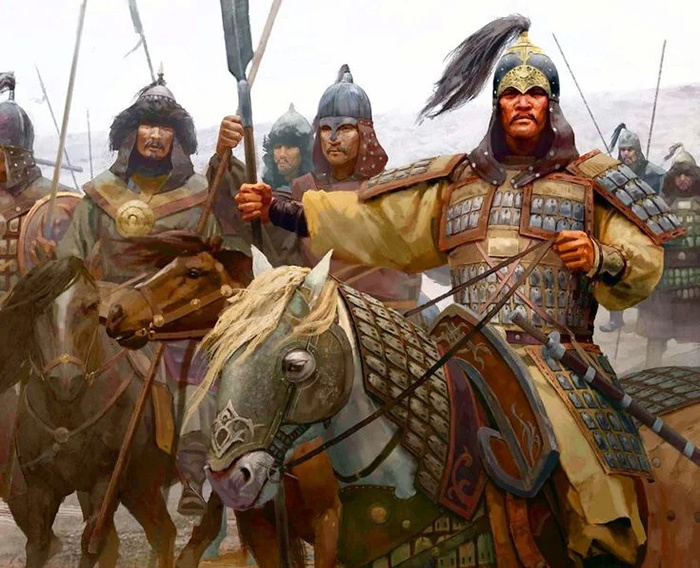
While the Genghis Khanid families were established in Persia, China, and Transoxiana, and appeared and disappeared in southern Russia, other branches of the same family fell behind and were forgotten in the northern steppes to replace and advertise historical empires. It is in this capacity that the Sheibanids appear. [1286]
As we have already seen, the Sheibanid family descended from the grandson of Genghis Khan, Sheiban, who was the brother of the Kipchak khans Batu and Berke. Shayban distinguished himself in 1241 during the Mongol campaign in Hungary, where, according to Rashid al-Din, when the Mongols held this country, he remained the governor. After the death of Genghis Khan, as we have already noted, Sheiban received territories located in the east and south-east of the southern Urals, in particular, in this direction, significant parts of Aktobe and Turgai regions. This group of territories is currently occupied by the Kyrgyz of the Middle Horde (between the sources of the Tobol in the west and the Semipalatinsk region, on the upper Irtysh, in the east) and the younger Horde (between the Urals and Sary-su). It seems that the headquarters of Sheiban and his heirs were located in the summer between the Ural Mountains, the Ilek River (a tributary of the Ural River, south of Orenburg) and the Irgiz River; in winter it approached Sary-su. Until the end of the 14th century, the Sheibanid Horde was not the only one on this side, since, as we have already seen, it was adjacent to the White Horde, which roamed the Sary-Sui steppe and the Ulu-Tau mountains. However, when, starting with Tokhtama Sha, the leaders of the White Horde became khans of the Golden Horde in 1380, it seems that almost the entire White Horde emigrated to southern Russia; this impression is based on the data of the «reconnaissance» conducted in the steppe by Tamerlane in 1391 [1287]
The entire region of Sary-su and Ulug-tag, and in particular, Turgai, was occupied by the Sheibanids. Meanwhile, the hordes conquered by the Sheibanids adopted the name Ozbek by the 14th century, or graphically more precisely, Uzbek, a name whose origin is disputed, but by which they are known in history.
The real creator of Uzbek power was the Sheibanid Prince Abul Khair, who lived an exceptionally risk-filled life. [1288] He was proclaimed khan of his horde at the age of seventeen, in 1428, on the Tura River, in Siberia, west of modern Tobolsk. Very soon, he captures from other Juchiids all the old villages of this branch of the Genghis Khanids, located east of the Ural River and north of the Syr Darya. In 1430-1431, he captured Khorezm and ravaged Urgench. A little earlier than 1447 . he becomes the master, to the detriment of the Timurids, of strong cities located along the Syr Darya, from Sygnak to Uzkend. Sygnak, in Barthold’s opinion, was his capital. In contrast, Iasi, modern Turkestan, remained with the Timurids. Abul Khair used the quarrel between the Timurid epigones to invade Transoxiana. This was possible because he supported Timurid Abu Said upon his accession to the throne of Samarkand (1451).
Abul Khair’s power has reached its peak. His empire stretched from the vicinity of Tobolsk to the Syr Darya, when by 1456-1457, he was attacked by the troops of the Oirat or Kalmyk invaders, that is, the eastern Mongols. The Oirats, as we will see below, were the rulers of a vast territory that included the Greater Altai and the Khangai Mountains from Tarbagatai and Dzungaria to the southwestern shore of Lake Baikal, crossing the regions of the Black Irtysh, Urungu, Kobdo, Ulasutai, the sources of Selenga and Kossogol. Carrying out a full-scale expansion, they sent their troops all the way to the outskirts of Beijing and into Western Turkestan. Abul Khair, defeated by them in a major battle, was forced to flee Signak, and left them to plunder the entire northern coast of the middle reaches of the Syr Darya (1456-1457).
This defeat seriously undermined the authority of Abul Khair. Earlier, two leaders dependent on him, who, like him, came from the Jochi family, Kerey and Janibek, left him in order to ask for land from the Chagataidi Khan Esen Bugi II, [1289] who sent them on a campaign against Moghulistan. During the following years, by 1465-1466, a large number of nomadic clans, which had previously depended on Abul Khair, separated from him in order to follow the example of Kerey and Janibek and continue their independent existence. In the future, these nomads, who later separated from the Uzbek Khanate, will be known as Kazak («free, rebellious»). or Kyrgyz-Kazakhs, as we distinguish them today. [1290]
Their separation is a historical event of great importance, because even in a dream it is impossible to imagine the territorial spaces very soon occupied by them and today held by their heirs, referring to the territories of the Middle Horde, that is, the steppes between Aktyubinsk and Semipalatinsk, the territories of the Lesser Horde between the confluence of the Urals and Sary-su, and the territories of the Greater Horde, between the city of Turkestan and the southern shore of Lake Baikal. Balkhash. [1291]
Abul Khair was killed in 1468 (the date was specified by Barthold) during the last battle against the Kyrgyz-Kazakhs, when he was trying to bring them back and avoid a split. About three years later, the Chagataidi Khan of Moghulistan, Yunus, completed the rout of the remaining loyal Uzbeks. As for the Uzbek schismatics, that is, the Kyrgyz Kazakhs, they formed a purely nomadic State in the steppe, which, after the death of their first leaders, was ruled by their sons, Baranduk, the son of Kerey (1488-1509) and Kasym, the son of Janibek (1509-1518).[1292]
Kassym even tried to take over Tashkent. He attacked and didn’t act aggressively enough. In reality, it was a purely nomadic method, which he himself characterized in a rather curious argument cited by Mirza Haidar: «We are people of the steppes, everything we have is concentrated in horses: their meat is our preferred food; milk of mares is our favorite drink. We don’t have houses. Our main entertainment is checking our herds and schools of horses.» [1293]
It was an attempt to combine hereditary nomadism with the demands of the semi-settled empire that had formed around Sygnak, from which Abul Khair had been ousted. But his story is instructive. Abul Khair’s activities are similar to those of Genghis Khan, but they are not as successful. After calling for the unification of the hordes to create a vast influential force, and already being called upon as an arbitrator among the Timurids of Transoxiana, he witnessed the collapse of his nomadic empire under the onslaught of more ferocious nomads, and especially as a result of a rebellion among some of his own tribes dissatisfied with his predilection for sedentary life. Undoubtedly, like Genghis Khan, Abul Khair was a factor in the history of the steppes! After all, where Abul Khair failed, his direct heirs succeeded.