
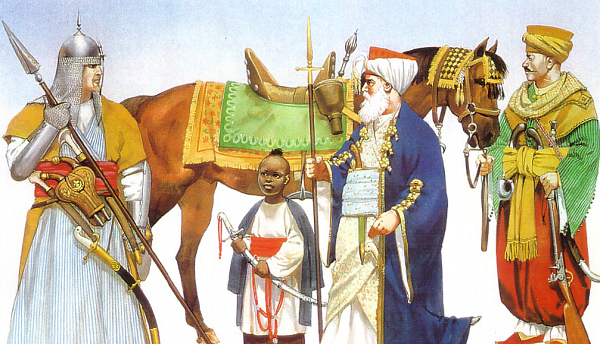
The Foreign Legion is an ancient invention. Already the Romans of the Empire and the Chinese under the Younger Han dynasty replenished their troops with barbarian detachments, as the Romans and Chinese themselves preferred to stay at home and enjoy culture and recreation. In early Byzantium, the fighting force was the Akrites, militant border guards who were not inferior to the Arabs and Sicilian Normans, and in late Byzantium, in the X–XII centuries, the Akrites were replaced by Varangians, hired foreigners. At first, the Varangians were mainly Scandinavians, then the Russians, and finally the Anglo-Saxons, who left their homeland conquered and oppressed by foreigners.
In Egypt, the same role was played by the Mamluks, who «belonged», that is, slaves, but with the difference that the Varangians, having earned money in Constantinople, could leave and return home, while the Mamluks had no way back: they were slaves.
It would seem that it was easiest for the Mamluks to convert to Islam, which gave them freedom, and dissolve into the conglomerate of the peoples of the Muslim world. But they avoided freedom like fire, and for good reason. A lonely man in a foreign land, without money or friends, was doomed to the most miserable life. And while in the army, he was well fed, clothed, armed, and had a great prospect of promotion, because the sultan or emir needed his loyalty and valor.
Above, we talked about the fate of Ildegiz in Arran. And there were many such lucky people, and the most favorable environment for them was in Egypt, because the Seljuks and Kurds were warriors themselves, but the Egyptians were not. But to be successful and make a career, you had to have loyal friends. And where will you find them in Cairo or Fustat? But here, too, a way out was found.
The Egyptian army under the Fatimids, according to the poet and traveler Nasir-i-Khosrow, consisted of 60,000 Ghulams: Sudanese Negroes, Turks, Slavs – and a 135,000 militia, which included the Berbers of the Maghreb and the Arabs of the Hijas. When the Berbers and Arabs fell away from the Fatimids, the importance of the guard increased. Being a slave warrior has become not shameful, but honorable and profitable.
According to the traditional ideas of evolutionary ethnography, the Mamluks had to blend into a single social group. In fact, the social community they really represented was torn apart by ethnic phenomena. It all started in 1062, when the Turks fought with the Sudanese Negroes and cut them down.
During the riots, the Khalifa’s palace, the state treasury, and even the library were looted. Only the energy of Caliph Mustansir, who summoned Badr (also a former slave who became a military commander) from Syria, saved the situation. His army occupied Cairo in 1073. Badr lured the Turkic rebels into a trap and killed every last one in one night. Order was restored, but during the troubles Algeria and Tunisia fell away, and in 1071 Sicily was conquered by the Normans, more precisely, the French from Normandy. It was necessary to re-recruit the army and learn how to do without people from Sudan, Blacks.
And imagine this picture. A centurion in a turban, sumptuous trousers, and a saber on his side comes out to the slave market, where naked young men are standing, and shouts: «Come on, baptized, some from Chernigov, some from Murom, respond!» Someone responds, and the centurion takes them to his barracks to include them in his the squad.
Then another centurion comes out and shouts, «Hey, ulanlar, kel mende.» He is replaced by a third who speaks Circassian, a fourth in Alan, a fifth in Georgian, and so on until everyone sorts out their fellow countrymen. The principle of ethnic proximity is maintained more strictly than in any other conflicts.
And this is natural! Loyalty to his superior is assured, because the warrior has nowhere to go. Strangers won’t accept him, and even if they don’t kick him out, they won’t let him advance. Of course, local Muslims, natives of the country, were not allowed to join this guard. After all, they were connected with the population, they could find protection from the mullahs and Ulama, had the opportunity to belong to various hidden Shiite denominations… No, not necessary, except as ordinary soldiers, without the right to service!
However, it is unlikely that well-fed, clothed, armed, and not offended by anyone, the Mamluks were happy. Having gained some comfort, they lost their homeland and relatives. Even if the military camp on the island where the steppe people were stationed, or the castle where Circassians and Georgians lived, were more luxurious than their nomads and villages, mountain villages and dugouts in the Rioni Valley, but there were friends and girlfriends, wise old men and affectionate grandmothers.
And their memory gave them pictures they didn’t need at all: enemies tying their hands and chasing them with whips tied to horses’ tails; merchants buying them at bazaars in Shafa, Crimea or Trebizond; overseers with belt whips.… It’s a hard thing, this memory. And you can’t throw her away like a gnawed bone.
That’s why it was better for the slavers to stay out of the way of the Mamluks. The slave traders in the 13th century were the Mongols, the Greeks with the Armenians, and the Venetians with the Genoese, as well as their friends, the Knights Templar, who sat in castles on the shores of the azure Mediterranean Sea.
Hating their sellers, the Mamluks did not adore their customers either. Therefore, they calmly allowed the Ismaili caliph to be replaced by a Sunni sultan in 1171. When it seemed to them that Sultan Turan Shah was leading them badly, they took the palace and killed the sultan. It happened on May 2, 1250. The initiator of the coup was Polovtsian Baybars, who was supported by his countrymen.
Baybars placed Kamil’s child on the throne, for whom his mother, Sultana Shedret ad-Durr, and the Mamluk Turkmen Aybek, who became her husband, ruled. In 1257, a jealous sultana poisoned her husband for treason. Then the Mamluks imprisoned her and in 1259 they elected another Polovtsian, Kutuz, a friend of Baybars, as sultan. This is how the «slave revolution» took place in Egypt, or, what is the same thing, the conquest of the country by the Mamluks. This happened in those very years when the Polovtsians were defeated and scattered in their homeland so that they no longer formed a single ethnic group. The terrible irony of fate!