
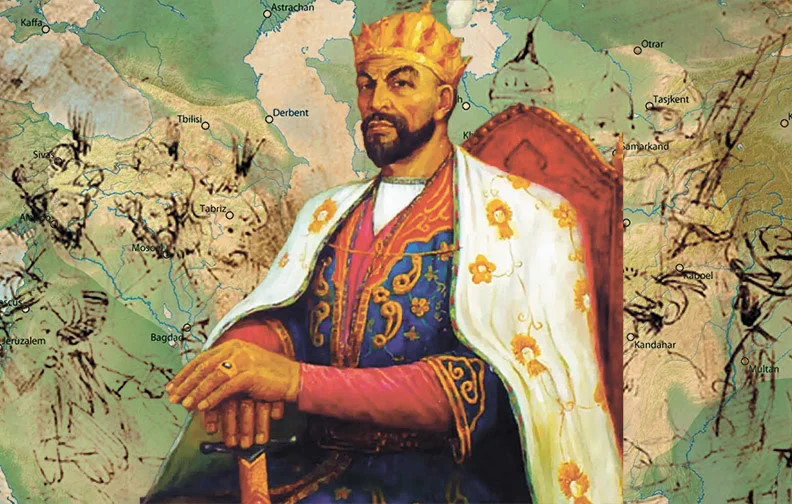
When Timur launched his campaign against the Golden Horde Khan Tokhtamysh and his troops reached the Ulug Tag area on Friday, the 23rd of the month of Jumadi, Timur ascended, according to Nizam al-din Shami, to the top of the mountain and surveyed the area.
«It was a steppe, and in the steppe there is a desert. He stopped there that day and ordered all the warriors to bring stones and build a tall sign there. He ordered the stonecutters to depict the highest name and date of these days on it, so that the memory of this campaign would remain on the face of time.» This is stated in the work of the French orientalist Francois Bernard Charmois «Exposition de Timour-i-Lenk ou Tamerlan contre Toqtamiche», which was translated by another Soviet orientalist and Iranist S.L. Volin. By the way, there is a place very close to this in the work of Sheref al-din Yazdi, which is also available to us in S.L. Volin’s translation, and in Abd-ar-rezak Samarqandi in Charmois’ translation.
This monument, erected in the last days of April 1391, is relatively well preserved. It was discovered in Soviet times at the Altyn Chuku mountain near the Karasakpai mine in the Kazakh SSR, and the stone block with the inscription carved on it was taken to the State Hermitage Museum, where it is currently stored.
In total, eleven lines can be distinguished on the inscription. Of these, eight were written in the Uighur alphabet, and the remaining three were written in Arabic letters.
Despite the fact that the inscription was carved on the uneven surface of the stone, which was severely cracked in places, it could be largely disassembled.
The part of the inscription, which is written in the characters of the Uighur alphabet, reads as follows:

Translation:
«In the country of seven hundred black Tokmaks in the year of the sheep, in the middle spring month, Sultan Turan Timur beg marched with two hundred thousand troops, for the sake of his name, through the blood of Tokhtamysh Khan. When he reached this area, he erected this mound so that it would be familiar. May God grant justice! If it pleases God! May God show mercy to people! May he remember us with a blessing!»
For all its brevity, the inscription is of undoubted interest, first of all, as confirmation of the reliability of the above-mentioned indications from narrative sources, because the year of the sheep to which the inscription is dated corresponds exactly to 1391, and the «average spring month» indicated in the inscription falls on the second half of April and the beginning of May.
As for the name Tokmak, it was used by the Uzbek country in the first half of the 15th century. This is described in more detail in V.V. Bartold’s work «Ulugbek and his time». According to Soviet historiography, this name was of Mongolian origin, and in Mongolian sources it was used by the Kipchak country and the Jochi ulus in general. You can read about this in Schmidt’s work «Geschichte der Ost-Mongolen und ihres Furstenhouses von Ssanang Ssetzen Chungtaidschi». This name has appeared in Mongolian literature since the beginning of the 13th century, but it probably existed among the Mongols earlier. In the inscription being analyzed, this country is called the country of the «seven hundred black Tokmaks.» The epithet «black», as well as the number seven hundred included in the name, are inexplicable and unknown to other sources. It is possible that hundreds (yüz) should be understood as separate hordes, such as the later Kazakh ulu züz «Big Horde», orta züz «Middle Horde» and kiši züz «Small Horde», into which the Kazakhs subsequently split. It is possible, however, that seven hundred is an analogy to other numerical designations in different ethnic names, such as the Mongolian dörben oirad «four oirats», etc.


The expressions ism-i üčün «for his name’s sake» and toqtamiš qan-ni qani-a «by the blood of Tokhtamysh Khan» attract attention. Tokhtamysh was known to have been friends with Timur in his youth, but later they became enemies through Tokhtamysh’s fault. Timur had every reason to consider himself insulted, and this insult could only be washed away by the blood of Tokhtamysh, as the inscription says. It is necessary, however, to make a reservation that the qan-niꞑ after the name toqtamiš is read very obscurely, but the name Tokhtamysh itself is understood without any difficulty.
Although the inscription is written in Uyghur letters, its language is not Uyghur, but the Central Asian-Turkic literary language, which was followed in the 19th century by the name of the Chagatai language: it is enough to point to the qani-ya form of its blood, typical «Chagatai» (North Uzbek), and not Uyghur. The language of the inscription is characterized by numerous Arabisms: ism «name», nisfat «justice», inšalla «if it pleases God», raxmat «mercy», duu-a «blessing».
As for the inscription, which is made in Arabic characters, it consists of three lines, of which only the first, and the most uninteresting, can be read as: The remaining lines cannot be read.