
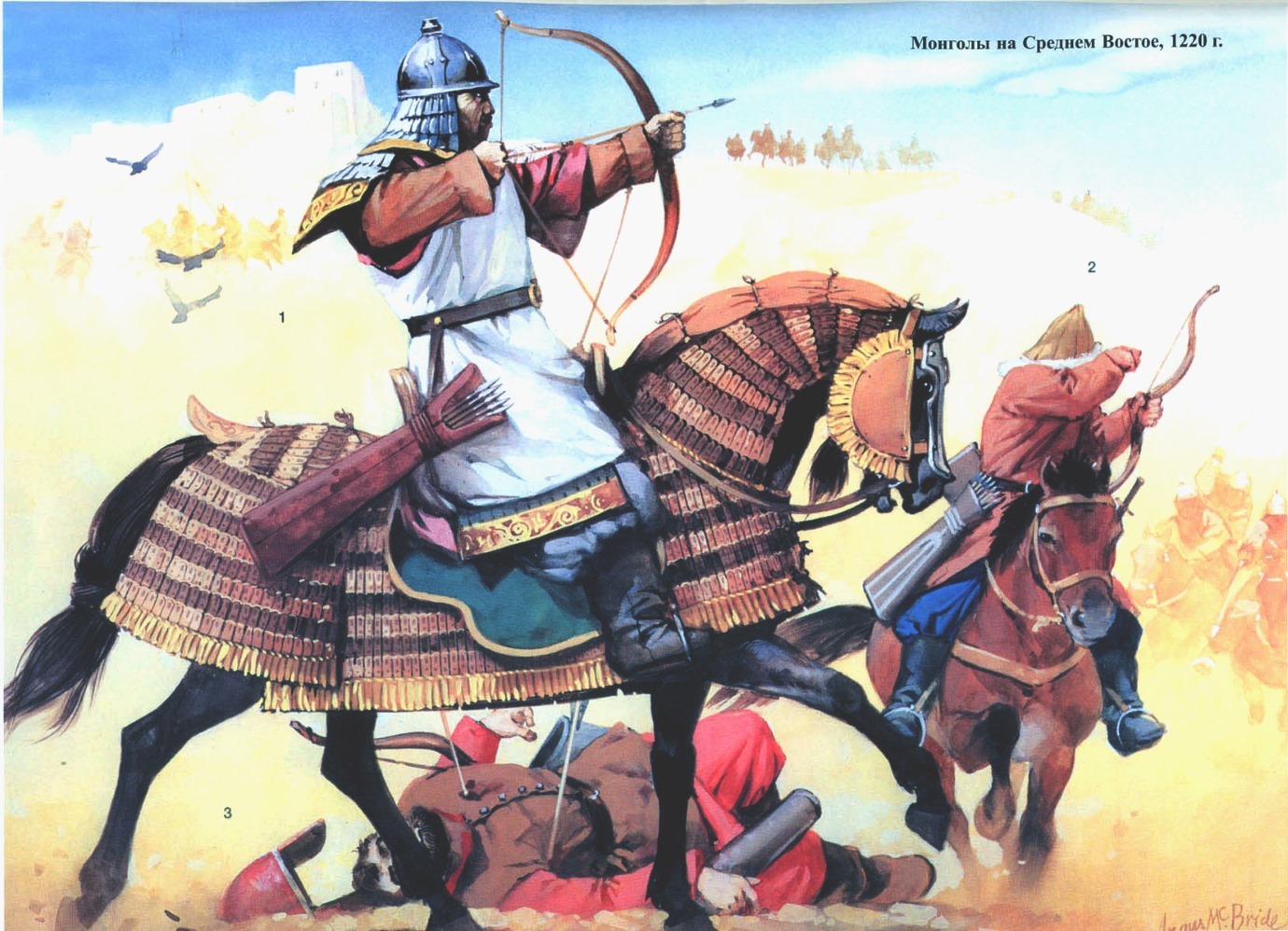
Chieftain Tanshihai
The Xianbei horde was disorganized. This prevented it from finally defeating the weakened Xiongnu. But in 141 AD, a man was born into the horde who was able to unite the Xianbei — Tanshihai.
At the age of 15, he became the elder of his mother’s clan, which suggests that he most likely had the same fate as Genghis Khan, who was abandoned by all his relatives after his father’s death. His mother’s clan was apparently impoverished and had no able-bodied men. The teenager had to take everything into his own hands, which made him a man early on and taught him to be independent.
In the end, Tanshihai was able to gather a band of horsemen around him and, with their help, unite other Xianbei bands (clans).
Tanshihai «plundered the areas bordering China in the south, stopped the Dinglings in the north, repelled the Fuyus in the east, defeated the Usuns in the west, and took possession of all the lands that had been under the rule of the Huns, stretching 14,000 li from east to west, with all the mountains, rivers, and salt lakes» — N. Ya. Bichurin (Iakinf), Collection of Information about the Peoples who Lived in Central Asia in Ancient Times, vol. I, Moscow-Leningrad, 1950, p. 154.
Thus, the ancestors of the Mongols expelled the Huns and Dinglings from modern Khalkha, where the Mongolian nation began to develop.
After that, most of the Huns went west and reached Europe, where they became known as the Huns. There was also a small Xiongnu possession in Semirechye — Yueban, which existed until the 5th century.
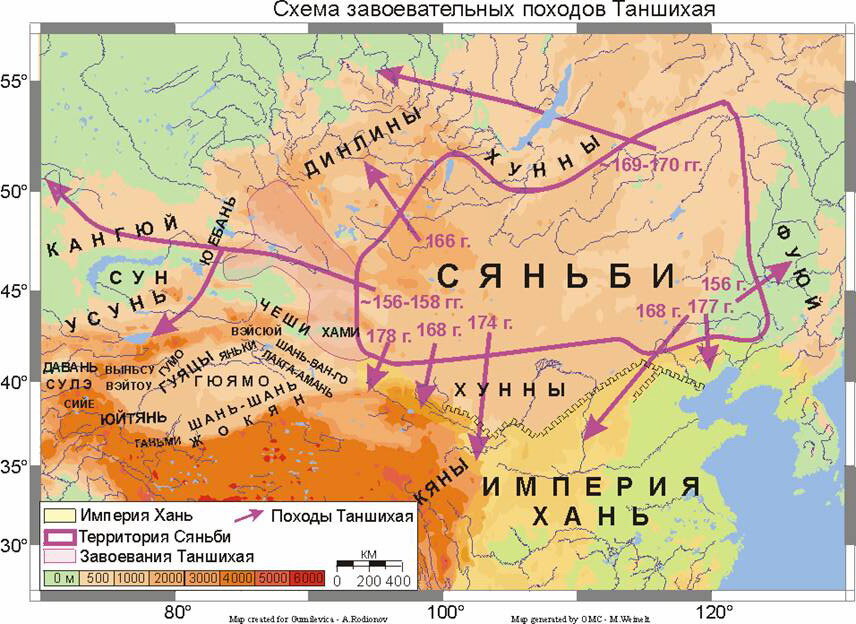
Tanshihai was the first to divide all the steppe peoples into parts — the right and left hands with the center. He ruled the center himself, and his assistants ruled the hands.
This allowed him to concentrate all his forces and begin raids on China in 158. In 166, the southern Xiongnu and the Uighurs recognized Tanshihai’s authority, and in 177, they together defeated the Chinese army that had invaded Halha.
After Tanshihai’s death in 181, his state did not last long. But he did the most important thing — he returned the fertile lands of modern northern China to the nomads, where they became masters.
Southern Xiongnu
Unlike their freedom-loving northern tribesmen, the Southern Xiongnu did not leave with them to seek happiness in distant lands. They were inert people who obeyed their tribal elders in everything, which Chinese officials took advantage of to keep them under control.
In 215, the last shanyu of the Southern Xiongnu, Huchuquan, was arrested and replaced by a Chinese governor. Those who did not agree to be ordinary Chinese subjects left for the Xianbei in Halha, while those who agreed gradually became Sinicized by the 5th century.
The Huns
But the Xiongnu as a political entity had not yet come to an end. Fleeing from the Xianbei, the Northern Xiongnu arrived in the lands of the Ugrians in the Urals in 155. Here they merged with the Ugrians, who became one people with them. Until 350, the new people of the Ugrians and Xiongnu — the Huns — lived quietly and gathered strength.
In the middle of the 4th century, they defeated the Alans, then the Goths, and led a huge tribal union across the lands from the Urals to the Dnieper. Europe stretched out before them, which they decided to conquer. But not all of them—many remained and became the Khazars, Bulgars, and ancestors of the Chuvash.