
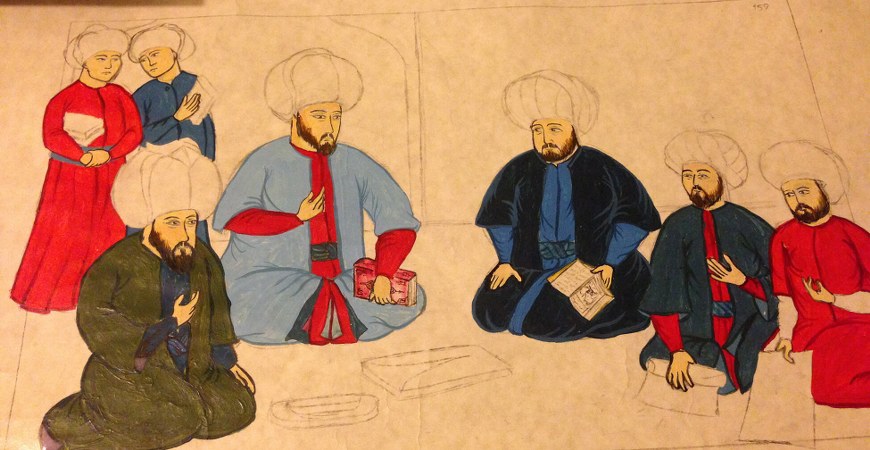
The atrocities committed by the Ottomans against the peoples inhabiting the region are countless. They are known in history as the most inhumane and have brought untold suffering to the people. When they captured the region, the Ottomans began looting property and anything else of value. Damascus suffered the same fate as other centers of civilization in the region. In all the streets of the ancient city, one could see gallows set up to execute and intimidate the inhabitants.
The Ottomans in Damascus: stories that make one shudder
The joy of the inhabitants of Damascus at the fall of the Mamluk sultans was short-lived — they were replaced by the Ottoman Turks (although the Mamluks were also Turks by origin). Both brought with them the most terrible, brutal things that defy human understanding. After occupying Sham, the Ottomans immediately set up gallows on all the busy streets of the city. This was done both to intimidate the inhabitants and to carry out executions.
The pain and tragedy of Damascus
Every district of Damascus remembers the moans and cries of the unfortunate people tortured in its squares and streets. Through them, the true nature of the Ottoman invaders emerges from the depths of history. In the very center of Damascus, on Marje Square, there is a large column. It is a witness to the crimes committed by the Ottomans. Many famous people of the city, politicians, and ordinary citizens were executed near it.
The Ottomans forced the inhabitants of Damascus to leave their homes and become refugees. Those who remained were burdened with heavy taxes, and non-Muslims were exterminated. At that time, non-Muslims were forbidden, for example, to enter Muslim areas or places frequented by Muslims on horseback or in carts.
The famous Damascus historian Shams al-Din Ibn Tulun, who lived in the capital at that time, recounts the crimes of the Ottomans in his book “Stories of Friends about the Events of Those Times.”
After the Battle of Marj Dabiq in 1516, in which the Mamluks were defeated by the Ottomans, Sultan Selim entered the city of Aleppo. First, he plundered the city fortress and took the citizens’ property. It is said that 108 huge bales were filled with the loot. The townspeople themselves decided to surrender the city to save it from destruction, but in this way they did not save it from looting.
For the Ottomans, there are no laws—only death rules the roost.
From the very beginning of his arrival in Damascus, Sultan Selim showed his backwardness compared to the advanced people of that time, who possessed advanced knowledge. Ibn Tulun says this about it: “Sultan Salim Khan, who ruled the Eastern Roman Empire (Byzantium), did not consider it necessary to meet with scholars and other advanced people of that time, of whom Sham (Damascus) was full, but he did negotiate with the French ambassador.”
The Ottomans could not hide their true colors for long. Just two days after the capture, they began to “confiscate” the property of citizens. Ibn Tolon recounts: «On Tuesday, the soldiers attacked Damascus and surrounded it. The inhabitants were driven into the streets, and all their property was thrown out. They had never experienced such pain before.»
The Ottomans knew no other law but murder. The main incentive to enforce their laws was the stake.
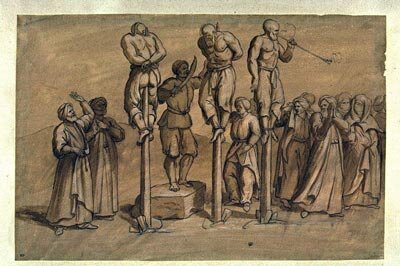
Ibn Tolun says: “The Ottomans brought stakes with them to Damascus. Anyone accused of theft was impaled on stakes, which were now available in every district of the city.”
According to numerous local supporters of the sultan, they were ordered to take control of all wheat and barley trading in Damascus. To this end, the elders of the surrounding villages were gathered and required to surrender their seed grain.
The Ottomans canceled all documents certifying land ownership and included all lands in the sultan’s possessions. In order to take away people’s horses, they were ordered to bring them in for various jobs. Numerous excessive taxes were invented. Sultan Salim robbed the people with expertise. Ibn Tolon writes: “New money was produced, called ‘Sultan Salim’, and the price of each dirham became 16 fils (previously 8 fils), so the money that people had became worthless.”
In his book, historian Ibn Al-Khomsi writes about what was happening at that time: «The fall of the homeland, the impoverishment of the robbed people, the plundered and emptied shops, the ruined houses and settlements… All these crimes shook Damascus. They were incomparable even to what happened during the time of Tamerlane. Many women and children were taken out of Damascus, and not a single horse or cart remained.»
The Ottomans had no respect for people of science. Ibn Tolun himself was expelled from his home in Sham: «They kicked me out of my house and threw my books into the street. They respected no one—neither small children, nor adult men, nor scholars, nor sofi (servants of Islam).» Many of Ibn Tulun’s manuscripts and works were barbarically destroyed. All this was reminiscent of the Mongol invasion of Baghdad.
Persecution of dissenters, destruction of shrines
Ottoman warriors, with the Koran in their hands, oppressed followers of other branches of Islam or other religions in the most brutal manner, forbidding them to pray, destroying churches, mosques, and houses of prayer, shrines, and desecrating the graves and mausoleums of revered religious figures. Among them was the Aliden Mosque in Damascus, which was turned into stables for camels and horses and sheds for carts. Schools were closed, and sheep and cows were kept in their premises. Ibn Tolon says: “Some of the sultan’s soldiers seized the Al-Azrawiyeh school and placed sheep there.”
The Ottomans brought the situation to such an extreme that, due to looting, prices for everything that was now in short supply in the city skyrocketed. Hunger was growing. Ibn Tolun says: «When the Ottoman troops entered Damascus, they attacked the city itself and the surrounding areas (Ghuta), seizing everything in their path and driving civilians from their homes. Those who could flee did so. They spared neither children nor the elderly. Those who remained were burdened with excessive taxes. People became impoverished, unable to buy food and other items that had risen in price.»
Because the army took everything from the people (grain, rice, meat, flour), everything else also rose in price exorbitantly. Every single builder was employed in the construction of palaces for the sultan to reside in. The day he left Damascus was a holiday for the city’s residents.
The Ottomans interfered in all areas of people’s lives. They even went so far as to require citizens to wear wide trousers. Ibn Tolun says about this: “There was an order: no one could leave the house without trousers, otherwise they would be impaled.” A little more, and there could have been a popular uprising against the Ottomans, so the order was later revoked.
The Ottomans oppressed Christians. According to Ibn Tolon, the sultan issued a decree prohibiting the use of horses and carts in Damascus by Jews, Samaritans, French, and other non-Muslims.
More than 40,000 Alawites were killed
When Sultan Salim entered Aleppo, he carried out a genocide of the Alawites (one of the most moderate branches of Islam. – Ed.). It was called the “genocide of al-tel” (from the word “mountain”: the Ottoman army collected the heads of those killed and piled them up (into a mountain) in the center of the city. – Ed.).
It is said that 40,000 innocent people were killed at that time. Some put the number at 90,000 children, women, and men. Only those who managed to flee to the mountains of Latakia survived.
Erdogan and his dream of reviving the Ottomans
The history of Ottoman genocides is endless. After many years, the region continues to suffer from this state. Today, the grandchildren of the Ottomans, represented by Erdogan, continue what was started in ancient times.
According to the grandson of the Ottomans, the state of Sham (the territories belonging to Damascus) is part of the Ottoman Empire. Since the beginning of the Syrian events, Erdogan has been making every effort to force the movement within Syria to serve his interests, which is why he supported the Muslim Brotherhood.
In recent years, Erdogan has opened all possible doors for terrorists to enter northern Syria and wage war there. He has supported armed groups, like his ancestors, using political, military, and economic attacks against regions in northern Syria.
Since the beginning of the Syrian crisis, Turkey has been trying to expand its zone of domination. Sometimes using ISIS, sometimes under the pretext of protecting its borders. As a result, Ankara has captured several cities and other settlements in northern Syria.
Under the pretext of forming regions where Turkey controls the ceasefire, it is sending its armed forces there, increasing its military contingent in Syria and hoping to remain in these territories.
If we analyze Turkey’s current activity in Syria, we can draw many parallels with the history of the Ottoman Empire. The thinking of the Turks today and their goals coincide with the thinking and goals of the Ottomans.
Erdogan’s actions are based on certain documents from the time of the Ottoman Empire. For example, Jarablus and Idlib were considered Ottoman emirates. The Turkish press often reminds readers of certain burial sites of Ottoman military leaders in northern Syria, which becomes another pretext for Turkey’s intervention.
In addition, Turkey is switching school education, the work of all institutions, and much more to the Turkish language in the occupied regions.
Many Turkish economic institutions are establishing themselves in northern Syria, investing money in various ventures and projects. The Turkish occupation authorities in Jarablus have opened a power plant. Turkish national flags and portraits of Erdogan can be seen on the fences and walls of the local hospital.