
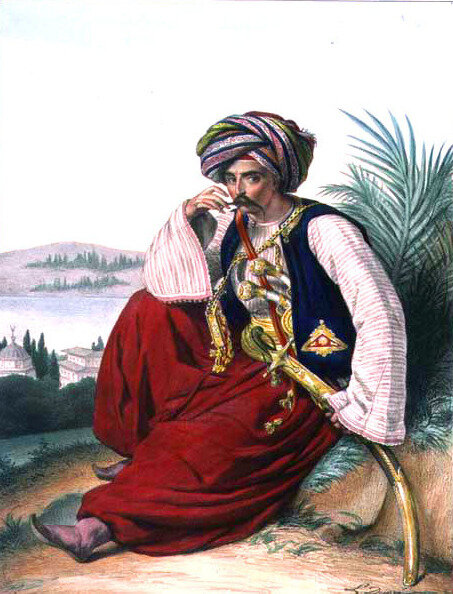
The capital of the Byzantine Empire fell to the Turkish assault on May 29, 1453. By that time, it had lost nearly all of its territories. Mehmet II built a fortress at the narrowest point of the Bosphorus and installed powerful siege cannons there. Now no ship could pass through the strait without being inspected.
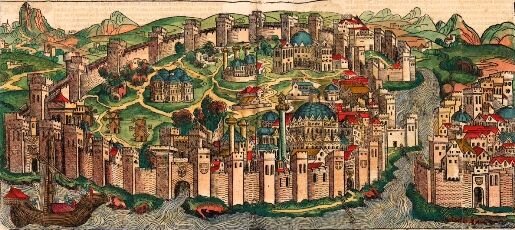
Constantinople during the Byzantine Empire
After the capture of Constantinople, the sultan gave his army three days to plunder the city. He forbade its destruction, and all the buildings, palaces, and even Orthodox churches remained virtually intact. This included Hagia Sophia. The building was majestic, and there was no point in destroying it. The Turks built four minarets at the corners and converted the cathedral into a mosque.
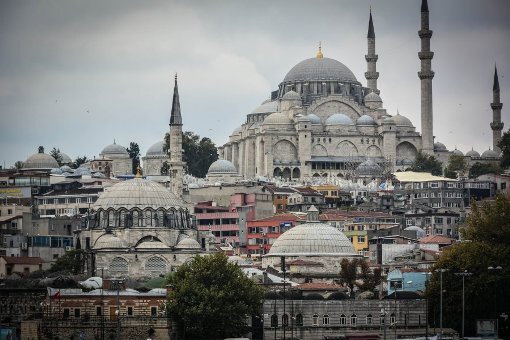
The Fatih Mosque in Istanbul
The Church of the Holy Apostles was not so lucky. It was demolished a few years later to make way for the construction of a mosque. It was named Fatih in honor of the conquering sultan. All the mosques built later blended harmoniously into the architecture of Constantinople.
After the conquest of Constantinople, Mehmed II had to decide what to do with the surviving Christians. Many managed to survive by hiding in the city and fleeing to the surrounding areas.
The sultan was guided in this matter by the provisions of the Quran. It prescribes three options:
-Conversion of non-believers to Islam with the granting of all rights enjoyed by Muslims
-Those who did not wish to convert to Islam but offered no resistance were granted the right to live. They -were required to pay a tribute in exchange.
Those who refused to submit and offered armed resistance were to be destroyed.
What Actually Happened
The inhabitants of Constantinople did not agree to the surrender proposed by the Turks and fought valiantly on the walls of their city. It was taken by storm and subjected to looting. Moreover, it is unlikely that the inhabitants of Constantinople could be counted among those who would have meekly accepted Islam. It follows that, according to the tenets of this religion, all surviving Christians should have been executed.
Mehmet II was not inclined to treat the Greeks so harshly. He was a fairly educated man for his time. He was educated not only in Sharia law, but also in geometry and mathematics. He knew Arabic, Persian, and Greek. He took an interest in literature and wrote poetry himself.
The Ottomans’ relations with Christians, which had continued for a century and a half even before the fall of Constantinople, had not been in vain. The Turks had adopted some of their customs and traditions. They no longer regarded Christians as sworn enemies.
Mehmet II decided to show leniency toward the inhabitants of Constantinople. The fact was that he intended to make the city his residence after conquering it, and for that he needed subjects. Therefore, the sultan began to persuade the Christians who had fled and were living elsewhere to return. A few days after the storming of Constantinople, heralds announced that all Greeks who had left their homes could return without fear and live as before.
They were permitted to perform religious rites in churches, with the exception of building new ones and ringing bells. Moreover, the sultan ordered that the Greeks elect a patriarch for themselves. He was presented with a charter listing his rights and the rights of the bishops and Christians under his authority.
This provision, established by Sultan Mehmed II, formed the basis of the Ottoman Empire’s state structure and remained unchanged for the next three and a half centuries.

The Galata Bridge across the Golden Horn in Istanbul
P.S. As part of the reforms carried out by the first president of the Republic of Turkey, Atatürk, Constantinople was renamed Istanbul in 1928. Nowadays, everyone calls it that, except the Greeks.