
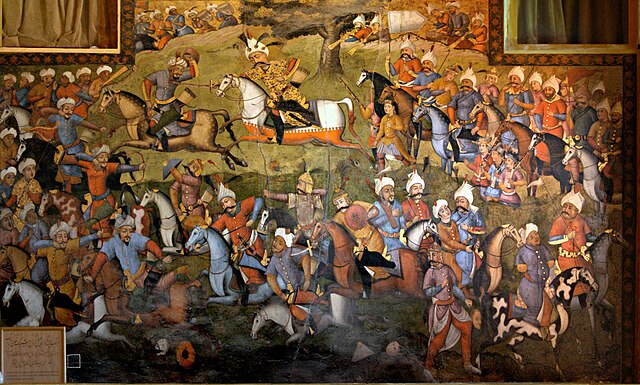
Mahmud Ghaznavi sought to conquer India. The campaigns brought huge spoils, but when the main forces went on a campaign, the Karakhanids and the Sazu tried to grab off pieces of the Ghaznavids’ territories.
At the same time, the Karakhanids found support from the local nobility, who suffered oppression from Mahmud Ghaznavi. He relied on his Ghoul warriors and 500 war elephants, so he was not afraid of uprisings.
Mahmud Ghaznavi also contributed to the civil strife between the Karakhanids. By doing this, he secured the military borders to some extent.
In 1030, the world saw the end of the reign of Mahmud of Ghaznavi, and his death became the catalyst for major changes in the state he left behind. Mahmoud appointed his son Muhammad as his successor, but he had an older brother named Masud. Immediately after his father’s death, Masud did not wait, but rebelled against his younger brother, overthrowing him from the throne. During this power struggle, he not only removed Muhammad from office, but also blinded him, which certainly added drama to this story.
However, Masud Ghaznavi was not the most successful ruler. His reign was characterized not only by weakness, but also by excessive suspicion of others. In 1040, the situation in the state deteriorated, and Masud lost control of Western Khorasan, which as a result came under the rule of the Seljuks, a people who would play an important role in the history of the region in the future. The military defeats that Masoud faced only made his situation worse. He began to crack down on military leaders, which, in turn, led to discontent among the military and to an uprising, as a result of which Massoud was overthrown.
The blind Mohammed returned to power, but his rule also did not become calm. In 1041, he faced a new threat — the son of his predecessor, Maudud, who, taking advantage of the situation, overthrew and executed Muhammad. Thus, there was a constant struggle for power in the Ghaznavid state, which led to a series of coups and violence, leaving only chaos and instability in its wake. Each new government was not only a continuation of previous conflicts, but also added new layers of intrigue and betrayal, which ultimately undermined the foundations of the state and its influence in the region.

The internal conflicts and strife that took place in the Ghaznavid state caused its rapid weakening. This created favorable conditions for the Karakhanids, who were able to capture the Ghaznavidian possessions located in the upper reaches of the Amu Darya River. However, despite this, the Ghaznavid gravediggers were not the Karakhanids, but the Iranian Ghurid dynasty, which broke away from the Ghaznavid state in the middle of the 12th century.
The Ghurids controlled an area known as Ghor, which was located east of the city of Herat. During its greatest heyday, the Ghurid Sultanate stretched over vast territories – from Bengal in the east to Gorgan in the west and to Merv in the north. This indicates the significant influence and power of the Ghurids in that historical period.
The Ghurid conquests in the southern regions of Transoxiana took place in the middle of the 12th century. However, despite its ambitious conquests and expansion of territory, already at the beginning of the 13th century, the sultanate of the Ghurids was absorbed by a more powerful state – the Khorezmshahs. This takeover was an important milestone in the history of the region, but the Ghurids, despite their short but vibrant history, have not left a significant mark on the history of Central Asia.
Information about the Ghurids is extremely limited, and the main source of information about them is the finds of coins that were minted during their reign. These coins are important historical artifacts that help researchers reconstruct the life and economy of the Ghurid Sultanate. Thus, despite the fact that the Ghurids did not leave behind extensive historical records, their influence on the development of the region and interaction with other states of that time cannot be underestimated.