
Since school history lessons, we have learned about the great generals and their armies, their victories on the battlefields. The results of their victories led to the creation of powerful empires, some of which were huge in size at that time. The victories themselves and the names of the winners have entered the annals of history as unsurpassed examples of military genius. And even people who are very far from military affairs know about some armies. Terms such as phalanx and legion are immediately associated with the victories of the great Alexander the Great, the generals of Ancient Rome. But the glory of their victories was not overshadowed by those isolated, one might say exceptional, examples of failures and defeats. History prefers to keep silent about these military failures, presenting future generations with images of the winners in an impeccable form. But they need to be talked about, because the victories that followed the failures and defeats confirm the strength and power of these armies. On the other hand, these examples show that there are always those who were able to find the Achilles’ heel of the “invincible” armies and, having defeated them, at least temporarily, but to stop their victorious march. This was the case with Alexander the Great during his Persian campaign and the crushing defeat of the Roman army in the Teutoburg Forest.
Alexander the Great is an outstanding commander of all time. The glory of his victories has stirred the minds of people throughout the ages. The works of historians, writers and cinematographers, and school history textbooks were dedicated to his victories. However, the road to victory was not always so rosy: in addition to continuous victories, Alexander the Great fully drank the cup of defeats and failures, which are not so often described by historiography. So, few people know about the defeat inflicted by the Armenian army on Alexander’s victorious troops. Shortly after the decisive victory over the Persians at the battle of Gavgamela, Alexander sent a significant part of his army under the command of Menon, one of his generals, to conquer the Armenian kingdom, an ally of the Persians and an active participant in the battle of Gavgamela. If we consider that the 47,000-strong Greek-Macedonian army participated in the Battle of Gavgamela, which defeated the 100,000-strong Persian army, then Menon’s 15,000-strong army is a formidable force that Alexander sent against the Armenians. But the Armenians took into account all the lessons of the crushing defeat at Gavgameli. They experienced not only the full power of the Macedonian phalanx, but also saw its shortcomings. Therefore, for a decisive battle, the Armenians lured Menon into the narrow mountain valley of the Armenian Highlands, where the Macedonian phalanx showed all its weaknesses. As a result, Menon’s army was completely defeated by the Armenians. The ancient historian Strabo, describing this campaign, wrote: “the Macedonian army was completely defeated, and the Armenians strangled Menon.” After this defeat, Alexander abandoned the idea of conquering Armenia, which became the only country in his path that he could not capture. And if you look at the map of Alexander the Great’s conquests, it becomes clear why the great commander of antiquity no longer tried to conquer Armenia, bypassing it.

The disastrous Macedonian campaign in Armenia
In the history of the strongest army of the Ancient World, the Roman army, there is a page that the Romans tried in every possible way to erase from their memory. In the 1st century A.D., the Roman legions suffered one of the most crushing defeats, which tarnished the history of brilliant victories ever won by the Roman army. In 9 A.D., Germanic tribes rose in armed rebellion against Roman aggression. The uprising was led by Arminius, one of the German leaders. As a child, he was sent as a hostage to Rome, where he received a Roman education and upbringing. Arminius then served for a long time in the Roman army, where he thoroughly studied military affairs. Knowing the strength of the Roman army, he understood that the rebels would not be able to withstand a direct clash with the enemy. Then he decided to lure the Roman legions into the forest and destroy the enemy with a sudden ambush. Everything turned out as he had hoped. Retreating under the onslaught of the Romans, Arminius lured them into the Teutoburg forest. And when the Roman legions were drawn into a dense forest and were forced to move along a narrow forest road, stretching out into a long column, the German soldiers suddenly attacked the stunned Romans from all sides. A real massacre began, in which all the Roman legions were completely destroyed. Such a humiliating and shameful defeat is an exceptional event in the history of Ancient Rome and in no way characterized the outstanding Roman army.
Some readers will wonder why such details are needed, and even far from the main topic of the article. With these examples, the author tries to show that defeats and failures are possible (some reasons are given in the article), no matter how strong the army is and its military leaders are talented. Referring to the well–known saying: ”truth is known by comparison” will make it possible to understand why the strongest army of the Middle Ages, the Mongol, could not avoid the same fate. And this will be discussed further in the article.
At the very beginning of the 13th century, in the steppes of Mongolia, the head of a small Mongol family, driven by the idea of uniting all Mongols under his command into a single state, began to persistently unite neighboring Mongolian tribes under his rule, sometimes by force, sometimes by persuasion. Thanks to his personal qualities, and somewhere by the grace of fate, he managed to achieve his goal. As a result, in 1206 Temujin, that was the name of this outstanding leader, was recognized as the supreme ruler of all Mongols under the name Genghis Khan. Genghis Khan owed much of his success to his highly organized and disciplined army, which he created in place of unbridled, predatory warfare, small detachments and talented generals who gained their khan the fame of the great Shaker of the Universe with fire and sword.
Having created a single Mongol state, Genghis Khan moved on to realize his dream – to establish his power over all the peoples of the world within his world empire. To this end, Genghis Khan launched a Mongol external military expansion in 1207. For several years, the famous Mongol cavalry swept through the entire eastern part of the Asian continent like an avalanche. The peoples of the neighboring states surrendered to the mercy of the cruel and bloodthirsty conquerors with horror and trembling. And those who tried to resist were ruthlessly destroyed. Thus, the resisting Tangut kingdom was literally wiped off the face of the earth. Even such a strong state of the East as the Chinese Jin could not resist the Mongol hordes. And in 1221, the Mongols defeated the powerful Khorezm, which controlled all of Central Asia. Despite the fact that Khorezmshah commanded the largest army in the world (according to some historical sources, the number reached about a million people), Genghis Khan’s Mongols completely defeated the Khorezmians. Now the whole of Central Asia was under the rule of the Mongols. It seemed that no one could resist the Mongol invasion.
Unexpectedly, an oriental “lion” appeared on the path of Genghis Khan, over which the indestructible Mongol army stumbled. After the crushing defeat of Khorezmshah, his son Jalal al-Din took up the banner of resistance to the Mongol invaders. Despite the fact that the whole of Khorezm was in the power of the invaders, Jalal al-Din, at the head of a small detachment, boldly opposed the Mongols and even sent a message to Genghis Khan himself demanding the return of his father’s empire captured by the Mongols. As the Latin proverb says: “Fortune fowers the brave» (Fortune favors the brave). These words can be fully attributed to Jalal al-Din, who was nicknamed the indomitable for his bravery and temper, making him dangerous to the Mongols. Jalal al-Din’s personal secretary described his ruler: “…He was a lion among lions and the bravest among his brave horsemen.” Indeed, the Khorezmians soon defeated a group of invaders, and Jalal al-Din sent the remaining two Mongols to Genghis Khan as confirmation of his ambitions. After this victory, the fame of Jalal al-Din began to spread throughout Khorezm. Hundreds and thousands of soldiers began to flock to Jalal al-Din’s army from all over the country. This led to the fact that soon he had ten thousand, and soon seventy thousand troops under his command, with whom Jalal al-Din could boldly fight and smash the already large Mongolian military contingents. Thus, Jalal al-Din defeated thirty thousand Mongol troops in the famous battle of Parwan. This was the only and largest defeat of the Mongol army during the time of Genghis Khan, however, under the leadership of one of his military leaders. Genghis Khan could not bear such a shameful fiasco of his soldiers, so he personally led a huge army against Jalal al-Din. In December 1221, the two armies met in the battle of the Indus River. Although the forces of the opposing sides were clearly unequal: Genghis Khan fielded up to 100,000 Mongol soldiers along with his allies against 30,000 Khorezmians, the battle was stubborn with the unpredictability of its outcome. Two talented warriors clashed, each of whom deserved to win. But the older and therefore more experienced Genghis Khan outplayed the young Jalal al-Din. Genghis Khan won thanks to Tumen, who had been sent around the day before and struck the rear of Jalal al-Din’s army at the most crucial moment of the battle. The young eastern “lion» lost this battle and had to flee with the remnants of his army. Subsequently, Jalal al-Din still attempted to resist the Mongols, but after the defeat on the Indus River, all former allies turned their backs on him. And, as always happens, a person who has lost all his former power must have enemies among his surroundings. What happened: in 1231, Jalal al-Din died at the hands of his enemies. This is how the star of the eastern “lion” set, who dared to resist the greatest Shaker of the universe. But the memory of Jalal al-Din’s feat has been preserved in history. The name of Jalal al-Din is revered to this day. He is a national hero of a number of Central Asian states.

Monument to Jalal al-Din. Urgench. Khorezm. Uzbekistan
Years have passed. Genghis Khan himself died during another victorious campaign. The Mongol Empire, thanks to the victorious campaigns of Genghis Khan’s successors, slowly but inexorably expanded its borders in an effort to become the largest in the history of mankind. Even Europe miraculously escaped the threat of complete conquest by the Mongols. No one, anywhere, could do anything to counteract the military machine of the Mongol expansion. But again, there were eastern “lions” who were able not only to defeat the Mongols, but also to stop their further advance.
In 1258, Genghis Khan’s grandson Hulagu continued his march west to the Abbasid state with Baghdad as its capital, famous for its wealth. After defeating the Abbasids, Hulagu captured Baghdad, committing the city to destruction and looting. After that, Hulagu sent his army further east. But then the Egyptian Mamluks appeared before the Mongols, led by two eastern “lions» — the Sultan of Egypt Kutuz and his talented commander Emir Baybars.
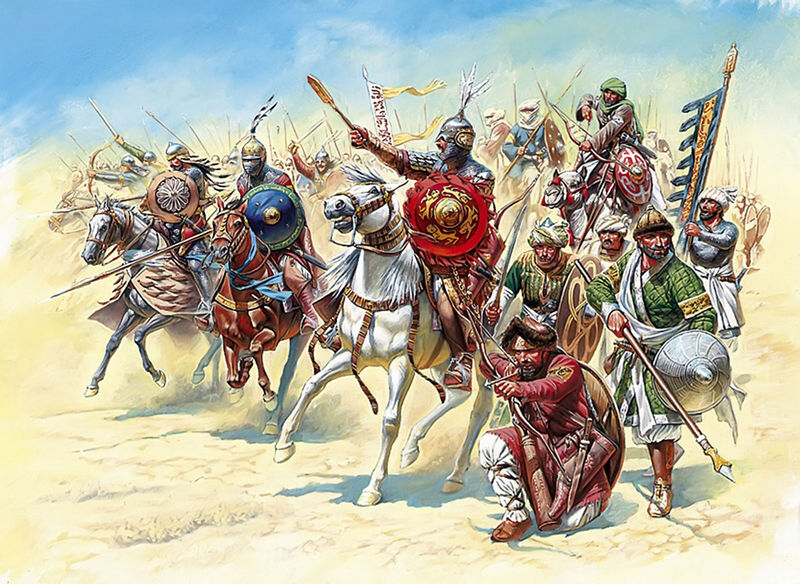
Since the 9th century, the eastern Arab rulers began to form military contingents from the captured children of the peoples of the Eurasian Steppe. Such soldiers became known as Mamluks, which in Arabic means “slaves, slaves.” Physically strong and healthy boys have been undergoing a brutal course of military science and physical improvement since childhood. They formed fearless, loyal to their masters, and skilled warriors. The Mamluks had no equal in battle. It was said about them that they fought to the last, rushed into battle like lions.

Mamluk cavalry on the attack
The Mamluks were most widespread in the Egyptian Caliphate. Over time, the Mamluks became a major and dominant force in the military and political life of Egypt. And in 1250, they even seized power as a result of a palace coup, establishing the Mamluk Sultanate. When the Mongol threat began to loom from the east, the Mamluks did not sit out in Egypt, moving forward to meet it. In 1260, the two armies met at Ain Jalut (modern-day Israel). In this battle, with an approximate equality of forces on both sides, all the qualities of Mamluk military prowess manifested themselves – the lions of the East completely defeated the Mongols. The battle was stubborn, the Mongols repeatedly avalanched into the ranks of the Mamluks, forcing them to retreat. But at the most crucial moment, the blow that Baybars and his warriors struck overturned the Mongols and threw them to flight. Thus, the Egyptian Mamluks inflicted the first great defeat on the descendants of Genghis Khan. After this defeat, the Mongols were forced to stop further expansion in this direction.
Thus, at the beginning of the 13th century, Pandora’s Box was discovered in the steppes of Mongolia. Hordes of nomadic Mongols burst out of the wild steppes of Mongolia like a fiery tornado. By killing and destroying everything and everyone in their path, the Mongols sought to conquer all of Asia and Europe. And if it weren’t for individual heroes and peoples, as in the case of the eastern “cats” who were able to break off the teeth of predatory conquerors, then how the story would have developed in the future is a big question!